

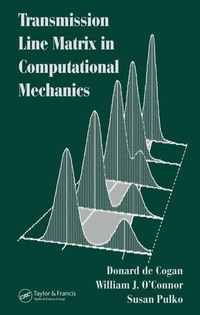
Transmission Line Matrix (TLM) in Computational Mechanics
1st Edition
Published on 1. November 2005
Book
Hardback
272 pages
978-0-415-32717-6 (ISBN)
Description
The finite element method reigns as the dominant technique for modeling mechanical systems. Originally developed to model electromagnetic systems, the Transmission Line Matrix (TLM) method proves to match, and in some cases exceed, the effectiveness of finite elements for modeling several types of physical systems. Transmission Line Matrix in Computational Mechanics provides a tutorial approach to applying TLM for modeling mechanical and other physical systems.
Transmission Line Matrix in Computational Mechanics begins with the history of TLM, an introduction to the theory using mechanical engineering concepts, and the electromagnetic basics of TLM. The authors then demonstrate the theory for use in acoustic propagation, along with examples of MATLAB (R) code. The remainder of the book explores the application of TLM to problems in mechanics, specifically heat and mass transfer, elastic solids, simple deformation models, hydraulic systems, and computational fluid dynamics. A discussion of state-of-the-art techniques concludes the book, offering a look at the current research undertaken by the authors and other leading experts to overcome the limitations of TLM in applying the method to diverse types of systems.
This valuable reference introduces students, engineers, and researchers to a powerful, accurate, and stable alternative to finite elements, providing case studies and examples to reinforce the concepts and illustrate the applications.
Transmission Line Matrix in Computational Mechanics begins with the history of TLM, an introduction to the theory using mechanical engineering concepts, and the electromagnetic basics of TLM. The authors then demonstrate the theory for use in acoustic propagation, along with examples of MATLAB (R) code. The remainder of the book explores the application of TLM to problems in mechanics, specifically heat and mass transfer, elastic solids, simple deformation models, hydraulic systems, and computational fluid dynamics. A discussion of state-of-the-art techniques concludes the book, offering a look at the current research undertaken by the authors and other leading experts to overcome the limitations of TLM in applying the method to diverse types of systems.
This valuable reference introduces students, engineers, and researchers to a powerful, accurate, and stable alternative to finite elements, providing case studies and examples to reinforce the concepts and illustrate the applications.
More details
Language
English
Place of publication
London
United Kingdom
Publishing group
Taylor & Francis Ltd
Target group
College/higher education
Professional and scholarly
Professional
Illustrations
116 s/w Abbildungen, 10 s/w Photographien bzw. Rasterbilder, 16 s/w Tabellen
16 Tables, black and white; 10 Halftones, black and white; 116 Illustrations, black and white
Dimensions
Height: 234 mm
Width: 156 mm
Weight
528 gr
ISBN-13
978-0-415-32717-6 (9780415327176)
Copyright in bibliographic data and cover images is held by Nielsen Book Services Limited or by the publishers or by their respective licensors: all rights reserved.
Schweitzer Classification
Other editions
Additional editions
Donard de Cogan | William J. O'Connor | Susan Pulko
Transmission Line Matrix (TLM) in Computational Mechanics
E-Book
11/2005
1st Edition
CRC Press
€73.99
Available for download
Donard de Cogan | William J. O'Connor | Susan Pulko
Transmission Line Matrix (TLM) in Computational Mechanics
E-Book
11/2005
1st Edition
CRC Press
€73.99
Available for download
Persons
Donard de Cogan, William J. O'Connor, Susan Pulko
Content
Preface. Introduction. TLM and the 1-D Wave Equation. The Theory of TLM: An Electromagnetic Viewpoint. TLM Modeling of Acoustic Propagation. TLM Modeling of Thermal and Particle Diffusion. TLM Models of Elastic Solids. Simple TLM Deformation Models. TLM Modeling of Hydraulic Systems. Application of TLM to Computational Fluid Mechanics. State of the Art Examples.