

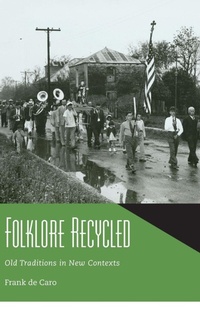
Folklore Recycled
Old Traditions in New Contexts
Published on 30. May 2013
Book
Hardback
240 pages
978-1-61703-764-1 (ISBN)
Description
Folklore Recycled starts from the proposition that folklore--usually thought of in its historical social context as ""oral tradition""--is easily appropriated and recycled into other contexts. That is, writers may use folklore in their fiction or poetry, taking plots, as an example, from a folktale. Visual artists may concentrate on depicting folk figures or events, like a ritual or a ceremony. Tourism officials may promote a place through advertising its traditional ways. Folklore may play a role in intellectual conceptualizations, as when nationalists use folklore to promote symbolic unity.
Folklore Recycled discusses the larger issue of folklore being recycled into non-folk contexts, and proceeds to look at a number of instances of repurposing. Colson Whitehead's novel John Henry Days is a literary text that recycles folklore but does so in a manner which examines a number of other uses of the American folk figure John Henry. The nineteenth-century members of the Louisiana branch of the American Folklore Society and the author Lyle Saxon in the twentieth century used African American folklore to establish personal connections to the world of the southern plantation and buttress their own social status. The writer Lafcadio Hearn wrote about folklore to strengthen his insider credentials wherever he lived. Photographers in Louisiana leaned on folklife to solidify local identity and to promote government programs and industry. Promoters of ""unorthodox"" theories about history have used folklore as historical document. Americans in Mexico took an interest in folklore for acculturation, for tourism promotion, for interior decoration, and for political ends. All of the examples throughout the book demonstrate the durability and continued relevance of folklore in every context it appears.
Folklore Recycled discusses the larger issue of folklore being recycled into non-folk contexts, and proceeds to look at a number of instances of repurposing. Colson Whitehead's novel John Henry Days is a literary text that recycles folklore but does so in a manner which examines a number of other uses of the American folk figure John Henry. The nineteenth-century members of the Louisiana branch of the American Folklore Society and the author Lyle Saxon in the twentieth century used African American folklore to establish personal connections to the world of the southern plantation and buttress their own social status. The writer Lafcadio Hearn wrote about folklore to strengthen his insider credentials wherever he lived. Photographers in Louisiana leaned on folklife to solidify local identity and to promote government programs and industry. Promoters of ""unorthodox"" theories about history have used folklore as historical document. Americans in Mexico took an interest in folklore for acculturation, for tourism promotion, for interior decoration, and for political ends. All of the examples throughout the book demonstrate the durability and continued relevance of folklore in every context it appears.
More details
Language
English
Place of publication
Jackson
United States
Target group
College/higher education
Illustrations
17 - 17 black & white photographs
Dimensions
Height: 235 mm
Width: 157 mm
Thickness: 19 mm
Weight
549 gr
ISBN-13
978-1-61703-764-1 (9781617037641)
Copyright in bibliographic data and cover images is held by Nielsen Book Services Limited or by the publishers or by their respective licensors: all rights reserved.
Schweitzer Classification
Person
Frank de Caro, New Orleans, Louisiana, is professor emeritus of English at Louisiana State University. He is the author or editor of eleven previous books, including An Anthology of American Folktales and Legends and Louisiana Sojourns: Travelers' Tales and Literary Journeys.