

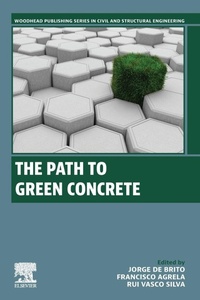
The Path to Green Concrete
Published on 6. June 2024
Book
Paperback/Softback
528 pages
978-0-443-19165-7 (ISBN)
Description
The Path to Green Concrete will enlighten the scientific community on recent developments in this field. Within this volume, world-renowned experts summarize recent research findings covering key topics such as: alkali-activated materials using aluminosilicate waste precursors; use of novel cost-effective and eco-efficient supplementary cementitious materials; state of the art characterization techniques and assessment methodologies; advances on the use of biomass ashes, steel slags and waste glass; the role of carbon capture in the production of concrete and mortar; development of eco-efficient composites for specialized applications; recycling of the fine fraction of construction and demolition wastes; and sustainable self-healing concrete.
This book will be a valuable reference resource for academic and industrial researchers, civil and structural engineers, manufacturers, and other construction professionals working in the development of sustainable construction materials.
This book will be a valuable reference resource for academic and industrial researchers, civil and structural engineers, manufacturers, and other construction professionals working in the development of sustainable construction materials.
More details
Series
Language
English
Place of publication
United States
Publishing group
Elsevier - Health Sciences Division
Target group
Professional and scholarly
Product notice
Paperback (trade)
Unsewn / adhesive bound
Dimensions
Height: 229 mm
Width: 152 mm
Thickness: 28 mm
Weight
757 gr
ISBN-13
978-0-443-19165-7 (9780443191657)
Copyright in bibliographic data and cover images is held by Nielsen Book Services Limited or by the publishers or by their respective licensors: all rights reserved.
Schweitzer Classification
Other editions
Additional editions
Jorge de Brito | Francisco Agrela | Rui Vasco Silva
The Path to Green Concrete
E-Book
06/2024
Woodhead Publishing
€250.00
Available for download
Persons
Jorge de Brito is Professor in the Department of Civil Engineering, Architecture and Georesources at the Instituto Superior Tecnico, Technical University of Lisbon, Portugal. He was Head of the ICIST Research Centre from 2009 to 2012. Francisco Agrela is a Full Professor of Civil and Agricultural Engineering at the University of Cordoba, Spain, where he also obtained his PhD in 2003. He is a prolific author of research papers, book chapters, and conferences proceedings. In the last ten years, he has participated as Principal Investigator in more than 40 R+D+i projects related to real-scale applications of waste management and recycled materials. He collaborates with several Elsevier journals as a reviewer, notably Construction and Building Materials, Waste Management, Materials and Design, Resources, Conservation and Recycling, etc., and he is also on the Editorial Board of Materials (MDPI).
Rui Vasco Silva is a lecturer in the Department of Civil Engineering, Architecture and Georesources at IST, University of Lisbon, Portugal. He completed his PhD on the use of recycled aggregates derived from construction, demolition, and excavation waste in the production of structural concrete. He is a member of the CERIS Research and Development Unit, hosted by IST-ID, and an honorary member of the CIB Student Chapter at IST. He has notable experience in FCT-funded Research Projects and is currently Managing Director of the Rinopolycrete project PTDC/ECI-CON/29196/2017 and is Principal Investigator of the upcoming research project ECO2Alkrete. He is the author of several publications concerning sustainable construction and is currently researching other approaches that can further decrease the environmental impact of concrete, namely reactive magnesium oxide, alkali-activated materials, municipal solid waste incinerator bottom ashes and electric arc furnace slag.
Rui Vasco Silva is a lecturer in the Department of Civil Engineering, Architecture and Georesources at IST, University of Lisbon, Portugal. He completed his PhD on the use of recycled aggregates derived from construction, demolition, and excavation waste in the production of structural concrete. He is a member of the CERIS Research and Development Unit, hosted by IST-ID, and an honorary member of the CIB Student Chapter at IST. He has notable experience in FCT-funded Research Projects and is currently Managing Director of the Rinopolycrete project PTDC/ECI-CON/29196/2017 and is Principal Investigator of the upcoming research project ECO2Alkrete. He is the author of several publications concerning sustainable construction and is currently researching other approaches that can further decrease the environmental impact of concrete, namely reactive magnesium oxide, alkali-activated materials, municipal solid waste incinerator bottom ashes and electric arc furnace slag.
Content
Section 1 - Developments on green supplementary cementitious materials
1. Reactive magnesia
Miguel Bravo and Bruna A. Silva
2. Stainless Steel Slag
Francisco Agrela Sainz and Julia Rosales
3. Alkali activation of slag
Francisca Puertas
4. New and More Sustainable Paths for the Development of Alkali Activated Cements
Nuno Cristelo, Jhonathan Rivera and Ines Garcia-Lodeiro
5. Alkali-activated aluminosilicate industrial wastes as alternative binders in precast paving blocks
Rui Vasco Silva
6. Granulation of incinerated municipal solid waste bottom ash with one-part alkali activation technology
Priyadharshini Perumal, Suman kumar Adhikary and Mirja Illikainen
Section 2 - Construction, demolition and industrial wastes as aggregates in cementitious composites
7. 3D printing concrete with by-products
Belen Gonzalez-Fonteboa
8. Steel slag aggregate in concrete
Flora Faleschini, Mariano Angelo Zanini and Daniel Trento
9. Microtomography of eco-efficient concrete
Carlos Thomas
10. Mining waste as aggregate for concrete
Lina M. Trujillo Lopez, Jesus Suarez-Gonzalez, Carlos Lopez-Colina, Ismael Garcia, Miguel Serrano and Fernando Lopez Gayarre
Section 3 - Advances on eco-efficient concrete
11. Ultra-high-performance concrete
Caijun Shi and Xuanhan Zhang
12. Self-healing concrete
Gurkan Yildirim and Behlul Furkan Ozel
13. Cellular concrete
Maria Victoria Borrachero Sr.
14. Graphene in eco-efficient concrete
Manuel Cruz
15. Nanoindentation of concrete with sustainable supplementary cementitious materials
Wengui Li, Zhiyu Luo, Yipu Guo, Xuqun Lin, Xiaonan Wang, Hanbing Zhao and Xuanrui Zhang
16. Pervious concrete with alternative materials
Krishna Prapoorna Biligiri and Avishreshth Singh
1. Reactive magnesia
Miguel Bravo and Bruna A. Silva
2. Stainless Steel Slag
Francisco Agrela Sainz and Julia Rosales
3. Alkali activation of slag
Francisca Puertas
4. New and More Sustainable Paths for the Development of Alkali Activated Cements
Nuno Cristelo, Jhonathan Rivera and Ines Garcia-Lodeiro
5. Alkali-activated aluminosilicate industrial wastes as alternative binders in precast paving blocks
Rui Vasco Silva
6. Granulation of incinerated municipal solid waste bottom ash with one-part alkali activation technology
Priyadharshini Perumal, Suman kumar Adhikary and Mirja Illikainen
Section 2 - Construction, demolition and industrial wastes as aggregates in cementitious composites
7. 3D printing concrete with by-products
Belen Gonzalez-Fonteboa
8. Steel slag aggregate in concrete
Flora Faleschini, Mariano Angelo Zanini and Daniel Trento
9. Microtomography of eco-efficient concrete
Carlos Thomas
10. Mining waste as aggregate for concrete
Lina M. Trujillo Lopez, Jesus Suarez-Gonzalez, Carlos Lopez-Colina, Ismael Garcia, Miguel Serrano and Fernando Lopez Gayarre
Section 3 - Advances on eco-efficient concrete
11. Ultra-high-performance concrete
Caijun Shi and Xuanhan Zhang
12. Self-healing concrete
Gurkan Yildirim and Behlul Furkan Ozel
13. Cellular concrete
Maria Victoria Borrachero Sr.
14. Graphene in eco-efficient concrete
Manuel Cruz
15. Nanoindentation of concrete with sustainable supplementary cementitious materials
Wengui Li, Zhiyu Luo, Yipu Guo, Xuqun Lin, Xiaonan Wang, Hanbing Zhao and Xuanrui Zhang
16. Pervious concrete with alternative materials
Krishna Prapoorna Biligiri and Avishreshth Singh