

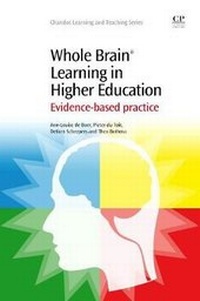
Whole Brain (R) Learning in Higher Education
Evidence-Based Practice
Published on 31. October 2013
Book
Paperback/Softback
330 pages
978-1-84334-742-2 (ISBN)
Description
Facilitating of learning in higher education can be transformed through the use of Whole Brain (R) learning. Whole Brain (R) Learning in Higher Education argues that facilitating learning in Higher Education should undergo transformation in order to develop the full academic potential of all stakeholders following the principles of action research. Empirical data was collected from participants in a number of projects across diverse disciplines. Participants included students, academic staff, instructional designers, and professionals attending short courses at tertiary level.
A number of case studies are discussed as evidence for the value of the proposed model for higher education. This title consists of seven chapters, covering: the theoretical framework, baseline study, professional development, studies in Whole Brain (R) application, learning material that makes a difference, multidisciplinary collaboration, and the way forward.
A number of case studies are discussed as evidence for the value of the proposed model for higher education. This title consists of seven chapters, covering: the theoretical framework, baseline study, professional development, studies in Whole Brain (R) application, learning material that makes a difference, multidisciplinary collaboration, and the way forward.
More details
Series
Language
English
Place of publication
Witney
United Kingdom
Publishing group
Woodhead Publishing Ltd
Target group
Professional and scholarly
Weight
580 gr
ISBN-13
978-1-84334-742-2 (9781843347422)
Copyright in bibliographic data and cover images is held by Nielsen Book Services Limited or by the publishers or by their respective licensors: all rights reserved.
Schweitzer Classification
Other editions
Additional editions
Ann-Louise de Boer | Pieter Du Toit | Detken Scheepers
Whole Brain® Learning in Higher Education
Evidence-Based Practice
E-Book
10/2013
Chandos Publishing
€65.95
Available for download
Persons
Ann-Louise de Boer is an associate professor and research fellow in the Department of Information Science, University of Pretoria, South Africa. She has BA, BEd, MED degrees and a PhD in curriculum design, and was recipient of the Ernest Oppenheimer Memorial Trust Award for Academic Achievement in 1990. She is also the CEO of Herrmann International Africa, the African arm of the global network of Herrmann International, originator of Whole Brain (R) Technolog. Pieter H. du Toit is a senior lecturer in the Department of Humanities Education, Faculty of Education at the University of Pretoria, South Africa. He holds a BA, BEd, MEd and PhD in Higher Education. He is programme coordinator of the Postgraduate Certificate in Higher Education (PGCHE) and the MEd (Educator Professional Development). His interests include action research, learning styles, professional development and education innovation. M. Detken Scheepers is the Head of e-Learning at the Department for Education Innovation, University of Pretoria, South Africa. She is responsible for the management of the e-learning group, academic staff development in the use of e-Learning and computer-based testing. She holds an MSc (Anatomy) and an MEd (Computer-assisted Education), both from the University of Pretoria. Theo J.D. Bothma is professor and head of the Department of Information Science and chairperson of the School of Information Technology at the University of Pretoria, South Africa. His teaching and research focus is on information organisation and retrieval (including information literacy), web development and electronic publishing, as well as on curriculum development.
Content
List of figures and tables
Acknowledgements
Foreword
Authors' prologue
About the authors
Chapter 1: Theoretical framework
Abstract:
1.1 Introduction
1.2 Key contributors
1.3 Herrmann's metaphoric Whole Brain (R) Model
1.4 HBDI (R) profiles
1.5 The construct Whole Brain (R) learning
1.6 Challenges for lecturers
1.7 The advantage of understanding thinking preferences
1.8 Herrmann's expanded Whole Brain (R) Model for Learning and Facilitating Learning
1.9 Learning style theories
1.10 Learning theories for adults
1.11 Conclusion
Chapter 2: Baseline data - determining thinking preferences
Abstract:
2.1 Introduction
2.2 Empirical data
2.3 Data analysis and discussion
2.4 Conclusion
Chapter 3: Professional development
Abstract:
3.1 Introduction
3.2 Action research as a process of professional learning
3.3 Scholarship of teaching
3.4 Peer mentoring
3.5 Conclusion
Chapter 4: Evidence-based practice - case studies
Abstract:
4.1 Introduction
4.2 Application of Whole Brain (R) principles in professional development
4.3 Application of Whole Brain (R) principles in engineering
4.4 Application of Whole Brain (R) principles in information science
4.5 Application of Whole Brain (R) principles in the coaching of leadership talent
4.6 Further applications of Whole Brain (R) principles
4.7 Collaboration in higher education: applying the Whole Brain (R) principles
4.8 Conclusion
Chapter 5: Learning material that makes a difference
Abstract:
5.1 Introduction
5.3 Instructional design
5.3 Blended learning environments
5.4 Whole Brain (R) learning material
5.6 Assessment of Whole Brain (R) learning
5.7 Conclusions
Chapter 6: The way forward
Abstract
6.1 Introduction
6.2 Comprehensive Whole Brain (R) Model for Learning and Facilitating Learning
6.3 Conclusion
List of reference
Index
Acknowledgements
Foreword
Authors' prologue
About the authors
Chapter 1: Theoretical framework
Abstract:
1.1 Introduction
1.2 Key contributors
1.3 Herrmann's metaphoric Whole Brain (R) Model
1.4 HBDI (R) profiles
1.5 The construct Whole Brain (R) learning
1.6 Challenges for lecturers
1.7 The advantage of understanding thinking preferences
1.8 Herrmann's expanded Whole Brain (R) Model for Learning and Facilitating Learning
1.9 Learning style theories
1.10 Learning theories for adults
1.11 Conclusion
Chapter 2: Baseline data - determining thinking preferences
Abstract:
2.1 Introduction
2.2 Empirical data
2.3 Data analysis and discussion
2.4 Conclusion
Chapter 3: Professional development
Abstract:
3.1 Introduction
3.2 Action research as a process of professional learning
3.3 Scholarship of teaching
3.4 Peer mentoring
3.5 Conclusion
Chapter 4: Evidence-based practice - case studies
Abstract:
4.1 Introduction
4.2 Application of Whole Brain (R) principles in professional development
4.3 Application of Whole Brain (R) principles in engineering
4.4 Application of Whole Brain (R) principles in information science
4.5 Application of Whole Brain (R) principles in the coaching of leadership talent
4.6 Further applications of Whole Brain (R) principles
4.7 Collaboration in higher education: applying the Whole Brain (R) principles
4.8 Conclusion
Chapter 5: Learning material that makes a difference
Abstract:
5.1 Introduction
5.3 Instructional design
5.3 Blended learning environments
5.4 Whole Brain (R) learning material
5.6 Assessment of Whole Brain (R) learning
5.7 Conclusions
Chapter 6: The way forward
Abstract
6.1 Introduction
6.2 Comprehensive Whole Brain (R) Model for Learning and Facilitating Learning
6.3 Conclusion
List of reference
Index