

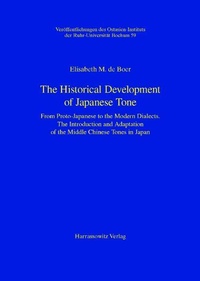
The Historical Development of Japanese Tone
From Proto-Japanese to the Modern Dialects. The Introduction and Adaptation of the Middle Chinese Tones in Japan
Published on 1. October 2010
Book
Hardback
XX, 600 pages
978-3-447-06282-4 (ISBN)
Description
The reconstruction of the historical development of the modern Japanese tone systems is one of the major issues in Japanese historical linguistics. The prevalent theory (Kindaichi 1951), which regards the Kyôto type tone system of central Japan as most archaic fails to explain the modern dialect data. In 1979 R.S. Ramsey proposed an alternative theory, which regards the peripheral Tôkyô type dialects as archaic. Even though this theory offered a convincing explanation to many problems that remained unsolved in the prevalent theory, it failed to find acceptance.
Part I of Elisabeth de Boer's study shows how data from a host of Japanese dialects - from the north-eastern tip of Japan to the Ryûkyû archipelago in the south-west - offer additional proof for Ramsey's theory. The appendix deals with evidence from Japanese loanwords in Ainu.
Part II states that - contrary to what has often been thought - Ramsey's theory is not in contradiction with the philological data. The appendix deals with the interpretation of Buddhist chant as a source of historical information on the Japanese tone.
More details
Series
Edition
Print on Demand-Nachdruck
Language
English
Place of publication
Wiesbaden
Germany
Target group
Professional and scholarly
Product notice
Paperback (trade)
Unsewn / adhesive bound
Illustrations
33
5 Karten
Dimensions
Height: 240 mm
Width: 170 mm
Thickness: 43 mm
Weight
1164 gr
ISBN-13
978-3-447-06282-4 (9783447062824)
Schweitzer Classification