

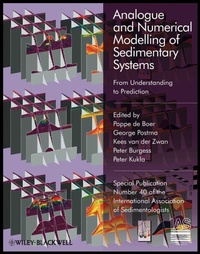
Analogue and Numerical Modelling of Sedimentary Systems
From Understanding to Prediction
1st Edition
Will be published approx. on 27. November 2008
Book
Hardback
328 pages
978-1-4051-8930-9 (ISBN)
Description
Understanding basin-fill evolution and the origin of stratal architectures has traditionally been based on studies of outcrops, well and seismic data, studies of and inferences on qualitative geological processes, and to a lesser extent based on quantitative observations of modern and ancient sedimentary environments. Insight gained on the basis of these studies can increasingly be tested and extended through the application of numerical and analogue forward models. Present-day stratigraphic forward modelling follows two principle lines: 1) the deterministic process-based approach, ideally with resolution of the fundamental equations of fluid and sediment motion at all scales, and 2) the stochastic approach. The process-based approach leads to improved understanding of the dynamics (physics) of the system, increasing our predictive power of how systems evolve under various forcing conditions unless the system is highly non-linear and hence difficult or perhaps even impossible to predict. The stochastic approach is more direct, relatively simple, and useful for study of more complicated or less-well understood systems. Process-based models, more than stochastic ones, are directly limited by the diversity of temporal and spatial scales and the very incomplete knowledge of how processes operate and interact on the various scales.
The papers included in this book demonstrate how cross-fertilization between traditional field studies and analogue and numerical forward modelling expands our understanding of Earth-surface systems.
The papers included in this book demonstrate how cross-fertilization between traditional field studies and analogue and numerical forward modelling expands our understanding of Earth-surface systems.
More details
Series
Language
English
Place of publication
Hoboken
United Kingdom
Publishing group
John Wiley and Sons Ltd
Target group
Professional and scholarly
Product notice
sewn/stitched
Cloth over boards
Dimensions
Height: 277 mm
Width: 223 mm
Thickness: 22 mm
Weight
1243 gr
ISBN-13
978-1-4051-8930-9 (9781405189309)
Copyright in bibliographic data and cover images is held by Nielsen Book Services Limited or by the publishers or by their respective licensors: all rights reserved.
Schweitzer Classification
Other editions
Additional editions
Poppe de Boer | George Postma | Kees van der Zwan
Analogue and Numerical Modelling of Sedimentary Systems
From Understanding to Prediction (Special Publication 40 of the IAS)
E-Book
01/2009
Wiley-Blackwell
€131.99
Available for download
Persons
Poppe de Boer and George Postma are the authors of Analogue and Numerical Modelling of Sedimentary Systems: From Understanding to Prediction, published by Wiley.
Content
Preface. Numerical simulation of the syn- to post-depositional history of a prograding carbonate platform: the Rosengarten, Middle Triassic, Dolomites, Italy (Axel Emmerich, Robert Tscherny, Thilo Bechstaedt, Carsten Bueker, Ullrich A. Glasmacher, Ralf Littke and Rainer Zuehlke).
Fine-scale forward modelling of a Devonian patch reef, Canning Basin, Western Australia (Claude-Alain Hasler, Erwin W. Adams, Rachel A. Wood and Tony Dickson).
Structural, reverse-basin and forward stratigraphic modelling of the Southern Cantabrian Basin, northwest Spain (Zbynek Veselovsky, Thilo Bechstaedt and Rainer Zuehlke).
Numerical modelling of alluvial deposits: recent developments (John Bridge).
Process-based stochastic modelling: meandering channelized reservoirs (Simon Lopez, Isabelle Cojan, Jacques Rivoirard and Alain Galli).
Simulation of tidal flow and circulation patterns in the Early Miocene (Upper Marine Molasse) of the Alpine foreland basin (Ulrich Bieg, Michael Peter Suess and Joachim Kuhlemann).
Predicting discharge and sediment flux of the Po River, Italy since the Last Glacial Maximum (Albert J. Kettner and James P.M. Syvitski).
Impact of discharge, sediment flux and sea-level change on stratigraphic architecture of river-delta-shelf systems (George Postma and Aart Peter van den Berg van Saparoea).
Grain-size sorting of river-shelf-slope sediments during glacial-interglacial cycles: modelling grain-size distribution and interconnectedness of coarse-grained bodies (Xander D. Meijer0.
Modelling the preservation of sedimentary deposits on passive continental margins during glacial-interglacial cycles (Xander D. Meijer, George Postma, Peter A. Burrough and Poppe L. de Boer).
Modelling source-rock distribution and quality variations: the organic facies modelling approach (Ute Mann and Janine Zweigel).
Spatial data templates: combining simple models of physical processes with stochastic noise to yield stable, archetypal landforms (Peter A. Burrough).
Models that talk back (John C. Tipper).
Index.
Fine-scale forward modelling of a Devonian patch reef, Canning Basin, Western Australia (Claude-Alain Hasler, Erwin W. Adams, Rachel A. Wood and Tony Dickson).
Structural, reverse-basin and forward stratigraphic modelling of the Southern Cantabrian Basin, northwest Spain (Zbynek Veselovsky, Thilo Bechstaedt and Rainer Zuehlke).
Numerical modelling of alluvial deposits: recent developments (John Bridge).
Process-based stochastic modelling: meandering channelized reservoirs (Simon Lopez, Isabelle Cojan, Jacques Rivoirard and Alain Galli).
Simulation of tidal flow and circulation patterns in the Early Miocene (Upper Marine Molasse) of the Alpine foreland basin (Ulrich Bieg, Michael Peter Suess and Joachim Kuhlemann).
Predicting discharge and sediment flux of the Po River, Italy since the Last Glacial Maximum (Albert J. Kettner and James P.M. Syvitski).
Impact of discharge, sediment flux and sea-level change on stratigraphic architecture of river-delta-shelf systems (George Postma and Aart Peter van den Berg van Saparoea).
Grain-size sorting of river-shelf-slope sediments during glacial-interglacial cycles: modelling grain-size distribution and interconnectedness of coarse-grained bodies (Xander D. Meijer0.
Modelling the preservation of sedimentary deposits on passive continental margins during glacial-interglacial cycles (Xander D. Meijer, George Postma, Peter A. Burrough and Poppe L. de Boer).
Modelling source-rock distribution and quality variations: the organic facies modelling approach (Ute Mann and Janine Zweigel).
Spatial data templates: combining simple models of physical processes with stochastic noise to yield stable, archetypal landforms (Peter A. Burrough).
Models that talk back (John C. Tipper).
Index.