

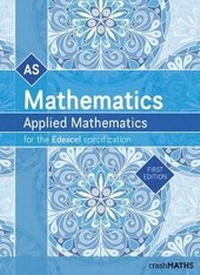
Edexcel AS Level Mathematics - Statistics and Mechanics Year 1/AS Textbook (AS and A Level Mathematics 2017) (crashMATHS)
Published on 6. September 2017
Book
Paperback/Softback
978-1-9997550-1-0 (ISBN)
Description
This book is part of a series of textbooks for the new AS and A Level Mathematics (2017). This covers the Applied Mathematics in Year 1/AS, specifically for the Edexcel specification. They are student-friendly and excellent in helping students to develop a genuine understanding of the concepts and ideas. Designed specifically for the new A Level, they have a strong emphasis on problem solving. Tough worked examples are broken down in designated `break-it-down' sections, helping to scaffold difficult problems for students. The textbooks complement our schemes of work for the new A Level Maths that have been designed and praised by teachers. Samples of these textbooks can be found on our website: www.crashmaths.com/textbooks.
This book is part of a series of textbooks for the new AS and A Level Mathematics (2017). This covers the Applied Mathematics in Year 1/AS, specifically for the Edexcel specification. They are student-friendly and excellent in helping students to develop a genuine understanding of the concepts and ideas. Designed specifically for the new A Level, they have a strong emphasis on problem solving. Tough worked examples are broken down in designated `break-it-down' sections, helping to scaffold difficult problems for students. The textbooks complement our schemes of work for the new A Level Maths that have been designed and praised by teachers. Samples of these textbooks can be found on our website: www.crashmaths.com/textbooks.
This book is part of a series of textbooks for the new AS and A Level Mathematics (2017). This covers the Applied Mathematics in Year 1/AS, specifically for the Edexcel specification. They are student-friendly and excellent in helping students to develop a genuine understanding of the concepts and ideas. Designed specifically for the new A Level, they have a strong emphasis on problem solving. Tough worked examples are broken down in designated `break-it-down' sections, helping to scaffold difficult problems for students. The textbooks complement our schemes of work for the new A Level Maths that have been designed and praised by teachers. Samples of these textbooks can be found on our website: www.crashmaths.com/textbooks.
More details
Series
Language
English
Place of publication
Telford
United Kingdom
Target group
Primary & secondary/elementary & high school
College/higher education
Dimensions
Height: 270 mm
Width: 196 mm
ISBN-13
978-1-9997550-1-0 (9781999755010)
Copyright in bibliographic data and cover images is held by Nielsen Book Services Limited or by the publishers or by their respective licensors: all rights reserved.
Schweitzer Classification
Persons
crashMATHS is a leading educational provider in the UK, specialising in the publication of resources to support GCSE and A Level Maths students.
crashMATHS is a leading educational provider in the UK, specialising in the publication of resources to support GCSE and A Level Maths students.
crashMATHS is a leading educational provider in the UK, specialising in the publication of resources to support GCSE and A Level Maths students.
Content
The Large Data Set
Sampling
2.1 The statistician's goal
2.2 Simple random sampling
2.3 Other random sampling methods
2.4 Non-random sampling methods
2.5 What a difference a sample can make
Mixed exercise
Summary
Measures of central tendency
3.1 Discrete and continuous data
3.2 Frequency tables
3.3 Calculating the mean, median and mode of a set of data
3.4 Calculating the mean, median and mode from a frequency table
3.5 Picking the best measure
Mixed exercise
Summary
Measures of dispersion
4.1 Standard deviation
4.2 Quartiles and percentiles
4.3 Coding
Mixed exercise
Summary
Representation of data
5.1 Cumulative frequency diagrams and frequency polygons
5.2 Box plots
5.3 Histograms
5.4 Outliers and data failure
5.5 Bivariate data
Mixed exercise
Summary
Probability
6.1 Definitions
6.2 Tree diagrams
6.3 Venn diagrams
6.4 Discrete and continuous distributions
6.5 The binomial distribution
6.6 Finding binomial probabilities using your calculator
6.7 Finding binomial probabilities using tables
6.8 Using the binomial distribution as a model
Mixed exercise
Summary
Hypothesis testing
7.1 Terminology
7.2 Critical regions
7.3 One-tailed tests
7.4 Two-tailed tests
Mixed exercise
Summary
Refresh and review 1
Fundamental Ideas in Mechanics
Kinematics
9.1 Uniform motion
9.2 Using graphs in kinematics
9.3 Non-uniform motion
9.4 Derivation of uniform motion formulae
Mixed exercise
Summary
Forces and Newton's Laws
10.1 Newton's Laws
10.2 Motion in 2D
10.3 Connected particles
10.4 Pulleys
Mixed exercise
Summary
Refresh and review 2
About the exam
Answers
Papers
Index
Sampling
2.1 The statistician's goal
2.2 Simple random sampling
2.3 Other random sampling methods
2.4 Non-random sampling methods
2.5 What a difference a sample can make
Mixed exercise
Summary
Measures of central tendency
3.1 Discrete and continuous data
3.2 Frequency tables
3.3 Calculating the mean, median and mode of a set of data
3.4 Calculating the mean, median and mode from a frequency table
3.5 Picking the best measure
Mixed exercise
Summary
Measures of dispersion
4.1 Standard deviation
4.2 Quartiles and percentiles
4.3 Coding
Mixed exercise
Summary
Representation of data
5.1 Cumulative frequency diagrams and frequency polygons
5.2 Box plots
5.3 Histograms
5.4 Outliers and data failure
5.5 Bivariate data
Mixed exercise
Summary
Probability
6.1 Definitions
6.2 Tree diagrams
6.3 Venn diagrams
6.4 Discrete and continuous distributions
6.5 The binomial distribution
6.6 Finding binomial probabilities using your calculator
6.7 Finding binomial probabilities using tables
6.8 Using the binomial distribution as a model
Mixed exercise
Summary
Hypothesis testing
7.1 Terminology
7.2 Critical regions
7.3 One-tailed tests
7.4 Two-tailed tests
Mixed exercise
Summary
Refresh and review 1
Fundamental Ideas in Mechanics
Kinematics
9.1 Uniform motion
9.2 Using graphs in kinematics
9.3 Non-uniform motion
9.4 Derivation of uniform motion formulae
Mixed exercise
Summary
Forces and Newton's Laws
10.1 Newton's Laws
10.2 Motion in 2D
10.3 Connected particles
10.4 Pulleys
Mixed exercise
Summary
Refresh and review 2
About the exam
Answers
Papers
Index