

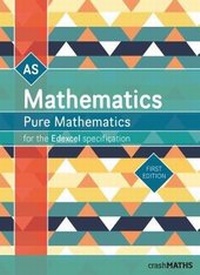
Edexcel AS Level Mathematics - Pure Mathematics Year 1/AS Textbook (AS and A Level Mathematics 2017) (crashMATHS)
Published on 7. August 2017
Book
Paperback/Softback
224 pages
978-1-9997550-0-3 (ISBN)
Description
This book is part of a series of textbooks for the new AS and A Level Mathematics (2017). This covers the Pure Mathematics in Year 1/AS, specifically for the Edexcel specification. They are student-friendly and excellent in helping students to develop a genuine understanding of the concepts and ideas. Designed specifically for the new A Level, they have a strong emphasis on problem solving. Tough worked examples are broken down in designated `break-it-down' sections, helping to scaffold difficult problems for students. The textbooks complement our schemes of work for the new A Level Maths that have been designed and praised by teachers. Samples of these textbooks can be found on our website: www.crashmaths.com/textbooks.
This book is part of a series of textbooks for the new AS and A Level Mathematics (2017). This covers the Pure Mathematics in Year 1/AS, specifically for the Edexcel specification. They are student-friendly and excellent in helping students to develop a genuine understanding of the concepts and ideas. Designed specifically for the new A Level, they have a strong emphasis on problem solving. Tough worked examples are broken down in designated `break-it-down' sections, helping to scaffold difficult problems for students. The textbooks complement our schemes of work for the new A Level Maths that have been designed and praised by teachers. Samples of these textbooks can be found on our website: www.crashmaths.com/textbooks.
This book is part of a series of textbooks for the new AS and A Level Mathematics (2017). This covers the Pure Mathematics in Year 1/AS, specifically for the Edexcel specification. They are student-friendly and excellent in helping students to develop a genuine understanding of the concepts and ideas. Designed specifically for the new A Level, they have a strong emphasis on problem solving. Tough worked examples are broken down in designated `break-it-down' sections, helping to scaffold difficult problems for students. The textbooks complement our schemes of work for the new A Level Maths that have been designed and praised by teachers. Samples of these textbooks can be found on our website: www.crashmaths.com/textbooks.
More details
Series
Language
English
Place of publication
Telford
United Kingdom
Target group
Primary & secondary/elementary & high school
College/higher education
Dimensions
Height: 270 mm
Width: 196 mm
Weight
724 gr
ISBN-13
978-1-9997550-0-3 (9781999755003)
Copyright in bibliographic data and cover images is held by Nielsen Book Services Limited or by the publishers or by their respective licensors: all rights reserved.
Schweitzer Classification
Persons
crashMATHS is a leading educational provider in the UK, specialising in the publication of resources to support GCSE and A Level Maths students.
crashMATHS is a leading educational provider in the UK, specialising in the publication of resources to support GCSE and A Level Maths students.
crashMATHS is a leading educational provider in the UK, specialising in the publication of resources to support GCSE and A Level Maths students.
Content
Proof
1.1 The structure of logic of a mathematical proof
1.2 The direction of a mathematical proof
1.3 Proof by deduction
1.4 Proof by exhaustion
1.5 Disproof by counter example
Mixed exercise
Summary
Algebra
2.1 GCSE algebra recap
i. Simplifying algebraic expressions
ii. Expanding brackets
iii. Factorising expressions
iv. Factorising quadratic expressions
v. Solving quadratic equations by factorising
vi. Solving quadratic equations by completing the square
vii. Solving quadratic equations by using the quadratic formula
2.2 Laws of indices
2.3 Using and manipulating surds
2.4 Rationalising the denominator of a fraction when it is a surd
2.5 Solving harder quadratic equations
Mixed exercise
Summary
Equations and Inequalities
3.1 Solving simple simultaneous equations by elimination
3.2 Solving simple simultaneous equations by substitution
3.3 Using substitution when one equation is linear and one is quadratic
3.4 Solving linear inequalities
3.5 Solving quadratic inequalities
3.6 Sketching regions
Mixed exercise
Summary
Functions
4.1 Function notation
4.2 Sketching quadratic functions
4.3 The discriminant for quadratic functions
4.4 Sketching cubic functions
4.5 Sketching other functions
4.6 Intersection points
4.7 Transformations of functions
4.8 Proportionality
Mixed exercise
Summary
The factor theorem
5.1 Algebraic long division
5.2 The remainder theorem
5.3 The factor theorem
Mixed exercise
Summary
Coordinate geometry in the (x,y) plane
6.1 The midpoint and length of a line segment
6.2 The equation of a straight line in the form y = mx + c
6.3 Finding the gradient and equation of a straight line
6.4 The equation of a straight line in the form y - y1 = m(x-x1)
6.5 Parallel and perpendicular lines
6.6 The equation of a circle
6.7 Further circle geometry
Mixed exercise
Summary
The binomial expansion
7.1 Pascal's Triangle
7.2 Factorial notation and combinations
7.3 The binomial expansion
7.4 Binomial probabilities
Mixed exercise
Summary
Refresh and review 1
Trigonometry I
8.1 The standard trigonometric functions
8.2 The graphs of the standard trigonometric functions
8.3 Simple transformations of the graphs of the standard trigonometric functions
8.4 The sine and cosine rule
8.5 The ambiguous case of the sine rule
Mixed exercise
Summary
Trigonometry II
9.1 Simple trigonometric identities
9.2 Solving simple trigonometric equations
9.3 Solving quadratic trigonometrical equations
Mixed exercise
Summary
Exponential functions
10.1 Exponential functions and their graphs
10.2 The exponential function
10.3 Logarithmic functions and their graphs
10.4 Laws of logarithms
10.5 Using logarithmic graphs
10.6 Applications
Mixed exercise
Summary
Differentiation
11.1 Gradients of curves
11.2 The idea of a limit
11.3 Finding the derivative from first principles
11.4 Differentiating x^n
11.5 Differentiating functions with more than one term
11.6 Increasing and decreasing functions
11.7 Tangents and normals
11.8 Stationary points
11.9 Sketching gradient functions
11.10 Applications with differentiation
Mixed exercise
Summary
Integration
12.1 The fundamental theorem of calculus
12.2 Integrating x^n
12.3 Integrating expressions with more than one term
12.4 Finding the equation of a curve given its gradient function
12.5 Definite integration
12.6 Using integration to find the area under a curve
Mixed exercise
Summary
Vectors
13.1 Vectors in two dimensions
13.2 Vector manipulation and their geometric interpretations
13.3 The magnitude and direction of a unit vector
13.4 Unit vectors and the distance between two points
13.5 Further vectors
Mixed exercise
Summary
Refresh and review 2
1.1 The structure of logic of a mathematical proof
1.2 The direction of a mathematical proof
1.3 Proof by deduction
1.4 Proof by exhaustion
1.5 Disproof by counter example
Mixed exercise
Summary
Algebra
2.1 GCSE algebra recap
i. Simplifying algebraic expressions
ii. Expanding brackets
iii. Factorising expressions
iv. Factorising quadratic expressions
v. Solving quadratic equations by factorising
vi. Solving quadratic equations by completing the square
vii. Solving quadratic equations by using the quadratic formula
2.2 Laws of indices
2.3 Using and manipulating surds
2.4 Rationalising the denominator of a fraction when it is a surd
2.5 Solving harder quadratic equations
Mixed exercise
Summary
Equations and Inequalities
3.1 Solving simple simultaneous equations by elimination
3.2 Solving simple simultaneous equations by substitution
3.3 Using substitution when one equation is linear and one is quadratic
3.4 Solving linear inequalities
3.5 Solving quadratic inequalities
3.6 Sketching regions
Mixed exercise
Summary
Functions
4.1 Function notation
4.2 Sketching quadratic functions
4.3 The discriminant for quadratic functions
4.4 Sketching cubic functions
4.5 Sketching other functions
4.6 Intersection points
4.7 Transformations of functions
4.8 Proportionality
Mixed exercise
Summary
The factor theorem
5.1 Algebraic long division
5.2 The remainder theorem
5.3 The factor theorem
Mixed exercise
Summary
Coordinate geometry in the (x,y) plane
6.1 The midpoint and length of a line segment
6.2 The equation of a straight line in the form y = mx + c
6.3 Finding the gradient and equation of a straight line
6.4 The equation of a straight line in the form y - y1 = m(x-x1)
6.5 Parallel and perpendicular lines
6.6 The equation of a circle
6.7 Further circle geometry
Mixed exercise
Summary
The binomial expansion
7.1 Pascal's Triangle
7.2 Factorial notation and combinations
7.3 The binomial expansion
7.4 Binomial probabilities
Mixed exercise
Summary
Refresh and review 1
Trigonometry I
8.1 The standard trigonometric functions
8.2 The graphs of the standard trigonometric functions
8.3 Simple transformations of the graphs of the standard trigonometric functions
8.4 The sine and cosine rule
8.5 The ambiguous case of the sine rule
Mixed exercise
Summary
Trigonometry II
9.1 Simple trigonometric identities
9.2 Solving simple trigonometric equations
9.3 Solving quadratic trigonometrical equations
Mixed exercise
Summary
Exponential functions
10.1 Exponential functions and their graphs
10.2 The exponential function
10.3 Logarithmic functions and their graphs
10.4 Laws of logarithms
10.5 Using logarithmic graphs
10.6 Applications
Mixed exercise
Summary
Differentiation
11.1 Gradients of curves
11.2 The idea of a limit
11.3 Finding the derivative from first principles
11.4 Differentiating x^n
11.5 Differentiating functions with more than one term
11.6 Increasing and decreasing functions
11.7 Tangents and normals
11.8 Stationary points
11.9 Sketching gradient functions
11.10 Applications with differentiation
Mixed exercise
Summary
Integration
12.1 The fundamental theorem of calculus
12.2 Integrating x^n
12.3 Integrating expressions with more than one term
12.4 Finding the equation of a curve given its gradient function
12.5 Definite integration
12.6 Using integration to find the area under a curve
Mixed exercise
Summary
Vectors
13.1 Vectors in two dimensions
13.2 Vector manipulation and their geometric interpretations
13.3 The magnitude and direction of a unit vector
13.4 Unit vectors and the distance between two points
13.5 Further vectors
Mixed exercise
Summary
Refresh and review 2