

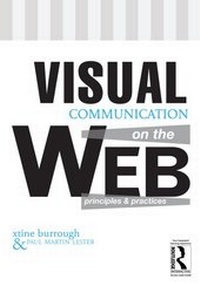
Visual Communication on the Web
1st Edition
Published on 10. December 2012
Book
Mixed media product
296 pages
978-0-415-52148-2 (ISBN)
Description
Most web design books developed for the trade market are a series of exercises without a theoretical, aesthetic, or historic framework. In this book, Visual Communication on the Web, web design exercises are accompanied by concise introductions that relate history, design principles, and visual communication theories to the practice of designing for the web.
Over the course of its 14 chapters, Visual Communication on the Web teaches the reader to develop one dynamic web page using Dreamweaver. Incorporating a cumulative-learning approach, exercises build upon each other so the reader creates and revises the work while learning new code and tools. In addition, predictable mistakes are purposely included so that readers learn to 'fix' the project while working on it-an invaluable skill for anyone interested in coding. By the end of this course-in-a-book, readers will have created a web page with a centered container div, a Lightbox image gallery, and an external style sheet using HTML, CSS, and copy-pasted and modified code.
This package includes a free one-year subscription to an enhanced Interactive eTextbook and provides short videos of burrough detailing some of the more complex step-by-step instructions, along with original chapter introductions by Lester. Users of the eTextbook may also engage in a traditional assessment exercise to test their knowledge of new material. For those who aren't reading electronically, many of these resources are freely available on the book's blog, viscommontheweb.wordpress.com.
With its easy to follow instruction and witty introductions, Visual Communication on the Web makes an excellent companion to xtine burrough's Digital Foundations and Net Works as well as Paul Martin Lester's Visual Communication: Images with Messages.
Key features of the interactive eTextbook:
Includes one-year access to the interactive eTextbook
Anytime, anywhere access - Made possible by a partnership between Routledge and VitalSource (R), your interactive eTextbook is accessible via VitalSource's Bookshelf, the most used eTextbook platform in the world.
Narrated videos by Lester to introduce chapters
End-of-chapter interactive exercises; multiple-choice exercises to encourage students to test their understanding of key concepts
Note-taking and sharing function
Clickable glossary definitions
Hyperlinked "further reading" section with links to key websites selected by the authors
A full-colour version of the text.
Over the course of its 14 chapters, Visual Communication on the Web teaches the reader to develop one dynamic web page using Dreamweaver. Incorporating a cumulative-learning approach, exercises build upon each other so the reader creates and revises the work while learning new code and tools. In addition, predictable mistakes are purposely included so that readers learn to 'fix' the project while working on it-an invaluable skill for anyone interested in coding. By the end of this course-in-a-book, readers will have created a web page with a centered container div, a Lightbox image gallery, and an external style sheet using HTML, CSS, and copy-pasted and modified code.
This package includes a free one-year subscription to an enhanced Interactive eTextbook and provides short videos of burrough detailing some of the more complex step-by-step instructions, along with original chapter introductions by Lester. Users of the eTextbook may also engage in a traditional assessment exercise to test their knowledge of new material. For those who aren't reading electronically, many of these resources are freely available on the book's blog, viscommontheweb.wordpress.com.
With its easy to follow instruction and witty introductions, Visual Communication on the Web makes an excellent companion to xtine burrough's Digital Foundations and Net Works as well as Paul Martin Lester's Visual Communication: Images with Messages.
Key features of the interactive eTextbook:
Includes one-year access to the interactive eTextbook
Anytime, anywhere access - Made possible by a partnership between Routledge and VitalSource (R), your interactive eTextbook is accessible via VitalSource's Bookshelf, the most used eTextbook platform in the world.
Narrated videos by Lester to introduce chapters
End-of-chapter interactive exercises; multiple-choice exercises to encourage students to test their understanding of key concepts
Note-taking and sharing function
Clickable glossary definitions
Hyperlinked "further reading" section with links to key websites selected by the authors
A full-colour version of the text.
More details
Language
English
Place of publication
London
United Kingdom
Publishing group
Taylor & Francis Ltd
Target group
College/higher education
Illustrations
279 s/w Photographien bzw. Rasterbilder, 4 s/w Zeichnungen
follow Net Works 9780415882224; 4 Line drawings, black and white; 279 Halftones, black and white
Dimensions
Height: 254 mm
Width: 178 mm
Weight
522 gr
ISBN-13
978-0-415-52148-2 (9780415521482)
Copyright in bibliographic data and cover images is held by Nielsen Book Services Limited or by the publishers or by their respective licensors: all rights reserved.
Schweitzer Classification
Other editions
Additional editions
xtine burrough | Paul Martin Lester
Visual Communication on the Web
Book
approx. 01/2013
Routledge
€141.13
Not yet published
Persons
xtine burrough is Associate Professor in the Department of Communications at California State University, Fullerton. She is the co-author of Digital Foundations, editor of Net Works, and author of Foundations of Digital Art and Design.
Paul Martin Lester is Professor in the Department of Communications at California State University, Fullerton. He is the author of The Ethics of Photojournalism, Visual Communication: Images with Messages, Visual Journalism: A Guide for New Media Professionals, and other titles.
Paul Martin Lester is Professor in the Department of Communications at California State University, Fullerton. He is the author of The Ethics of Photojournalism, Visual Communication: Images with Messages, Visual Journalism: A Guide for New Media Professionals, and other titles.
Content
Introduction 1. Intro to HTML: Hello World 2. Graphics: Saving Images for the Web 3. Images and Links: Connecting Pages Online 4. Blogs: Creating Online Collections 5. Styles: Introduction to CSS 6. Uploading: Transferring Files 7. Navigation: Lists and Divs 8. Creating Unity: Using a Container Div 9. Footers: Adding CSS3 Elements 10. Positioning: Alignment with CSS 11. Other Code: Implementing Borrowed Code 12. Inspiration: The More You See, the More You Know