

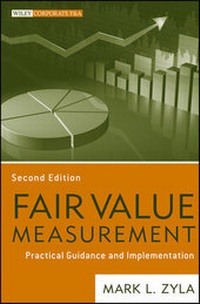
Fair Value Measurement
Practical Guidance and Implementation
2nd Edition
Published on 11. December 2012
Book
Hardback
592 pages
978-1-118-22907-1 (ISBN)
Description
Fair Value Measurements, Second Edition: Practical Guidance and Implementation is a hands-on guide for implementing the FASB's Topic 820 (formerly SFAS 157), and provides the latest information about the best practices for measuring fair value in financial reporting. The book includes detailed examples of the cost, market and income approaches for measuring the fair value of certain assets and liabilities. It covers fair value measurements in a business combination, measuring contingent consideration, and how to subsequently test the value of acquired assets for impairment. The book also assists financial statement preparers, valuation specialists and auditors in improving their understanding of measure fair value.
More details
Other editions
New editions
Book
02/2020
3rd Edition
Wiley
€88.50
Shipment within 15-20 days
Previous edition
Book
01/2010
1st Edition
Wiley
€89.90
Article exhausted; check for reprint
Person
MARK L. ZYLA, CPA/ABV, CFA, ASA, is a leader in the area of fair value measurement. He is Managing Director of Acuitas, Inc., an Atlanta, Georgia-based valuation and litigation consultancy firm, providing valuation consulting for various entities for the purposes of mergers and acquisitions, financial reporting, tax planning, corporate recapitalizations, as well as valuing various types of intellectual property and other intangible assets. He has served as Chairman of the AICPA's Fair Value Measurement Conference and serves on the AICPA's Impairment Issues Task Force. He is also the author of the AICPA courses "Fair Value Accounting: A Critical New Skill for CPAs" and "Valuing Goodwill and Other Intangible Assets." He was vice chairman of the Appraisal Foundation's first Best Practices in Valuation for Financial Reporting Working Group. He serves on the faculty of the National Judicial College. Mark lives in Atlanta with his wife, JoAnn, and son, Jack.
Content
Preface xiii
Acknowledgments xix
Chapter 1: The History and Evolution of Fair Value Accounting 1
Why the Trend toward Fair Value Accounting? 2
History and Evolution of Fair Value 7
Fair Value Accounting and the Economic Crisis 15
The FASB and IASB Convergence Project 22
The Future of Fair Value Measurement 29
Conclusion 30
Notes 31
Chapter 2: Fair Value Measurement Standards and Concepts 37
FASB ASC 820, Fair Value Measurement 38
Disclosures 65
Fair Value Option 69
Conclusion 78
Notes 78
Chapter 3: Business Combinations 79
Mergers and Acquisitions 80
Accounting Standards for Business Combinations--A Brief History 83
ASC 805, Business Combinations 86
Other Business Combination Highlights 93
Subsequent Accounting for Goodwill and Other Intangible Assets 97
Conclusion 98
Notes 99
Chapter 4: The Nature of Goodwill and Intangible Assets 103
History of Intangible Assets 104
Intellectual Property 106
Economic Basis of Intangible Assets 106
Identification of Intangible Assets 108
Useful Life of an Intangible Asset 113
Intangible Assets and Economic Risk 114
Goodwill 115
Economic Balance Sheet 118
Conclusion 120
Notes 121
Chapter 5: Impairment 123
Evolution of Impairment Testing 125
Applicable FASB Guidance for Impairment Testing 127
Accounting for the Impairment of Long?]Lived Assets 128
Goodwill Impairment Testing 131
Testing Other Indefinite?]Lived Intangible Assets for Impairment 147
Conclusion 148
Notes 149
Appendix 5A: Example of a Qualitative Impairment Analysis--PlanTrust, Inc. 151
Financial Accounting Standards Board ASC 350, Intangibles--Goodwill and Other 151
PlanTrust, Inc. 152
Notes 170
Chapter 6: The Cost Approach 171
The Cost Approach under FASB ASC 820, Fair Value Measurement 172
Economic Foundation for the Cost Approach 175
Cost versus Price versus Fair Value 175
The Role of Expected Economic Benefits in the Cost Approach 178
Reproduction Cost versus Replacement Cost 178
Components of Cost 180
Obsolescence 182
The Relationships among Cost, Obsolescence, and Value 182
Physical Deterioration 184
Functional (Technological) Obsolescence 185
Economic (External) Obsolescence 186
Applying the Cost Approach 188
Taxes under the Cost Approach 192
Limitations of the Cost Approach 194
Conclusion 195
Notes 195
Chapter 7: The Market Approach 199
Measuring the Fair Value of an Entity Using a Market Approach 201
Conclusion 232
Notes 232
Appendix 7A: Using the Guideline Transaction Method to Measure the Fair Value of a Privately Held (or Thinly Traded) Debt Security 235
Chapter 8: The Income Approach 253
Discounted Cash Flow Method 254
Multiperiod Excess Earnings Method 262
FASB Concepts Statement 7 280
Rates of Return under the Income Approach 286
The Income Increment/Cost Decrement Method 287
Profit Split Method 288
Build?]Out Method, or "Greenfield Method" (With and Without) 294
Weighted Average Cost of Capital Calculation 294
Conclusion 303
Notes 303
Chapter 9: Advanced Valuation Methods for Measuring the Fair Value of Intangible Assets 307
Limitations of Traditional Valuation Methods 308
Real Options 309
Using Option?]Pricing Methodologies to Value Intangible Assets 313
Black?]Scholes Option Pricing Model 317
Binomial or Lattice Models 320
Monte Carlo Simulation 327
Decision Tree Analysis 328
Conclusion 331
Notes 331
Chapter 10: The Remaining Useful Life of Intangible Assets 333
FASB Guidance on Determining the Remaining Useful Life 333
Considerations in Measuring Useful Lives of Intangible Assets 336
Guideline Useful Lives 341
Conclusion 342
Notes 342
Chapter 11: Fair Value Measurement for Alternative Investments 345
Investments in Certain Entities That Calculated Net Asset Value per Share 347
AICPA Technical Practice Aid 349
AICPA Guidance for Determining the Fair Value of Investment 351
U.S. Private Equity Valuation Guidelines 356
Fair Value Measurement for Alternative Investment Funds 357
Conclusion 359
Notes 360
Chapter 12: Contingent Consideration 361
Contingent Consideration: Earn?]Outs in Business Combinations 362
Accounting for Contingent Consideration 363
Conclusion 376
Notes 377
Appendix 12A: Measuring the Fair Value of a Loan Guarantee 379
The Jordan Lee Fund Guarantee of Townsend Farm Development, LLC 381
Notes 387
Chapter 13: Auditing Fair Value Measurement 389
Auditing Standards 390
Audit Standards for Fair Value Measurements and Disclosures 392
The Audit Process 394
Auditing Estimates in Fair Value Measurements 399
AU 328, Auditing Fair Value Measurements and Disclosures 400
PCAOB Staff Audit Practice Alert No. 2 409
PCAOB Staff Audit Practice Alert No. 9 413
SEC Audit Guidance 415
AICPA Non?]Authoritative Guidance 416
The Appraisal Foundation 416
Conclusion 417
Notes 418
Appendix 13A: Auditing a Business Combination or a Step 2 Impairment Test 421
General 421
Income Approach 423
Cost Approach 426
Market Approach 427
Appendix 13B: Auditing a Step 1 Goodwill Impairment Test 429
General 429
Income Approach 430
Market Approach 432
Appendix 13C: Survey of Fair Value Audit Deficiencies 435
Audit Deficiencies Increase in Difficult Economic Times 436
PCAOB Inspections 436
Methodology 437
Description of a Deficiency 438
Audit Deficiency Trends 438
FVM Deficiencies 440
Impairment Deficiencies 442
Conclusion 443
Notes 445
Chapter 14: Fair Value Measurement Case Study 447
Learning Objectives 447
Business Background and Facts--Mobile Apps Source, Inc. 448
Note 484
Appendix 14A: Suggested Case Study Solutions 485
Information Request--ASC 350 517
Information Request for Business Combination--ASC 805 519
Glossary of International Business Valuation Terms 523
Bibliography 533
About The Author 547
Index 549