

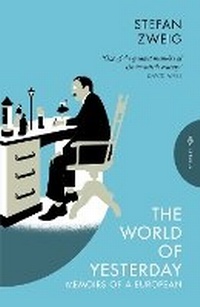
The World of Yesterday
Memoirs of a European
Published on 28. March 2024
Book
Paperback/Softback
480 pages
978-1-80533-115-5 (ISBN)
Description
Stefan Zweig's seminal memoir recalls the golden age of pre-war Europe - its seeming permanence, its promise and its devastating fall. Through the story of his life and his relationships with the leading literary figures of the day, Zweig's fervent, evocative prose paints a stunning portrait of an era that danced brilliantly on the brink of extinction.
This translation by the award-winning Anthea Bell captures the passionate fluency of Zweig's writing in arguably his most important work, completed the day before his suicide in 1942 - a unique elegy for a lost world of security and peace.
This translation by the award-winning Anthea Bell captures the passionate fluency of Zweig's writing in arguably his most important work, completed the day before his suicide in 1942 - a unique elegy for a lost world of security and peace.
Reviews / Votes
One of the greatest memoirs of the twentieth century, as perfect in its evocation of the world Zweig loved, as it is in its portrayal of how that world was destroyed -- David Hare No one captures the sweep of history like Stefan Zweig... An eerie, spellbinding read * Economist * A marvellous recapturing of a Europe that Hitler and his thugs destroyed. Zweig seems to have known everyone, and writes about the great figures of his day with insight, sympathy and, most unusually for a writer, modesty * John Banville * This absolutely extraordinary book is more than just an autobiography... A book that should be read by anyone who is even slightly interested in the creative imagination and the intellectual life, the brute force of history upon individual lives, the possibility of culture and, quite simply, what it meant to be alive between 1881 and 1942. That should cover a fair number of you -- Nicholas Lezard A wonderful book... [Zweig's] writings have come to embody the lost world of the Habsburg Empire... of Europe before the fall -- Dominic Sandbrook One of the great accounts of life in Europe in the first part of the twentieth century -- Sheila Heti, New Yorker The book fits the uneasy mood of the moment, the nightmarish ways that history can abruptly overturn even the most secure lives. A powerful statement of the implacable power of circumstance on our lives -- Ron Chernow, New York Times One of the canonical European testaments... [Zweig's] life and work tell of the perilous flimsiness of our world of security-a message that many insistently deny, but somehow need to hear -- John Gray, New Statesman Unnervingly topical * The Week * This is a wonderful book of a lifetime -- Eileen Battersby * Irish Times * I can't recommend it highly enough -- Gareth Russell * Four Thought * Zweig's memoir speaks an important message to us today about how quickly war can erupt and change our lives for good. It also demonstrates how unprepared most people were, ignoring all the signs. Zweig was one of the best known authors in Europe at his time, an excellent observer and writer * EUobserver * Zweig's celebration of the brotherhood of peoples reminds us that there is another way * The Nation * One of liberalism's greatest defenders * New Republic * Zweig's accumulated historical and cultural studies... remain a body of achievement almost too impressive to take in -- Clive JamesMore details
Language
English
Place of publication
United Kingdom
Publishing group
Pushkin Press
Product notice
Paperback (UK-B)
Dimensions
Height: 198 mm
Width: 131 mm
Thickness: 43 mm
Weight
352 gr
ISBN-13
978-1-80533-115-5 (9781805331155)
Copyright in bibliographic data and cover images is held by Nielsen Book Services Limited or by the publishers or by their respective licensors: all rights reserved.
Schweitzer Classification
Persons
Stefan Zweig (1881-1942) was born in Vienna, into a wealthy Austrian-Jewish family. He studied in Berlin and Vienna and was first known as a poet and translator, then as a biographer. Zweig travelled widely, living in Salzburg between the wars, and was an international bestseller with a string of hugely popular novellas including Letter from an Unknown Woman, Amok and Fear.
In 1934, with the rise of Nazism, he moved to London where he wrote his only novel, Beware of Pity. He later moved to Bath, taking British citizenship after the outbreak of the Second World War. After a short period in New York, Zweig settled in Brazil where in 1942 he and his wife were found dead in an apparent double suicide.Much of his work is available from Pushkin Press.
In 1934, with the rise of Nazism, he moved to London where he wrote his only novel, Beware of Pity. He later moved to Bath, taking British citizenship after the outbreak of the Second World War. After a short period in New York, Zweig settled in Brazil where in 1942 he and his wife were found dead in an apparent double suicide.Much of his work is available from Pushkin Press.