

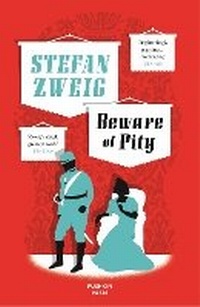
Beware of Pity
Description
<strong>Stefan's Zweig's <em>Beware of Pity</em> is an almost unbearably tense and powerful tale of unrequited love and the danger of pity. The famous novel is published by Pushkin Press in a cloth bound hardback, beautifully designed by Nathan Burton and translated by the award-winning Anthea Bell.</strong>
In 1913 a young second lieutenant discovers the terrible danger of pity. He had no idea the girl was lame when he asked her to dance his compensatory afternoon calls relieve his guilt but give her a dangerous glimmer of hope.
Stefan Zweig's only novel is a devastating depiction of the torment of the betrayal of both honour and love, realised against the background of the disintegration of the Austro-Hungarian Empire.
'Beware of Pity is the most exciting book I have ever read...a feverish, fascinating novel'
— Anthony Beevor, <em>Sunday Telegraph</em>
The novel I'll really remember reading this year is Stefan Zweig's frighteningly gripping <em>Beware of Pity</em>, first published in 1939 ... and part of the ongoing, valiant reprinting by Pushkin Press of Zweig's collected oeuvre; an intoxicating, morally shaking read about human responsibilities and a real reminder of what fiction can do best'<br/>— Ali Smith, <em>TLS Book of the Year 2008</em>
'An unremittingly tense parable about emotional blackmail, this is a book which turns every reader into a fanatic'
— Julie Kavanagh, <em>Intelligent Life</em> (The Economist)
'It's just a masterpiece. When I read it I thought, how is it that I don't already know
about this?' Wes Anderson
'The rediscovery of this extraordinary writer could well be on a par with last year's refinding of the long-lost <em>Stoner</em>, by John Williams, and which similarly could pluck his name out of a dusty obscurity.' Simon Winchester, <em>Telegraph</em>
'Zweig's single greatest work' <em>The Times</em>
'Zweig's fictional masterpiece' <em>Guardian</em>
'Originaland powerful' <em>New York Times</em>
Translated from the German by Anthea Bell, Stefan Zweig's <em>Beware of Pity</em> is published by Pushkin Press.
<strong>Stefan Zweig</strong> (1881-1942) was born in Vienna, into a wealthy Austrian-Jewish family. He studied in Berlin and Vienna and was first known as a poet and translator, then as a biographer. Zweig travelled widely, living in Salzburg between the wars, and was an international bestseller with a string of hugely popular novellas including <em>Letter from an Unknown Woman</em>, <em>Amok</em> and <em>Fear</em>.
In 1934, with the rise of Nazism, he moved to London, where he wrote his only novel <em>Beware of Pity</em>. He later moved on to Bath, taking British citizenship after the outbreak of the Second World War. With the fall of France in 1940 Zweig left Britain for New York, before settling in Brazil, where in 1942 he and his wife were found dead in an apparent double suicide.
Much of his work is available from Pushkin Press.
Reviews / Votes
It's just a masterpiece. When I read it I thought, how is it that I don't already know about this? * Wes Anderson * Zweig's fictional masterpiece * Guardian * It really touched me. I'm not an easy crier, not at all. But this book was one of the few moments that I found myself sobbing. It was a knife to my heart * Shira Haas, star of Netflix hit series 'Unorthodox' * The novel I'll really remember reading this year is Stefan Zweig's frighteningly gripping Beware of Pity, first published in 1939 ... and part of the ongoing, valiant reprinting by Pushkin Press of Zweig's collected oeuvre; an intoxicating, morally shaking read about human responsibilities and a real reminder of what fiction can do best -- Ali Smith * TLS Book of the Year 2008 * An unremittingly tense parable about emotional blackmail, this is a book which turns every reader into a fanatic -- Julie Kavanagh * Intelligent Life (The Economist) * Beware of Pity is the most exciting book I have ever read...a feverish, fascinating novel -- Antony Beevor * Sunday Telegraph * Original and powerful * The New York Times * Combines great storytelling with wonderful prose -- Jeffrey Archer * Independent * It's a masterpiece. I didn't discover it till I was 16-years-old. He was number one on the bestseller lists in the 1940s. He was a great storyteller and a great writer, amazing combination -- Jeffrey Archer * DNA India * Beware of Pity is chillingly resonant in the Trump era... [in Beware of Pity] this sense of creeping decomposition is compulsively alive. It is hypnotic -- Simon McBurney * Guardian * I was riveted by it * Colin Firth * Absolutely marvellous * Roy Hodgson * In the novel a character remarks that 'the human tendency to self-delusion likes to declare dangers null and void even when we sense in our hearts that they are real * Evening Standard (review of stage adaptation) * Beware of Pity... is a tale of the past, memory and regret set in a world about to turn * The Stage * One of the most underestimated [novels of all time]... An extraordinary book -- Stephen FryMore details
Other editions
Previous edition
Persons
In 1934, with the rise of Nazism, he moved to London, where he wrote his only novel Beware of Pity. He later moved on to Bath, taking British citizenship after the outbreak of the Second World War. With the fall of France in 1940 Zweig left Britain for New York, before settling in Brazil, where in 1942 he and his wife were found dead in an apparent double suicide.
Much of his work is available from Pushkin Press.