

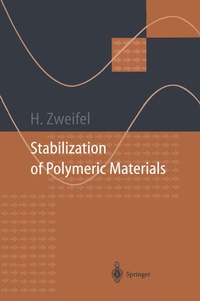
Stabilization of Polymeric Materials
Published on 14. December 2011
Book
Paperback/Softback
XII, 219 pages
978-3-642-80307-9 (ISBN)
Description
Plastics are used worldwide in everyday life, e.g. as food packaging, electronics, construction, automotive parts, and household appliances. To produce these products with the desired service lifetimes the use of suitable stabilizers is necessary. This book provides a concise and comprehensive overview of the basic mechanisms of plastic degradation processes caused by heat and light. At its core is a detailed description of the stabilization of different polymers, including an explanation of stabilization mechanisms and the influence of commonly used additives such as fillers, flame retardents and pigments on the stability of plastic. Every polymer scientist, material technologist, or application engineer dealing with the design of the properties of plastics will benefit from this new overview.
More details
Series
Edition
Softcover reprint of the original 1st ed. 1998
Language
English
Place of publication
Berlin
Germany
Publishing group
Springer Berlin
Target group
Professional and scholarly
Research
Illustrations
XII, 219 p.
Dimensions
Height: 235 mm
Width: 155 mm
Thickness: 14 mm
Weight
371 gr
ISBN-13
978-3-642-80307-9 (9783642803079)
DOI
10.1007/978-3-642-80305-5
Schweitzer Classification
Other editions
Additional editions
Hans Zweifel
Stabilization of Polymeric Materials
Book
12/1997
1st Edition
Springer
€85.55
Article exhausted; check different version
Content
1 Principles of Oxidative Degradation.- 1.1 Introduction.- 1.2 Autoxidation.- 1.3 Diffusion and Solubility of Oxygen in Polymers.- 1.4 Degradation of Polymers During Processing in the Melt.- 1.5 Upper Limit of Processing Temperature.- 1.6 Degradation of Polymers Under Long Term Thermal Conditions.- 1.7 Degradation of Polymers by Photooxidation.- 2 Principles of Stabilization.- 2.1 Stabilization Against Thermo-Oxidative Degradation.- 2.2 Stabilization Against Photooxidative Degradation.- Conclusions.- 3 Principles of Stabilization of Individual Substrates.- 3.1 Polyolefins.- 3.2 Thermoplastic Polyolefins (TPO).- 3.3 Elastomers.- 3.4 Styrenic Polymers.- 3.5 Polyesters.- 3.6 Polyamides.- 3.7 Polyacetals.- 3.8 Polycarbonates.- 3.9 Polyurethane.- 3.10 High Performance Engineering Thermoplastics.- 3.11 Polymer Blends and Alloys.- 4 Influence of Metals, Fillers and Pigments on Stability.- 4.1 Metal Ion Deactivators.- 4.2 Fillers.- 4.3 Pigments.- 5 Solubility and Diffusion of Stabilizers in Polymers.- 5.1 Solubility in Theory.- 5.2 Solubility in Practice.- Conclusions.- 5.3 Physical Loss of Stabilizers from Polymers Through Diffusion and Evaporation.- Conclusions.- Conclusions.- 5.4 Service Lifetime Predictions for Polymer End Use Applications.- 6 Testing of Stabilizers in the Substrate.- 6.1 Introduction.- 6.2 Testing of Melt Stability.- 6.3 Testing of Long Term Thermal Stability.- 6.4 Testing Light Stability of Polymers.- 6.5 Effect of Gamma Radiation on Polymers.- Conclusions.- 7 Outlook and Trends.- 7.1 New Substrates.- 7.2 Recycling of Polymers.- References.- Appendix 1.- List of Abbreviations and Symbols.- Chemical Symbols.- Physical Symbols.- Appendix 2.- Appendix 3.