

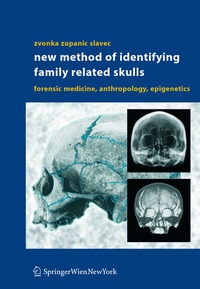
New Method of Identifying Family Related Skulls
Forensic Medicine, Anthropology, Epigenetics
Published on 1. December 2004
Book
Hardback
XIII, 243 pages
978-3-211-22044-3 (ISBN)
Description
If DNA cannot be isolated, don't give up the identification! The author has used for the same purpose methods ranging from physical anthropology to forensic medicine and especially a recent method of comparison of epigenetic traits, which proved to be very useful for the identification of family related skulls in connection with historical and other data.
The kinship of 18 identified skulls (buried together in a family vault) is established by comparison of X-ray images of paranasal cavities (frontal and maxillary sinuses, orbital and nasal cavities), the shape and size of which are strongly genetically determined. The comparison also extends to numerous other epigenetic trait similarities on the skulls.
It is recommended for: scientists working on human identification and studying heredity, forensic scientists, physical anthropologists, radiologists, stomatologists, paleopathologists, geneticists, historians and many others.
More details
Edition
2004 ed.
Language
English
Place of publication
Vienna
Austria
Publishing group
Springer Wien
Target group
Professional and scholarly
Research
Illustrations
XIII, 243 p.
Dimensions
Height: 286 mm
Width: 215 mm
Thickness: 21 mm
Weight
976 gr
ISBN-13
978-3-211-22044-3 (9783211220443)
DOI
10.1007/978-3-7091-0605-1
Schweitzer Classification
Other editions
Additional editions
Zvonka Zupanic Slavec
New Method of Identifying Family Related Skulls
Forensic Medicine, Anthropology, Epigenetics
Book
11/2012
Springer
€106.99
Shipment within 10-15 days
Persons
Content
1. Introduction.- 2. Scientific Hypotheses.- 3. Methodology of Work.- 3.1. Historiographic methods.- 3.2. Identification methods.- 4 RESULTS.- 4.1. Historiographic results.- 4.2. Identification results.- 4.3. Comparison of the historical and identificational results.- 4.4. Results on kinship.- 4.5. Conclusions based on the historiographical and identificational results.- 4.6. Genealogical results.- 4.7. Art history results.- 5. Discussion.- 6. Conclusion.- List of Pictures and Illustrations.- 7. Literature.- Abstract.- About The Author.