

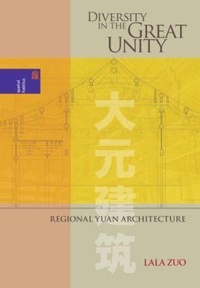
Diversity in the Great Unity
Regional Yuan Architecture
Published on 30. October 2019
Book
Hardback
248 pages
978-0-8248-7731-6 (ISBN)
Description
Timber-framed architecture has long been viewed as an embodiment of Chinese civilization, a hierarchic society ruled by Confucian orthodoxy. Throughout its history, Chinese architectural design was closely regulated by court-enforced building codes, which created a highly standardized and modularized system. In Diversity in the Great Unity - the first in-depth English-language work to present regional traditions of Chinese architecture based on a detailed study of the timber construction system - Lala Zuo maintains that during the nearly century-long Yuan dynasty (1271-1368), the tradition of "Han-Chinese" architecture as coded, uniform, and controlled by the central government did not take hold. She presents case studies of twenty buildings along the Yangtze River built during the Yuan, often considered a transitional phase in Chinese architectural history.
Most of the structures have firm dates, and all are analyzed according to patronage, chronology, and function. Their representativeness is determined by their broad geographic distribution as well as by their scarcity. Numerous photographs and line-drawings accompany the analyses. Referencing Yuan architecture in north China along the Yellow River, Zuo outlines its characteristics in three regions and connects the regional traditions to periods before and after the Yuan, allowing her to contextualize architecture in Yuan social and political history. She explains how the division of regional traditions, especially those in the south, contributed to the transformation of dynastic styles from the Song (960-1279) to the Ming (1368-1644) and how the Song-Yuan migration may have affected architectural design.
An appendix presents an extensive glossary of Chinese architectural terms in Song terminology to enable a better understanding of the subject. Although the primary focus of this book is the technical evolution of surviving Yuan architecture, its interdisciplinary approach goes beyond architecture by offering a re-evaluation of Chinese society in light of cultural and religious diversity under Mongol rule.
Most of the structures have firm dates, and all are analyzed according to patronage, chronology, and function. Their representativeness is determined by their broad geographic distribution as well as by their scarcity. Numerous photographs and line-drawings accompany the analyses. Referencing Yuan architecture in north China along the Yellow River, Zuo outlines its characteristics in three regions and connects the regional traditions to periods before and after the Yuan, allowing her to contextualize architecture in Yuan social and political history. She explains how the division of regional traditions, especially those in the south, contributed to the transformation of dynastic styles from the Song (960-1279) to the Ming (1368-1644) and how the Song-Yuan migration may have affected architectural design.
An appendix presents an extensive glossary of Chinese architectural terms in Song terminology to enable a better understanding of the subject. Although the primary focus of this book is the technical evolution of surviving Yuan architecture, its interdisciplinary approach goes beyond architecture by offering a re-evaluation of Chinese society in light of cultural and religious diversity under Mongol rule.
Reviews / Votes
Abundantly illustrated with photographs and fine line drawings, this valuable analysis of Yuan regional architecture convincingly argues that while some of its buildings reflect Chinese models, others indicate cultural integration due to foreign rule, thereby presenting a fuller picture of the period. Diversity in the Great Unity is a highly significant work that will help readers better understand Chinese architecture within a Chinese context. Dr. Zuo is to be applauded for her efforts to introduce to a western audience the methodologies and terminologies used by Chinese archaeologists and historians studying heritage architecture in the last decade.More details
Series
Language
English
Place of publication
Honolulu, HI
United States
Target group
Professional and scholarly
Product notice
sewn/stitched
Cloth over boards
Illustrations
4 colour, 154 black & white illustrations
Dimensions
Height: 257 mm
Width: 180 mm
Thickness: 23 mm
Weight
726 gr
ISBN-13
978-0-8248-7731-6 (9780824877316)
Copyright in bibliographic data and cover images is held by Nielsen Book Services Limited or by the publishers or by their respective licensors: all rights reserved.
Schweitzer Classification