

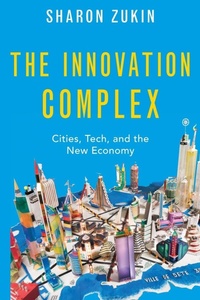
The Innovation Complex
Cities, Tech, and the New Economy
Published on 29. April 2022
Book
Paperback/Softback
336 pages
978-0-19-762160-8 (ISBN)
Description
An in-depth look at how New York adopted "innovation" and became a destination for startups and large tech companies.
In recent years, the language of "innovation" has spurred visions of urban economic revival led by digital technology. Investors, mayors, and tech evangelists transform the city into an "innovation complex" that expands the tech industry while struggling to control its power. No city has been more ambitious in this pursuit than New York. In The Innovation Complex, Sharon Zukin looks to the people who created New York's tech economy and the places where it took root. She traces its origins to the city's response to the 2008 financial crisis and the aggressive leveraging of wealth from the US and overseas. Through interviews with venture capitalists, startup founders, and economic development officials, she explores the spaces where the rules of the new economy are made--transforming the city but increasing dependence on Big Tech firms, siphoning public subsidies, and enabling the rise of a new meritocratic elite. Updated with a preface on the effects of Covid-19, Zukin's provocative interpretation of the innovation complex is a warning to cities around the world.
In recent years, the language of "innovation" has spurred visions of urban economic revival led by digital technology. Investors, mayors, and tech evangelists transform the city into an "innovation complex" that expands the tech industry while struggling to control its power. No city has been more ambitious in this pursuit than New York. In The Innovation Complex, Sharon Zukin looks to the people who created New York's tech economy and the places where it took root. She traces its origins to the city's response to the 2008 financial crisis and the aggressive leveraging of wealth from the US and overseas. Through interviews with venture capitalists, startup founders, and economic development officials, she explores the spaces where the rules of the new economy are made--transforming the city but increasing dependence on Big Tech firms, siphoning public subsidies, and enabling the rise of a new meritocratic elite. Updated with a preface on the effects of Covid-19, Zukin's provocative interpretation of the innovation complex is a warning to cities around the world.
Reviews / Votes
Zukin's work mainly provides a fascinating insight into a city in transition... Zukin's book can convince us to make cities sustainable, not only physically but also in a social sense. * Wouter J. Verheul, Delft University of Technology, TESG * There are many ways agglomeration serves to create value through innovation. However, Zukin goes beyond the typically described positive effects, in particular efficient knowledge diffusion, to recognize the negative social and economic effects. * S. J. Gabriel, CHOICE * I found the book particularly interesting for those scholars dealing with innovation and entrepreneurship in a rather quantitative manner, since it may help them to better comprehend the interesting stories behind innovative entrepreneurship, which too often risk being hidden by the 'cold' numbers of econometrics. * Luca Grilli, Regional Studies * Sharon Zukin's Innovation Complex proves once again that she is one of the most astuteAobservers of American cities. For decades, innovation and the tech industry were thought to be the province of the suburbs. But Zukin shows how and why innovation and startup companies have come back to the city en masse and the economic contradictions that the rise of the urban innovation complex brings. * Richard Florida, author of The Rise of the Creative Class * With a keen eye and a sly sense of irony, Sharon Zukin takes us behind the doors of the startups, venture capital firms, business incubators, co-working spaces, and coding camps that have made New York a major hub of what she aptly dubs 'The Innovation Complex.' ABeneath the technical wizardry and relentless boosterism of this new world, Zukin sees reasons to be skeptical about its promises to deliver a better life for us all. * Joshua B. Freeman, author of Behemoth: A History of the Factory and the Making of the Modern World? * In The Innovation Complex, Sharon Zukin masterfully reveals how New York City-of all places-pivoted to tech and established an ecosystem rivaling Silicon Valley. In the process, she helps us understand cities, the startup world, and the economic tensions that come with progress. * Steven Levy, author In the Plex and Facebook: TheAInside Story * Sharon Zukin deftly argues in The Innovation Complex that tech capitals do not simply bubble up from a primordial soup of young entrepreneurs' inventions. They are made through ideas, norms, and narratives as well as by policies and investments. Zukin takes us on a tour of the specific places and activities that make up the New York City innovation complex-hackathons, meetups, innovation districts, tech campuses, boot camps, and co-working spaces. What we come to see is the political process of innovation itself and how this process reconfigures cities. The result is a nuanced and critical look at the costs that a tech boom exacts on cities and citizens. * Gina Neff, University of Oxford, author of Venture Labor: Work and the Burden of Risk in Innovative Industries * Loft Living, published in 1982, expanded our thinking about cities * who uses them and for what. Now [Zukin] has done it again.... She translates for the naive reader enough to understand what these people do, exercising great taste in choosing examples for special focus... Once again, in Zukinland, urban geography takes new shape, micro and macro." - Harvey Molotch, American Journal of Sociology * A masterful guide to the intricacies of the city's most recent bout of self-reinvention.... It will serve as a standard text for understanding the technology-driven transformations in urban development and governance." - John Stehlin, International Journal of Urban and Regional Research [Zukin's] gift is to track the political economy of the particular cultural desires of an era, and concern for the interplay between cultural production and the production of urban space has been a constant as she has charted New York City's packaging of creativity, authenticity, and now, innovation." - Hillary Angelo, European Journal of SociologMore details
Language
English
Place of publication
New York
United States
Target group
College/higher education
Dimensions
Height: 234 mm
Width: 156 mm
Thickness: 18 mm
Weight
500 gr
ISBN-13
978-0-19-762160-8 (9780197621608)
Copyright in bibliographic data and cover images is held by Nielsen Book Services Limited or by the publishers or by their respective licensors: all rights reserved.
Schweitzer Classification
Other editions
Additional editions
E-Book
02/2020
OUP eBook
€11.49
Available for download
E-Book
02/2020
OUP eBook
€11.49
Available for download
Person
Sharon Zukin is Professor Emerita of Sociology at Brooklyn College and the Graduate Center, City University of New York, and author of Naked City (Oxford).
Content
Preface
1. Imagining Innovation
2. Hackathons and the Spirit of the New Capitalism
3. Meetups: Leveraging the Community
4. Accelerators, Startups, and the Circulation of Capital
5. The VC Office and the Concentration of Capital
6. Brooklyn's "Innovation Coastline"
7. Pipelines: Talent, Meritocracy, and Academic Capitalism
8. "The Address of Innovation"
9. Author's Note: On Methods and Journeys
1. Imagining Innovation
2. Hackathons and the Spirit of the New Capitalism
3. Meetups: Leveraging the Community
4. Accelerators, Startups, and the Circulation of Capital
5. The VC Office and the Concentration of Capital
6. Brooklyn's "Innovation Coastline"
7. Pipelines: Talent, Meritocracy, and Academic Capitalism
8. "The Address of Innovation"
9. Author's Note: On Methods and Journeys