

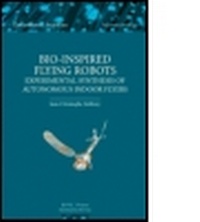
Bio-inspired Flying Robots
Experimental Synthesis of Autonomous Indoor Flyers
1st Edition
Published on 16. May 2008
Book
Hardback
250 pages
978-1-4200-6684-5 (ISBN)
Description
This book demonstrates how bio-inspiration can lead to fully autonomous flying robots without relying on external aids. Most existing aerial robots fly in open skies, far from obstacles, and rely on external beacons, mainly GPS, to localise and navigate. However, these robots are not able to fly at low altitude or in confined environments, and yet this poses absolutely no difficulty to insects. Indeed, flying insects display efficient flight control capabilities in complex environments despite their limited weight and relatively tiny brain size.
From sensor suite to control strategies, the literature on flying insects is reviewed from an engineering perspective in order to extract useful principles that are then applied to the synthesis of artificial indoor flyers. Artificial evolution is also utilised to search for alternative control systems and behaviors that match the constraints of small flying robots. Specifically, the basic sensory modalities of insects, vision, gyroscopes and airflow sense, are applied to develop navigation controllers for indoor flying robots. These robots are capable of mapping sensor information onto actuator commands in real time to maintain altitude, stabilize the course and avoid obstacles. The most prominent result of this novel approach is a 10-gram microflyer capable of fully autonomous operation in an office-sized room using fly-inspired vision, inertial and airspeed sensors.
This book is intended for all those interested in autonomous robotics, in academia and industry.
From sensor suite to control strategies, the literature on flying insects is reviewed from an engineering perspective in order to extract useful principles that are then applied to the synthesis of artificial indoor flyers. Artificial evolution is also utilised to search for alternative control systems and behaviors that match the constraints of small flying robots. Specifically, the basic sensory modalities of insects, vision, gyroscopes and airflow sense, are applied to develop navigation controllers for indoor flying robots. These robots are capable of mapping sensor information onto actuator commands in real time to maintain altitude, stabilize the course and avoid obstacles. The most prominent result of this novel approach is a 10-gram microflyer capable of fully autonomous operation in an office-sized room using fly-inspired vision, inertial and airspeed sensors.
This book is intended for all those interested in autonomous robotics, in academia and industry.
More details
Language
English
Place of publication
Bosa Roca
United States
Publishing group
Taylor & Francis Inc
Target group
Professional and scholarly
Dimensions
Height: 235 mm
Width: 156 mm
Weight
544 gr
ISBN-13
978-1-4200-6684-5 (9781420066845)
Copyright in bibliographic data and cover images is held by Nielsen Book Services Limited or by the publishers or by their respective licensors: all rights reserved.
Schweitzer Classification
Other editions
Additional editions
Jean-Christophe Zufferey
Bio-inspired Flying Robots
Experimental Synthesis of Autonomous Indoor Flyers
E-Book
04/2008
1st Edition
EPFL Press
€88.49
Available for download
Person
Content
Preface. Foreword. Introduction. Related Work. Flying Insects. Robotic Platforms. Optic Flow. Optic-flow-based Control Strategies. Envolved Control Strategies. Concluding Remarks. Bibliography. Index.