

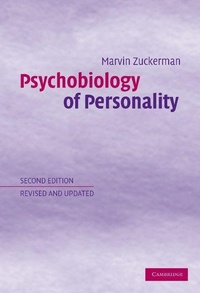
Psychobiology of Personality
2nd Edition
Published on 11. April 2005
Book
Hardback
338 pages
978-0-521-81569-7 (ISBN)
Description
Personality is now understood to be a function of both biological and environmental influences. This revised and updated edition of Psychobiology of Personality describes what is currently known about the biological basis of the primary personality traits, including genetic, neurological, biochemical, physiological, and behavioral influences. Emphasis is placed on understanding the connections between phenomena at these levels. The research discussed makes use of animal models, based on experimental brain research, as well as human clinical and normal personality research. Chapters are devoted to temperament and personality trait structure, psychobiological methods, and each of four major personality traits: extraversion, impulsive, sensation seeking, and aggression. Recent advances in psychobiological methods, such as molecular genetics and brain imaging have enabled us to begin to unravel the genetic and neurological sources of behavior and personality. These advances are discussed in this new edition, making it essential reading for advanced students of psychology and psychiatry.
Reviews / Votes
'Zuckerman's book presents a wealth of data supporting the idea of consistency of traits over the lifetime of an individual. This is an important book for the student of human behavior ... Its strength lies in its thoroughness.' George Kucan, Human Ethology Bulletin '... effectively brings the integration of psychology and biology closer to a reality ... a valuable addition to undergraduate libraries if only to show other approaches to the study of personality.' Choice '... a useful book. It presents an up-to-date review of thinking and research dealing with personality, primarily from a psychobiological point of view ... Reading through the book provides the reader with a broad grasp of the field as well as an understanding of some of the important conceptual and methodological problems inherent in much of the research described.' Samuel B. Guze, American Journal of Psychiatry '... by far the best introduction to the field, and will undoubtedly be the textbook chosen by the adventurous souls who decide to lecture on the psychobiology of personality.' H. J. Eysenck, Personality & Individual Differences 'The second edition of Zuckerman's 1991 text is an extremely well researched review of what is a fast moving inextricably linked area of biology/psychology/ethology. ... a thorough review ... well referenced ... It is academically rigorous and would be an excellent starting point for undergraduate psychologists and ethologists alike in their pursuit of understanding what is one of the most challenging of current psychobiological research areas.' Journal of Biological EducationMore details
Edition
2nd Revised edition
Language
English
Place of publication
Cambridge
United Kingdom
Target group
Professional and scholarly
Edition type
Revised edition
Illustrations
41 Tables, unspecified; 6 Halftones, unspecified; 40 Line drawings, unspecified
Dimensions
Height: 235 mm
Width: 157 mm
Thickness: 24 mm
Weight
700 gr
ISBN-13
978-0-521-81569-7 (9780521815697)
Copyright in bibliographic data and cover images is held by Nielsen Book Services Limited or by the publishers or by their respective licensors: all rights reserved.
Schweitzer Classification
Other editions
Additional editions
Marvin Zuckerman
Psychobiology of Personality
E-Book
09/2005
2nd Edition
Cambridge University Press
€54.49
Available for download
Previous edition
Marvin Zuckerman
Psychobiology of Personality
Book
05/1991
Cambridge University Press
€52.62
Article exhausted; check for reprint
Person
Marvin Zuckerman is Professor Emeritus of Psychology at the University of Delaware. He has written over 200 articles and six books, including the first edition of Psychobiology of Personality (1991).
Content
Preface; 1. Temperament and personality: trait structure and persistence; 2. Psychobiological methods; 3. Extraversion/sociability; 4. Neuroticism; 5. Psychoticism (psychopathy), impulsivity, sensation and/or novelty seeking, conscientiousness; 6. Aggression-hostility/agreeableness; 7. Consilience; References.