

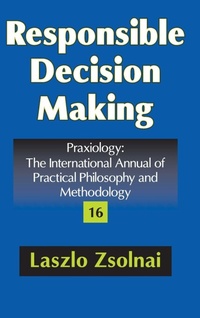
Responsible Decision Making
1st Edition
Published on 15. December 2008
Book
Hardback
214 pages
978-1-4128-0818-7 (ISBN)
Description
"What should I do?," "How should I deal with this?," "How should I behave?," "How should I act?" we ask ourselves daily. But, this is only the first part of the sentence, while the full sentence is "What should I do ... to achieve such and such?", for example to complete an assigned task, to do well before my boss or a client, to be pleased with myself, to carry out my plans, to make money in the stock market, to pass an exam, to complete an application, etc. These and similar questions that people ask, consciously or not, openly or not, are decisions.
What skills must we master, especially when there is a need to make not only elementary decisions, but also decisions that affect the existence, health, and even lives of people? First, Laszlo Zsolnai writes that we should acquire the skill of gaining knowledge. Only then will we stand a chance of reacting to things that are improbable today, but could become a fact tomorrow. Also essential is the skill of designing, i.e., preparing actions conceptually in order to make decisions before irreversible changes occur. Finally, it is essential to master the skill of multidimensional judgment within the space defined by effectiveness, efficiency, and ethics.
This is Zsolnai's attempt to build a model of making ethical decisions both effectively and efficiently. Therefore, the model is much broader than purely an analytical framework would be. It must tell us how to act rather than limit us to reflection on actions already performed; it must combine decision and praxiological analysis of human conduct. The proposed model enlarges the scope of the debate and suggests new avenues of both rational and responsible decision making. This is an original statement of the crossover of policy and morality.
What skills must we master, especially when there is a need to make not only elementary decisions, but also decisions that affect the existence, health, and even lives of people? First, Laszlo Zsolnai writes that we should acquire the skill of gaining knowledge. Only then will we stand a chance of reacting to things that are improbable today, but could become a fact tomorrow. Also essential is the skill of designing, i.e., preparing actions conceptually in order to make decisions before irreversible changes occur. Finally, it is essential to master the skill of multidimensional judgment within the space defined by effectiveness, efficiency, and ethics.
This is Zsolnai's attempt to build a model of making ethical decisions both effectively and efficiently. Therefore, the model is much broader than purely an analytical framework would be. It must tell us how to act rather than limit us to reflection on actions already performed; it must combine decision and praxiological analysis of human conduct. The proposed model enlarges the scope of the debate and suggests new avenues of both rational and responsible decision making. This is an original statement of the crossover of policy and morality.
More details
Series
Language
English
Place of publication
New York
United States
Publishing group
Taylor & Francis Inc
Dimensions
Height: 235 mm
Width: 157 mm
Thickness: 16 mm
Weight
471 gr
ISBN-13
978-1-4128-0818-7 (9781412808187)
Copyright in bibliographic data and cover images is held by Nielsen Book Services Limited or by the publishers or by their respective licensors: all rights reserved.
Schweitzer Classification
Other editions
Additional editions
Laszlo Zsolnai
Responsible Decision Making
Book
10/2017
1st Edition
Routledge
€72.20
Shipment within 10-20 days
Person
Laszlo Zsolnai is professor and director of the Business Ethics Center at the Corvinus University of Budapest, and chairman of the Business Ethics Inter-faculty Group of the Community of European Management Schools (CEMS). He has written many books including Spirituality as a Public Good, Business Within Limits: Deep Ecology and Buddhist Economics, and Spirituality, Ethics and Management.
Content
1: Introduction: Responsibility and Choice; 2: The Idea of Moral Responsibility; 3: Criticizing Rational Choice; 4: Norms, Goals, and Stakeholders; 5: Responsibility and the Diversity of Choices; 6: The Psychology of Choice; 7: Modeling Responsible Decision Making; 8: Real World Cases; 9: Applications in Economics and Public Policy; 10: Epilogue: The Responsible Person