

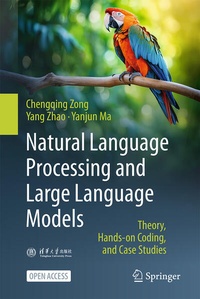
Natural Language Processing and Large Language Models
Description
The open access book unlocks the full potential of Natural Language Processing (NLP) through a comprehensive and hands-on guide that bridges foundational theory and cutting-edge practice. Whether you're a student, researcher, or industry practitioner, it enables you to build and deploy state-of-the-art NLP models-from classical statistical approaches to modern neural architectures and large language models (LLMs)-with confidence and clarity.
Unlike traditional texts that focus solely on concepts, this book offers a practical journey through real-world NLP applications, including sentiment analysis, information extraction, summarization, text matching, question answering, and machine translation. Each chapter is grounded in executable code and datasets, presented in the form of Jupyter Notebooks hosted on Baidu AI Studio. Readers can access free cloud-based resources to run, test, and modify models, making the learning experience interactive and scalable.
Designed for senior undergraduate and graduate students in computer science and AI-related fields, as well as NLP beginners and developers, the book demystifies key concepts such as Transformer, BERT, GPT, ERNIE, and RLHF through step-by-step case studies. It also addresses practical challenges-such as data preprocessing, model fine-tuning, and deployment-that reflect real-world R&D scenarios. Readers don't just learn what works in NLP-they understand how and why it works.
With its task-driven structure, fully tested codebase, and ready-to-use implementations, this book serves as a valuable academic and technical resource for anyone seeking to master applied NLP with modern deep learning techniques.
More details
Persons
Chengqing Zong received the Ph.D. degree in computer science from Institute of Computing Techonology, Chinese Academy of Sciences, China in March 1998. He is currently a professor with Institute of Automation, Chinese Academy of Sciences, China. His research interests include natural language processing, machine translation, and cognitive language computing. He has published more than 200 papers in top-tier conferences and journals. He has authored and co-authored six books, including Text Data Mining, which was published with Springer in 2021. He is a member of the Academia Europaea, IEEE Fellow, and ACL Fellow. He is President of the Association for Computational Linguistics (ACL) in 2025 and was President of the Asian Federation of Natural Language Processing (AFNLP) from 2019 to 2021. He won many awards such as the Second Prize of the National Scientific and Technological Progress Award of China, 2015, one of the most prestigious and influential awards in China.
Yang Zhao received the Ph.D. degree in pattern recognition and intelligent system from Institute of Automation, Chinese Academy of Sciences, China in 2019. He is currently an associate professor with the State Key Laboratory of Multimodal Artificial Intelligence Systems, Institute of Automation, Chinese Academy of Sciences. His research interests include machine translation and natural language processing.
Yanjun Ma received the Ph.D. degree in computer science from Dublin City University in 2009. He currently serves as the General Manager of Baidu AI Platform & Ecosystem, overseeing the development of the open-source deep learning platform PaddlePaddle. His research focuses on natural language processing and deep learning, which is widely used in Baidu's products. Dr. Yanjun Ma has authored and co-authored over 20 research publications and served as the Area Co-Chair for a number of top international conferences. In 2015, Dr. Yanjun Ma received National Technology Advancement Award.
Content
Introduction.- Basics of Neural Network.- Distributed Representation.- Sequence Generation Models.- Basic Language Models.- Pre-trained Large Models.