

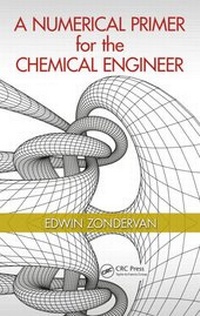
A Numerical Primer for the Chemical Engineer
1st Edition
Published on 12. August 2014
Book
Hardback
193 pages
978-1-4822-2944-8 (ISBN)
Description
Solve Developed Models in a Numerical Fashion
Designed as an introduction to numerical methods for students, A Numerical Primer for the Chemical Engineer explores the role of models in chemical engineering. Combining mathematical correctness (model verification) with numerical performance (model validation), this text concentrates on numerical methods and problem solving, rather than focusing on in-depth numerical analysis. It applies actual numerical solution strategies to formulated process models to help identify and solve chemical engineering problems.
Describe Motions with Accuracy
The book starts with a recap on linear algebra, and uses algorithms to solve linear equations, nonlinear equations, ordinary differential equations, and partial differential equations (PDEs). It includes an introductory chapter on MATLAB (R) basics, contains a chapter on the implementation of numerical methods in Excel, and even adopts MATLAB and Excel as the programming environments throughout the text.
The material addresses implicit and explicit schemes, and explores finite difference and finite volume methods for solving transport PDEs. It covers the methods for error and computational stability, as well as curve fitting and optimization. It also contains a case study chapter with worked out examples to demonstrate the numerical techniques, and exercises at the end of each chapter that students can use to familiarize themselves with the numerical methods.
A Numerical Primer for the Chemical Engineer lays down a foundation for numerical problem solving and sets up a basis for more in-depth modeling theory and applications. This text addresses the needs of senior undergraduates in chemical engineering, and students in applied chemistry and biochemical process engineering/food process engineering.
Designed as an introduction to numerical methods for students, A Numerical Primer for the Chemical Engineer explores the role of models in chemical engineering. Combining mathematical correctness (model verification) with numerical performance (model validation), this text concentrates on numerical methods and problem solving, rather than focusing on in-depth numerical analysis. It applies actual numerical solution strategies to formulated process models to help identify and solve chemical engineering problems.
Describe Motions with Accuracy
The book starts with a recap on linear algebra, and uses algorithms to solve linear equations, nonlinear equations, ordinary differential equations, and partial differential equations (PDEs). It includes an introductory chapter on MATLAB (R) basics, contains a chapter on the implementation of numerical methods in Excel, and even adopts MATLAB and Excel as the programming environments throughout the text.
The material addresses implicit and explicit schemes, and explores finite difference and finite volume methods for solving transport PDEs. It covers the methods for error and computational stability, as well as curve fitting and optimization. It also contains a case study chapter with worked out examples to demonstrate the numerical techniques, and exercises at the end of each chapter that students can use to familiarize themselves with the numerical methods.
A Numerical Primer for the Chemical Engineer lays down a foundation for numerical problem solving and sets up a basis for more in-depth modeling theory and applications. This text addresses the needs of senior undergraduates in chemical engineering, and students in applied chemistry and biochemical process engineering/food process engineering.
More details
Language
English
Place of publication
Oakville
Canada
Target group
College/higher education
Senior undergraduates in chemical engineering, students in applied chemistry, biochemical process engineering/food process engineering.
Illustrations
61 s/w Abbildungen, 14 s/w Tabellen
300 equations; 14 Tables, black and white; 61 Illustrations, black and white
Dimensions
Height: 235 mm
Width: 156 mm
Weight
408 gr
ISBN-13
978-1-4822-2944-8 (9781482229448)
Copyright in bibliographic data and cover images is held by Nielsen Book Services Limited or by the publishers or by their respective licensors: all rights reserved.
Schweitzer Classification
Other editions
New editions
Edwin Zondervan
A Numerical Primer for the Chemical Engineer, Second Edition
Book
08/2019
2nd Edition
CRC Press
€136.66
Shipment within 10-20 days
Person
Edwin Zondervan obtained a bachelor degree in chemical engineering at Noordelijke Hogeschool Leeuwarden. In November 2003 he graduated from Groningen University with an M.Sc. in chemical engineering. In November 2007 he obtained his Ph.D. at Groningen University. Zondervan has published in several journals. He currently acts as a reviewer for the Journal of Membrane Science, Computers and Chemical Engineering, Journal of Environmental Management, Industrial Engineering & Chemistry Research, Separation and Purification Technology, and Recent Patent in Chemical Engineering. From 2007 to 2010 he has worked as an assistant professor at Eindhoven University. He recently moved to the Polymer Reaction Engineering group.
Content
<P><STRONG>The role of models in chemical engineering</STRONG></P>
<P>Introduction</P>
<P>The idea of a model</P>
<P>Model building</P>
<P>Model analysis</P>
<P>Model solution strategies</P>
<P>Summary</P>
<P>Exercises</P><STRONG>
<P>Errors in computer simulations</P></STRONG>
<P>Introduction</P>
<P>Significant digits</P>
<P>Round off and truncation errors</P>
<P>Break errors</P>
<P>Loss of digits</P>
<P>Ill conditioned problems</P>
<P>(Un-)stable methods</P>
<P>Summary</P>
<P>Exercises</P><STRONG>
<P>Linear equations</P></STRONG>
<P>Introduction</P>
<P>MATLAB</P>
<P>Linear systems</P>
<P>The inverse of a matrix</P>
<P>The determinant of a matrix</P>
<P>Useful properties</P>
<P>Matrix ranking</P>
<P>Eigenvalues and eigenvectors</P>
<P>Spectral decomposition</P>
<P>Summary</P>
<P>Exercises</P><STRONG>
<P>Elimination methods</P></STRONG>
<P>Introduction</P>
<P>MATLAB</P>
<P>Gaussian elimination</P>
<P>LU factorization</P>
<P>Summary</P>
<P>Exercises</P><STRONG>
<P>Iterative methods</P></STRONG>
<P>Introduction</P>
<P>Laplace's equation</P>
<P>LU factorization</P>
<P>Iterative methods</P>
<P>The Jacobi method</P>
<P>Example for the Jacobi method</P>
<P>Summary</P>
<P>Exercises</P><STRONG>
<P>Nonlinear equations</P></STRONG>
<P>Introduction </P>
<P>Newton's method D </P>
<P>Newton's method D </P>
<P>Reduced Newton step method</P>
<P>Quasi Newton's method</P>
<P>Summary</P>
<P>Exercises</P><STRONG>
<P>Ordinary di?erential equations</P></STRONG>
<P>Introduction </P>
<P>Euler's method</P>
<P>Accuracy and stability of Euler's method</P>
<P>The implicit Euler method</P>
<P>Stability of the implicit Euler method</P>
<P>Systems of ODE's </P>
<P>Stability of ODE systems</P>
<P>Sti?ness of ODE systems</P>
<P>Higher order methods</P>
<P>Summary</P>
<P>Exercises</P><STRONG>
<P>Partial di?erential equations 1</P></STRONG>
<P>Introduction </P>
<P>Types of PDE's</P>
<P>The method of the lines</P>
<P>Stability </P>
<P>Summary</P>
<P>Exercises</P><STRONG>
<P>Partial di?erential equations 2</P></STRONG>
<P>Introduction</P>
<P>Transport PDE's</P>
<P>Finite Volumes</P>
<P>Discretizing the control volumes</P>
<P>Transfer of heat to ?uid in a pipe</P>
<P>Simulation of the heat PDE</P>
<P>Summary</P>
<P>Exercises</P><STRONG>
<P>Data regression and curve ?tting</P></STRONG>
<P>Introduction</P>
<P>The least squares method</P>
<P>Residual analysis</P>
<P>ANOVA analysis</P>
<P>Con?dence limits</P>
<P>Summary</P>
<P>Exercises</P><STRONG>
<P>Optimization</P></STRONG>
<P>Introduction</P>
<P>Linear programming</P>
<P>Nonlinear programming</P>
<P>Integer programming</P>
<P>Summary</P>
<P>Exercises</P><STRONG>
<P>Basics of Matlab</P></STRONG>
<P>Introduction</P>
<P>The Matlab user interface</P>
<P>The array structure</P>
<P>Basic calculations</P>
<P>Plotting </P>
<P>Reading and writing data</P>
<P>Functions and m-?les</P>
<P>Repetitive operations</P><STRONG>
<P>Numerical methods in Excel</P></STRONG>
<P>Introduction</P>
<P>Basic functions in Excel</P>
<P>The Excel solver</P>
<P>Solving nonlinear equations in Excel</P>
<P>Di?erentiation Excel</P>
<P>Curve ?tting in Excel</P><STRONG>
<P>Case studies</P></STRONG>
<P>Introduction</P>
<P>Modeling a separation system</P>
<P>Modeling a chemical reactor system</P>
<P>PVT behavior of pure substances</P>
<P>Dynamic modeling of a distillation column </P>
<P>Dynamic modeling of an extraction cascade (ODE's)</P>
<P>Distributed parameter models for a tubular reactor</P>
<P>Modeling of an extraction column</P>
<P>Fitting of kinetic data</P>
<P>Fitting of NRTL model parameters</P>
<P>Optimizing a crude oil re?nery</P>
<P>Planning in a manufacturing line</P>
<P>Bibliography</P>
<P>Introduction</P>
<P>The idea of a model</P>
<P>Model building</P>
<P>Model analysis</P>
<P>Model solution strategies</P>
<P>Summary</P>
<P>Exercises</P><STRONG>
<P>Errors in computer simulations</P></STRONG>
<P>Introduction</P>
<P>Significant digits</P>
<P>Round off and truncation errors</P>
<P>Break errors</P>
<P>Loss of digits</P>
<P>Ill conditioned problems</P>
<P>(Un-)stable methods</P>
<P>Summary</P>
<P>Exercises</P><STRONG>
<P>Linear equations</P></STRONG>
<P>Introduction</P>
<P>MATLAB</P>
<P>Linear systems</P>
<P>The inverse of a matrix</P>
<P>The determinant of a matrix</P>
<P>Useful properties</P>
<P>Matrix ranking</P>
<P>Eigenvalues and eigenvectors</P>
<P>Spectral decomposition</P>
<P>Summary</P>
<P>Exercises</P><STRONG>
<P>Elimination methods</P></STRONG>
<P>Introduction</P>
<P>MATLAB</P>
<P>Gaussian elimination</P>
<P>LU factorization</P>
<P>Summary</P>
<P>Exercises</P><STRONG>
<P>Iterative methods</P></STRONG>
<P>Introduction</P>
<P>Laplace's equation</P>
<P>LU factorization</P>
<P>Iterative methods</P>
<P>The Jacobi method</P>
<P>Example for the Jacobi method</P>
<P>Summary</P>
<P>Exercises</P><STRONG>
<P>Nonlinear equations</P></STRONG>
<P>Introduction </P>
<P>Newton's method D </P>
<P>Newton's method D </P>
<P>Reduced Newton step method</P>
<P>Quasi Newton's method</P>
<P>Summary</P>
<P>Exercises</P><STRONG>
<P>Ordinary di?erential equations</P></STRONG>
<P>Introduction </P>
<P>Euler's method</P>
<P>Accuracy and stability of Euler's method</P>
<P>The implicit Euler method</P>
<P>Stability of the implicit Euler method</P>
<P>Systems of ODE's </P>
<P>Stability of ODE systems</P>
<P>Sti?ness of ODE systems</P>
<P>Higher order methods</P>
<P>Summary</P>
<P>Exercises</P><STRONG>
<P>Partial di?erential equations 1</P></STRONG>
<P>Introduction </P>
<P>Types of PDE's</P>
<P>The method of the lines</P>
<P>Stability </P>
<P>Summary</P>
<P>Exercises</P><STRONG>
<P>Partial di?erential equations 2</P></STRONG>
<P>Introduction</P>
<P>Transport PDE's</P>
<P>Finite Volumes</P>
<P>Discretizing the control volumes</P>
<P>Transfer of heat to ?uid in a pipe</P>
<P>Simulation of the heat PDE</P>
<P>Summary</P>
<P>Exercises</P><STRONG>
<P>Data regression and curve ?tting</P></STRONG>
<P>Introduction</P>
<P>The least squares method</P>
<P>Residual analysis</P>
<P>ANOVA analysis</P>
<P>Con?dence limits</P>
<P>Summary</P>
<P>Exercises</P><STRONG>
<P>Optimization</P></STRONG>
<P>Introduction</P>
<P>Linear programming</P>
<P>Nonlinear programming</P>
<P>Integer programming</P>
<P>Summary</P>
<P>Exercises</P><STRONG>
<P>Basics of Matlab</P></STRONG>
<P>Introduction</P>
<P>The Matlab user interface</P>
<P>The array structure</P>
<P>Basic calculations</P>
<P>Plotting </P>
<P>Reading and writing data</P>
<P>Functions and m-?les</P>
<P>Repetitive operations</P><STRONG>
<P>Numerical methods in Excel</P></STRONG>
<P>Introduction</P>
<P>Basic functions in Excel</P>
<P>The Excel solver</P>
<P>Solving nonlinear equations in Excel</P>
<P>Di?erentiation Excel</P>
<P>Curve ?tting in Excel</P><STRONG>
<P>Case studies</P></STRONG>
<P>Introduction</P>
<P>Modeling a separation system</P>
<P>Modeling a chemical reactor system</P>
<P>PVT behavior of pure substances</P>
<P>Dynamic modeling of a distillation column </P>
<P>Dynamic modeling of an extraction cascade (ODE's)</P>
<P>Distributed parameter models for a tubular reactor</P>
<P>Modeling of an extraction column</P>
<P>Fitting of kinetic data</P>
<P>Fitting of NRTL model parameters</P>
<P>Optimizing a crude oil re?nery</P>
<P>Planning in a manufacturing line</P>
<P>Bibliography</P>