

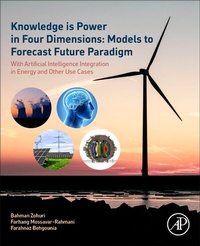
Knowledge is Power in Four Dimensions: Models to Forecast Future Paradigm
With Artificial Intelligence Integration in Energy and Other Use Cases
Published on 12. July 2022
Book
Paperback/Softback
998 pages
978-0-323-95112-8 (ISBN)
Description
Knowledge is Power in Four Dimensions: Models to Forecast Future Paradigms, Forecasting Energy for Tomorrow's World with Mathematical Modeling and Python Programming Driven Artificial Intelligence delivers knowledge on key infrastructure topics in both AI technology and energy. Sections lay the groundwork for tomorrow's computing functionality, starting with how to build a Business Resilience System (BRS), data warehousing, data management, and fuzzy logic. Subsequent chapters dive into the impact of energy on economic development and the environment and mathematical modeling, including energy forecasting and engineering statistics. Energy examples are included for application and learning opportunities.
A final section deliver the most advanced content on artificial intelligence with the integration of machine learning and deep learning as a tool to forecast and make energy predictions. The reference covers many introductory programming tools, such as Python, Scikit, TensorFlow and Kera.
A final section deliver the most advanced content on artificial intelligence with the integration of machine learning and deep learning as a tool to forecast and make energy predictions. The reference covers many introductory programming tools, such as Python, Scikit, TensorFlow and Kera.
More details
Language
English
Place of publication
Oxford
United Kingdom
Publishing group
Elsevier Science & Technology
Target group
Professional and scholarly
Energy engineers; electrical engineers; data scientists; environmental engineers; alternative energy researchers
Product notice
Paperback (trade)
Dimensions
Height: 235 mm
Width: 191 mm
Thickness: 50 mm
Weight
1679 gr
ISBN-13
978-0-323-95112-8 (9780323951128)
Copyright in bibliographic data and cover images is held by Nielsen Book Services Limited or by the publishers or by their respective licensors: all rights reserved.
Schweitzer Classification
Other editions
Additional editions
Bahman Zohuri | Farhang Mossavar Rahmani | Farahnaz Behgounia
Knowledge is Power in Four Dimensions: Models to Forecast Future Paradigm
With Artificial Intelligence Integration in Energy and Other Use Cases
E-Book
07/2022
Academic Press
€175.00
Available for download
Persons
Prof. Bahman Zohuri is an accomplished scientist, engineer, and academic with deep expertise in nuclear engineering, thermodynamics, and applied physics. He serves as an Adjunct Professor at Golden Gate University, where he teaches courses in artificial intelligence and machine learning. Prof. Zohuri holds degrees in Applied Mathematics, Physics, Mechanical Engineering, and Nuclear Engineering from institutions including the University of Illinois and the University of New Mexico. Early in his career, he contributed to advanced research projects at Westinghouse, and later in defense and semiconductor industries, before founding Galaxy Advanced Engineering, Inc. in 1991. Over his career, Prof. Zohuri has authored dozens of technical books and published over a hundred journal articles. He continues to pursue research in fields such as heat transfer, reactor design, computational methods, data mining, and AI-driven engineering solutions. Farahnaz Behgounia is presently a graduate student at Golden Gate University at San Francisco, California and in the process of obtaining her Master of Science degree from the school of Business Analytics. She has obtained her Bachlor Degreee (BS) in pure mathematics and have taught the subject at various schools as an instructor. Ms. Behgounia's present interest is in Artificial Intelligence (AL) and its application in industry along with its sub-component such as Machine Learning (ML) and Deep Leaning (DL). Her recent interest in the subject of AI has directed her into more innovative research in AI and writing various algorithim by utilizing python language for various applications such as E-Commerce,the medical field and others.
Content
Part I: Infrastructure Concepts
1. Knowledge is Power
2. A General Approach to Business Resilience System (BRS)
3. Data Warehousing, Data Mining, Data Modeling, and Data Analytics
4. Structured and Unstructured Data Processing
5. Mathematical Modeling Driven Predication
6. Fuzzy Logics: A New Method of Predictions
7. Neural Network Concept
8. Population - Human Growth Driving Ecology
9. Economic Factors
10. Risk Management, Risk Assessment, and Risk Analysis
11. Today's Fast-Paced Technology
Part II: The Impact of Energy on Tomorrow's World
12. Understanding of Energy
13. Economic Impact of Energy
14. Renewable Energy
15. Non-Renewable Energy
16. Nuclear Energy as Non-Renewable Energy Source
17. Energy Storage Technologies and their Role in Renewable Integration
Part III: The Mathematical Approach and Modeling
18. Predictive Analytics
19. Engineering Statistics
20. Data and Data Collection Driven Information
21. Statistical Forecasting - Regression and Time Series Analysis
22. Introduction to Forecasting: The Simplest Models
23. Notes on Linear Regression Analysis
24. Principles and Risks of Forecasting
25. Artificial Intelligence Driving Predictive and Forecasting Paradigm
Part IV: Python Programming Driven Artificial Intelligence
26. Python Programming Driven Artificial Intelligence
27. Artificial Intelligence, Machine Learning and Deep Learning Driving Big Data
28. Artificial Intelligence, Machine Learning and Deep Learning Use Cases
1. Knowledge is Power
2. A General Approach to Business Resilience System (BRS)
3. Data Warehousing, Data Mining, Data Modeling, and Data Analytics
4. Structured and Unstructured Data Processing
5. Mathematical Modeling Driven Predication
6. Fuzzy Logics: A New Method of Predictions
7. Neural Network Concept
8. Population - Human Growth Driving Ecology
9. Economic Factors
10. Risk Management, Risk Assessment, and Risk Analysis
11. Today's Fast-Paced Technology
Part II: The Impact of Energy on Tomorrow's World
12. Understanding of Energy
13. Economic Impact of Energy
14. Renewable Energy
15. Non-Renewable Energy
16. Nuclear Energy as Non-Renewable Energy Source
17. Energy Storage Technologies and their Role in Renewable Integration
Part III: The Mathematical Approach and Modeling
18. Predictive Analytics
19. Engineering Statistics
20. Data and Data Collection Driven Information
21. Statistical Forecasting - Regression and Time Series Analysis
22. Introduction to Forecasting: The Simplest Models
23. Notes on Linear Regression Analysis
24. Principles and Risks of Forecasting
25. Artificial Intelligence Driving Predictive and Forecasting Paradigm
Part IV: Python Programming Driven Artificial Intelligence
26. Python Programming Driven Artificial Intelligence
27. Artificial Intelligence, Machine Learning and Deep Learning Driving Big Data
28. Artificial Intelligence, Machine Learning and Deep Learning Use Cases