

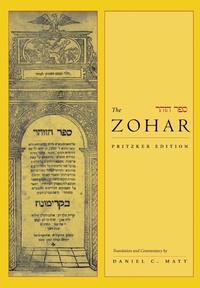
The Zohar
Pritzker Edition, Volume Five
Stanford University Press
Will be published approx. on 21. October 2009
Book
Hardback
656 pages
978-0-8047-6219-9 (ISBN)
Description
Sefer ha-Zohar (The Book of Radiance) has amazed and overwhelmed readers ever since it emerged mysteriously in medieval Spain toward the end of the thirteenth century. Written in a unique, lyrical Aramaic, this masterpiece of Kabbalah exceeds the dimensions of a normal book; it is virtually a body of literature, comprising over twenty discrete sections. The bulk of the Zohar consists of a running commentary on the Torah, from Genesis through Deuteronomy.
This fifth volume of The Zohar: Pritzker Edition opens in the middle of Exodus immediately following the revelation at Mount Sinai. The first chapter features a famous narrative about two rabbis and an old donkey-driver they encounter on the road. This old man seems like a complete ignoramus and pesters them with nonsensical riddles, but he turns out to be a sage and explains to them one of the most tightly guarded secrets of Kabbalah: the reincarnation of the soul. In the course of his exposition, the old man enthralls his two listeners with a romantic account of Torah as a maiden who reveals herself only to one who pursues her lovingly.
The rest of this volume consists mainly of the Zohar's commentary on the biblical description of the mishkan, the Dwelling (or Tabernacle) in the desert. The mishkan symbolizes Shekhinah, the feminine presence of God who "dwells" on earth. Since the Dwelling was the center of worship, the Zohar explores here the theme of prayer.
The volume concludes with one of the shortest yet most important sections of the Zohar-Sifra di-Tsni'uta (The Book of Concealment). This enigmatic and poetic composition contains a veiled description of God's body, focusing on the beard. Its few pages convey the central teachings of Kabbalah, including the balance between male and female energies, and how divine breath animates all that exists.
This fifth volume of The Zohar: Pritzker Edition opens in the middle of Exodus immediately following the revelation at Mount Sinai. The first chapter features a famous narrative about two rabbis and an old donkey-driver they encounter on the road. This old man seems like a complete ignoramus and pesters them with nonsensical riddles, but he turns out to be a sage and explains to them one of the most tightly guarded secrets of Kabbalah: the reincarnation of the soul. In the course of his exposition, the old man enthralls his two listeners with a romantic account of Torah as a maiden who reveals herself only to one who pursues her lovingly.
The rest of this volume consists mainly of the Zohar's commentary on the biblical description of the mishkan, the Dwelling (or Tabernacle) in the desert. The mishkan symbolizes Shekhinah, the feminine presence of God who "dwells" on earth. Since the Dwelling was the center of worship, the Zohar explores here the theme of prayer.
The volume concludes with one of the shortest yet most important sections of the Zohar-Sifra di-Tsni'uta (The Book of Concealment). This enigmatic and poetic composition contains a veiled description of God's body, focusing on the beard. Its few pages convey the central teachings of Kabbalah, including the balance between male and female energies, and how divine breath animates all that exists.
More details
Series
Edition
New edition
Language
English
Place of publication
Palo Alto
United States
Edition type
New edition
Product notice
Cloth
Dimensions
Height: 262 mm
Width: 191 mm
Thickness: 53 mm
Weight
1386 gr
ISBN-13
978-0-8047-6219-9 (9780804762199)
Copyright in bibliographic data and cover images is held by Nielsen Book Services Limited or by the publishers or by their respective licensors: all rights reserved.
Schweitzer Classification
Person
Daniel C. Matt is a leading authority on Jewish mysticism. He served as Professor at the Graduate Theological Union in Berkeley, California and has taught at Stanford University and the Hebrew University of Jerusalem. Matt is the author of The Essential Kabbalah (1996); Zohar: Annotated and Explained (2002); and God and the Big Bang (1996). Matt is also the translator of the first four volumes of The Zohar: Pritzker Edition
Content
@fmct:Contents @toc4:Foreword iii @tocca:Margot Pritzker @toc4:Translator's Introduction iii @tocca:Daniel C. Matt @toc4:Acknowledgments iii Diagram of the Ten Sefirot iii Introduction iii @tocca:Arthur Green @toc2: Haqdamat Sefer ha-Zohar 000 Parashat Be-Reshit 000 Parashat Noah 000 @toc4: List of Abbreviations 000 Transliteration of Hebrew and Aramaic 000 Glossary 000 Bibliography 000 Index 000 Library of Congress Subject Headings for this publication: Bible, O, T, Pentateuch Commentaries Early works to 1800, Cabala Early works to 1800, Zohar