

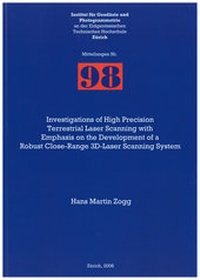
Investigations of High Precision Terrestrial Laser Scanning with Emphasis on the Development of a Robust Close-Range 3D-Laser Scanning System
Published in 2008
Book
Paperback/Softback
171 pages
978-3-906467-78-8 (ISBN)
Unfortunately, price unknown
Article not available
Description
In recent years, numerous measurement systems and techniques have become available on the market for three-dimensional (3D) surveying of objects. Largely due to the increasing need of 3D-data, fast area-wide 3D-measurement methods are in high demand. In the world of surveying and the field of engineering geodesy, terrestrial laser scanning has been established as a newer measurement method for fast, area-wide 3D-surveying. Terrestrial laser scanners measure distances and angles to objects without any contact. The actual geometry information of the scanned object has to be derived from a resulting 3D-point cloud in post-processing.
After the initial hype of terrestrial laser scanning, a slight disillusionment set in. Projects were not profitable or failed due to insufficient knowledge about laser scanning technology and its specifics. In addition, the hardware and software products available on the market often do not meet the requirements of specific applications. Thus, the selection of convenient applications for a particular terrestrial laser scanning system, the sensitivity in terms of environmental conditions, or the extensive post-processing of laser scanning data are just a few of the difficulties in using laser scanning technology. As a result, terrestrial laser scanning is rarely used for projects in engineering geodesy. Even though terrestrial laser scanning offers great potential, new fields of application have yet to be investigated.
This thesis originated from a project addressing the development of a qualified measurement system based on terrestrial laser scanning for the surveying of underground utility caverns in the field of water and sewage engineering. There was no convenient measurement system available on the market when the project started in 2005. There are three main objectives of this thesis: the development of a cost-efficient robust close-range 3D-laser scanning system largely for surveying underground utility caverns, the calibrations and investigations of terrestrial laser scanners with focus on the newly developed measurement system, and the development of new fields of application for terrestrial laser scanning. Moreover, this thesis contributes to the area of terrestrial laser scanning by offering better knowledge on its integration into engineering geodesy.
For the hardware development, the 2D-laser scanner SICK LMS200-30106 by Sick AG was selected and implemented as a distance measurement unit measuring distances and angles. This unit is well known and established in industrial applications and in the field of robotics. In addition, all components that were used for the close-range 3D-laser scanning system were selected according to predefined requirements. These requirements were strongly related to the application of the measurement of underground utility caverns. Furthermore, this thesis shows that an appropriate calibration of the close-range 3D-laser scanning system - the distance measurement unit specifically - allows its application in the field of engineering geodesy. Thus, appropriate calibration routines were developed, and intensive additional investigations of the measurement systems enabled the verification of the measurement accuracy and
performance.
The close-range terrestrial 3D-laser scanner ZLS07 resulted from the development of a 3Dmeasurement system based on the terrestrial laser scanning technology. The ZLS07 is a robust and reliable measurement system that fulfils the requirements focused on surveying of underground utility caverns. Its specific limitations lie in the measurement range, accuracy, and angular resolution. However, the ZLS07 has been successfully established as a new measurement instrument at the surveying department of the city of Zurich. In addition to the hardware developments, an approach for automatic geometry modelling from 3D-point clouds was developed, tested, and discussed for post-processing 3D-point clouds of underground utility caverns. Furthermore, the ZLS07 was successfully used in other applications, such as the damage detection of an incinerator or the reverse engineering of technical constructions.
After the initial hype of terrestrial laser scanning, a slight disillusionment set in. Projects were not profitable or failed due to insufficient knowledge about laser scanning technology and its specifics. In addition, the hardware and software products available on the market often do not meet the requirements of specific applications. Thus, the selection of convenient applications for a particular terrestrial laser scanning system, the sensitivity in terms of environmental conditions, or the extensive post-processing of laser scanning data are just a few of the difficulties in using laser scanning technology. As a result, terrestrial laser scanning is rarely used for projects in engineering geodesy. Even though terrestrial laser scanning offers great potential, new fields of application have yet to be investigated.
This thesis originated from a project addressing the development of a qualified measurement system based on terrestrial laser scanning for the surveying of underground utility caverns in the field of water and sewage engineering. There was no convenient measurement system available on the market when the project started in 2005. There are three main objectives of this thesis: the development of a cost-efficient robust close-range 3D-laser scanning system largely for surveying underground utility caverns, the calibrations and investigations of terrestrial laser scanners with focus on the newly developed measurement system, and the development of new fields of application for terrestrial laser scanning. Moreover, this thesis contributes to the area of terrestrial laser scanning by offering better knowledge on its integration into engineering geodesy.
For the hardware development, the 2D-laser scanner SICK LMS200-30106 by Sick AG was selected and implemented as a distance measurement unit measuring distances and angles. This unit is well known and established in industrial applications and in the field of robotics. In addition, all components that were used for the close-range 3D-laser scanning system were selected according to predefined requirements. These requirements were strongly related to the application of the measurement of underground utility caverns. Furthermore, this thesis shows that an appropriate calibration of the close-range 3D-laser scanning system - the distance measurement unit specifically - allows its application in the field of engineering geodesy. Thus, appropriate calibration routines were developed, and intensive additional investigations of the measurement systems enabled the verification of the measurement accuracy and
performance.
The close-range terrestrial 3D-laser scanner ZLS07 resulted from the development of a 3Dmeasurement system based on the terrestrial laser scanning technology. The ZLS07 is a robust and reliable measurement system that fulfils the requirements focused on surveying of underground utility caverns. Its specific limitations lie in the measurement range, accuracy, and angular resolution. However, the ZLS07 has been successfully established as a new measurement instrument at the surveying department of the city of Zurich. In addition to the hardware developments, an approach for automatic geometry modelling from 3D-point clouds was developed, tested, and discussed for post-processing 3D-point clouds of underground utility caverns. Furthermore, the ZLS07 was successfully used in other applications, such as the damage detection of an incinerator or the reverse engineering of technical constructions.