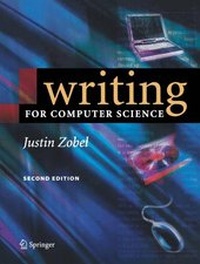
Writing for Computer Science is an introduction to doing and describing - search. For the most part the book is a discussion of good writing style and effective research strategies. Some of the material is accepted wisdom, some is controversial, and some is my opinions. Although the book is brief, it is designed to be comprehensive: some readers may be interested in exploring topics further, but for most readers this book should be suf?cient. The ?rst edition of this book was almost entirely about writing. This e- tion, partly in response to reader feedback and partly in response to issues that arose in my ownexperiences as an advisor, researcher, and referee, is also about research methods. Indeed, the two topics-writing about and doing research- are not clearly separated. It is a small step from asking how do I write? to askingwhatisitthatIwriteabout? As previously, the guidance on writing focuses on research, but much of the material is applicable to general technical and professional communication. Likewise, the guidance on the practice of research has broader lessons. A pr- titioner trying a new algorithm or explaining to colleagues why one solution is preferable to another should be con?dent that the arguments are built on robust foundations. And, while this edition has a stronger emphasis on research than did the ?rst, nothing has been deleted; there is additional material on research, but the guidance on writing has not been taken away.
Reviews / Votes
From the reviews of the second edition:
"Zobel emphasizes that clarity . . my review would read as follows: buy this book. . The contents of the book are valuable, both as a reference . . has tailored his book quite specifically to computer science researchers. He presents valuable examples drawn from computer science papers . . This book is best suited to individual use. However, it could also serve as a supplementary text for a course on research methods. ." (Max Hailperin, Computing Reviews, February, 2005)
"I decided to recommend Zobel's work to my advanced students and Ph.D. candidates. . An extra goody are the twenty exercises. They constitute a good start into raising many of the issues treated in the book. Many chapters give check-lists or lists of good practice. . His own way of writing demonstrates that there are helpful rules no writer should disobey. . Good writing, even in computing science, remains a process of experience and dialectics. Zobel's book proves the point." (Frieder Nake, Zentralblatt MATH, Vol. 1106 (8), 2007)
Edition
Language
Place of publication
Target group
College/higher education
Professional and scholarly
Research
Edition type
Product notice
Illustrations
Dimensions
Height: 23.5 cm
Width: 17.8 cm
Thickness: 15 mm
Weight
ISBN-13
978-1-85233-802-2 (9781852338022)
DOI
10.1007/978-0-85729-422-7
Schweitzer Classification
Contents Preface
Contents
1 Introduction
Kinds of publication
Writing, science, and skepticism
Using this book
Spelling and terminology 2 Good style
Economy
Tone
Examples
Motivation
Balance
Voice
The upper hand
Obfuscation
Analogies
Strawmen
Reference and citation
Quotation
Acknowledgements
Grammar
Beauty 3 Style specifics
Titles and headings
Theopening paragraphs
Variation
Paragraphing
Ambiguity
Sentence structure
Tense
Repetition and parallelism
Emphasis
Definitions
Choice of words
Qualifiers
Misused words
Spelling conventions
Jargon
Cliche and idiom
Foreignwords
Overuse of words
Padding
Plurals
Abbreviations
Acronyms
Sexism 4 Punctuation
Fonts and formatting
Stops
Commas
Colons and semicolons
Apostrophes
Exclamations
Hyphenation
Capitalization
Quotations
Parentheses
Citations 5 Mathematics
Clarity
Theorems
Readability
Notation
Ranges and sequences
Alphabets
Linebreaks
Numbers
Percentages
Units of measurement 6 Graphs, figures, and tables
Graphs
Visualization of results
Diagrams
Tables
Captions and labels
Axes, labels, and headings 7 Algorithms
Presentation of algorithms
Formalisms
Level of detail
Figures
Notation
Environment of algorithms
Performance of algorithms
Asymptotic complexity 8 Editing
Consistency
Style
Proofreading
Choice of word-processor
An editing checklist 9 Writing up
The scope of apaper
Telling a story
Organization
The First draft
Fromdraft to submission
Prepublication
Theses
A writing-up checklist 10 Doing research
Beginnings
Shaping a research project
Students and advisors
Findingresearch literature
Reading
Research planning
Hypotheses
Defending hypotheses
Evidence
Good and bad science
Reflections on research
A research checklist 11 Experimentation
Designing experiments
Measurements and coding
Describing experiments
Variables
Statistics
Intuition
An experimentation checklist 12 Refereeing
Responsibilities
Contribution
Evaluation of papers
Referees' reports
A refereeing checklist 13 Ethics
Plagiarism
Self-plagiarism
Misrepresentation
Authorship
Confidentiality and conflict of interest
Anethics checklist 14 Giving presentations
Content
Organization
The introduction
The conclusion
Preparation
Delivery
Question time
Slides
Slide tools
Text slides
Figures
A presentations checklist
Examples of slides
Afterword
Bibliography
Exercises
Index