

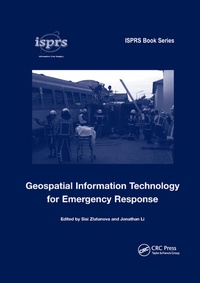
Geospatial Information Technology for Emergency Response
1st Edition
Published on 18. October 2019
Book
Paperback/Softback
394 pages
978-0-367-38779-2 (ISBN)
Description
Disaster management is generally understood to consist of four phases: mitigation, preparedness, response and recovery. While these phases are all important and interrelated, response and recovery are often considered to be the most critical in terms of saving lives. Response is the acute phase occurring after the event, and includes all arrangements to remove detriments and a long-term inventory of supplies to deal with irreversible damage. The timely provision of geospatial information is crucial in the decision-making process, and can save lives and rescue citizens.
The aim of this volume is to share technological advances that allow wider, faster and more effective utilization of geospatial information in emergency response situations. The volume describes current accomplishments and challenges in providing geospatial information with these attributes, and is organized in six parts:
- Practice and legislation, with a focus on the utilization of geospatial information in recent disaster events, as well as resulting legislative attempts to share and access data.
- Data collection and data products.
- Data management and routing in 3D.
- Emerging technologies, including positioning, virtual reality and simulation models.
- Integration of heterogeneous data.
- Applications and solutions.
This volume is aimed at researchers, practitioners and students who work in the variety of disciplines related to geospatial information technology for emergency response, and represents the very best of current thinking from a number of pioneering studies over the past four years.
The aim of this volume is to share technological advances that allow wider, faster and more effective utilization of geospatial information in emergency response situations. The volume describes current accomplishments and challenges in providing geospatial information with these attributes, and is organized in six parts:
- Practice and legislation, with a focus on the utilization of geospatial information in recent disaster events, as well as resulting legislative attempts to share and access data.
- Data collection and data products.
- Data management and routing in 3D.
- Emerging technologies, including positioning, virtual reality and simulation models.
- Integration of heterogeneous data.
- Applications and solutions.
This volume is aimed at researchers, practitioners and students who work in the variety of disciplines related to geospatial information technology for emergency response, and represents the very best of current thinking from a number of pioneering studies over the past four years.
More details
Language
English
Place of publication
London
United Kingdom
Publishing group
Taylor & Francis Ltd
Target group
Professional and scholarly
Academic and Professional Practice & Development
Dimensions
Height: 246 mm
Width: 174 mm
Weight
740 gr
ISBN-13
978-0-367-38779-2 (9780367387792)
Copyright in bibliographic data and cover images is held by Nielsen Book Services Limited or by the publishers or by their respective licensors: all rights reserved.
Schweitzer Classification
Other editions
Additional editions
Book
01/2008
1st Edition
CRC Press
€371.40
Shipment within 15-20 days
Sisi Zlatanova | Jonathan Li
Geospatial Information Technology for Emergency Response
E-Book
01/2008
CRC Press
€92.49
Available for download
Sisi Zlatanova | Jonathan Li
Geospatial Information Technology for Emergency Response
E-Book
01/2008
CRC Press
€92.49
Available for download
Persons
Sisi Zlatanova, Jonathan Li
Content
Part 1: Practice and legislation Improving geospatial information in disaster management through action on lessons learned from major events, Legal aspects of using space-derived geospatial information for emergency response, with particular reference to the Charter on Space and Major Disasters, Part 2: Data collection and products Real-time data collection and information generation using airborne sensors, Satellite remote sensing for near-real time data collection, Terrestrial mobile mapping towards real-time geospatial data collection, Part 3: Data management and routing in 3D Real time and spatiotemporal data indexing for sensor based databases, A 3D data model and topological analyses for emergency response in urban areas J. Lee & S. Zlatanova Multidimensional and dynamic vehicle emergency routing algorithm based on 3D GIS, Part 4: Positioning, virtual reality and simulation 3D positioning systems for emergency response, Virtual Reality for training and collaboration in emergency management, Visual analytics in flood forecasting M. Jern Part 5: Integration of heterogeneous data The semantic mismatch as limiting factor for the use of geospatial information in disaster management and emergency response, CityGML - 3D city models and their potential for emergency response, Integrated emergency management: Experiences and challenges of a national geospatial information provider, Ordnance Survey, Part 6: Applications and solutions The value of Gi4DM for transport and water management, A decision support system for the preventive evacuation of people in a dike-ring area, GIS technology and applications for the fire services.