

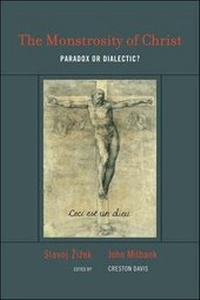
The Monstrosity of Christ
Paradox or Dialectic?
Published on 1. April 2009
Book
Hardback
320 pages
978-0-262-01271-3 (ISBN)
Description
"What matters is not so much that Zizek is endorsing a demythologized,
disenchanted Christianity without transcendence, as that he is offering in the end (despite what he
sometimes claims) a heterodox version of Christian belief."--John Milbank"To put it even
more bluntly, my claim is that it is Milbank who is effectively guilty of heterodoxy, ultimately of
a regression to paganism: in my atheism, I am more Christian than Milbank."--Slavoj
ZizekIn this corner, philosopher Slavoj Zizek, a militant atheist who represents
the critical-materialist stance against religion's illusions; in the other corner, "Radical
Orthodox" theologian John Milbank, an influential and provocative thinker who argues that
theology is the only foundation upon which knowledge, politics, and ethics can stand. In The
Monstrosity of Christ, Zizek and Milbank go head to head for three rounds, employing an
impressive arsenal of moves to advance their positions and press their respective advantages. By the
closing bell, they have not only proven themselves worthy adversaries, they have shown that faith
and reason are not simply and intractably opposed. Zizek has long been interested in the
emancipatory potential offered by Christian theology. And Milbank, seeing global capitalism as the
new century's greatest ethical challenge, has pushed his own ontology in more political and
materialist directions. Their debate in The Monstrosity of Christ concerns the future of religion,
secularity, and political hope in light of a monsterful event--God becoming human. For the first
time since Zizek's turn toward theology, we have a true debate between an atheist and a
theologian about the very meaning of theology, Christ, the Church, the Holy Ghost, Universality, and
the foundations of logic. The result goes far beyond the popularized atheist/theist
point/counterpoint of recent books by Christopher Hitchens, Richard Dawkins, and others.
Zizek begins, and Milbank answers, countering dialectics with "paradox." The
debate centers on the nature of and relation between paradox and parallax, between analogy and
dialectics, between transcendent glory and liberation. Slavoj Zizek is a philosopher and
cultural critic. He has published over thirty books, including Looking Awry, The Puppet and the
Dwarf, and The Parallax View (these three published by the MIT Press). John Milbank is an
influential Christian theologian and the author of Theology and Social Theory: Beyond Secular Reason
and other books. Creston Davis, who conceived of this encounter, studied under both Zizek
and Milbank.
disenchanted Christianity without transcendence, as that he is offering in the end (despite what he
sometimes claims) a heterodox version of Christian belief."--John Milbank"To put it even
more bluntly, my claim is that it is Milbank who is effectively guilty of heterodoxy, ultimately of
a regression to paganism: in my atheism, I am more Christian than Milbank."--Slavoj
ZizekIn this corner, philosopher Slavoj Zizek, a militant atheist who represents
the critical-materialist stance against religion's illusions; in the other corner, "Radical
Orthodox" theologian John Milbank, an influential and provocative thinker who argues that
theology is the only foundation upon which knowledge, politics, and ethics can stand. In The
Monstrosity of Christ, Zizek and Milbank go head to head for three rounds, employing an
impressive arsenal of moves to advance their positions and press their respective advantages. By the
closing bell, they have not only proven themselves worthy adversaries, they have shown that faith
and reason are not simply and intractably opposed. Zizek has long been interested in the
emancipatory potential offered by Christian theology. And Milbank, seeing global capitalism as the
new century's greatest ethical challenge, has pushed his own ontology in more political and
materialist directions. Their debate in The Monstrosity of Christ concerns the future of religion,
secularity, and political hope in light of a monsterful event--God becoming human. For the first
time since Zizek's turn toward theology, we have a true debate between an atheist and a
theologian about the very meaning of theology, Christ, the Church, the Holy Ghost, Universality, and
the foundations of logic. The result goes far beyond the popularized atheist/theist
point/counterpoint of recent books by Christopher Hitchens, Richard Dawkins, and others.
Zizek begins, and Milbank answers, countering dialectics with "paradox." The
debate centers on the nature of and relation between paradox and parallax, between analogy and
dialectics, between transcendent glory and liberation. Slavoj Zizek is a philosopher and
cultural critic. He has published over thirty books, including Looking Awry, The Puppet and the
Dwarf, and The Parallax View (these three published by the MIT Press). John Milbank is an
influential Christian theologian and the author of Theology and Social Theory: Beyond Secular Reason
and other books. Creston Davis, who conceived of this encounter, studied under both Zizek
and Milbank.
More details
Series
Language
English
Place of publication
Cambridge, Mass.
United States
Publishing group
MIT Press Ltd
Target group
Adult education
Dimensions
Height: 229 mm
Width: 152 mm
Thickness: 0 mm
Weight
454 gr
ISBN-13
978-0-262-01271-3 (9780262012713)
Copyright in bibliographic data and cover images is held by Nielsen Book Services Limited or by the publishers or by their respective licensors: all rights reserved.
Schweitzer Classification
Other editions
Additional editions
E-Book
02/2011
MIT Press
€29.49
Available for download