

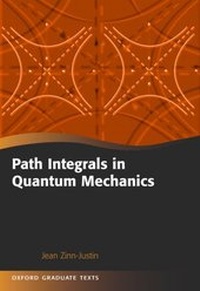
Path Integrals in Quantum Mechanics
Published on 8. July 2010
Book
Paperback/Softback
336 pages
978-0-19-856675-5 (ISBN)
Description
The main goal of this work is to familiarize the reader with a tool, the path integral, that offers an alternative point of view on quantum mechanics, but more important, under a generalized form, has become the key to a deeper understanding of quantum field theory and its applications, which extend from particle physics to phase transitions or properties of quantum gases.
Path integrals are mathematical objects that can be considered as generalizations to an infinite number of variables, represented by paths, of usual integrals. They share the algebraic properties of usual integrals, but have new properties from the viewpoint of analysis.
Path integrals are powerful tools for the study of quantum mechanics, because they emphasize very explicitly the correspondence between classical and quantum mechanics.
Physical quantities are expressed as averages over all possible paths but, in the semi-classical limit, the leading contributions come from paths close to classical paths. Thus, path integrals lead to an intuitive understanding and simple calculations of physical quantities in the semi-classical limit. We will illustrate this observation with scattering processes, spectral properties or barrier penetration.
The formulation of quantum mechanics based on path integrals, if it seems mathematically more complicated than the usual formulation based on partial differential equations, is well adapted to systems with many degrees of freedom, where a formalism of Schroedinger type is much less useful. It allows a simple construction of a many-body theory both for bosons and fermions.
Path integrals are mathematical objects that can be considered as generalizations to an infinite number of variables, represented by paths, of usual integrals. They share the algebraic properties of usual integrals, but have new properties from the viewpoint of analysis.
Path integrals are powerful tools for the study of quantum mechanics, because they emphasize very explicitly the correspondence between classical and quantum mechanics.
Physical quantities are expressed as averages over all possible paths but, in the semi-classical limit, the leading contributions come from paths close to classical paths. Thus, path integrals lead to an intuitive understanding and simple calculations of physical quantities in the semi-classical limit. We will illustrate this observation with scattering processes, spectral properties or barrier penetration.
The formulation of quantum mechanics based on path integrals, if it seems mathematically more complicated than the usual formulation based on partial differential equations, is well adapted to systems with many degrees of freedom, where a formalism of Schroedinger type is much less useful. It allows a simple construction of a many-body theory both for bosons and fermions.
Reviews / Votes
... an exceptionally clear and thorough book ... should be about as good a book on the subject as one could imagine. * John Chalker, University of Oxford * ... very well written ... and not only pedagogically useful, but also useful to the experienced practitioner. * Randall Kamien, University of Pennsylvania *More details
Series
Language
English
Place of publication
Oxford
United Kingdom
Target group
College/higher education
Illustrations
20 b/w line illustrations
Dimensions
Height: 241 mm
Width: 168 mm
Thickness: 19 mm
Weight
560 gr
ISBN-13
978-0-19-856675-5 (9780198566755)
Copyright in bibliographic data and cover images is held by Nielsen Book Services Limited or by the publishers or by their respective licensors: all rights reserved.
Schweitzer Classification
Other editions
Additional editions
Jean Zinn-Justin
Path Integrals in Quantum Mechanics
Book
11/2004
Oxford University Press
€151.91
Shipment within 15-20 days
Jean Zinn-Justin
Path Integrals in Quantum Mechanics
E-Book
11/2004
1st Edition
OUP Oxford
€83.29
Available for download
Person
Professor Jean Zinn-Justin
Head of Department, Dapnia, CEA/Saclay, France
Head of Department, Dapnia, CEA/Saclay, France
Content
QUANTUM MECHANICS: MINIMAL BACKGROUND