

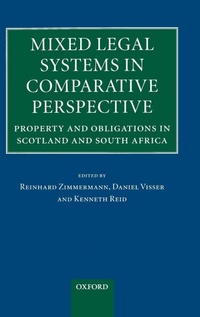
Mixed Legal Systems in Comparative Perspective
Property and Obligations in Scotland and South Africa
Published on 10. March 2005
Book
Hardback
900 pages
978-0-19-927100-9 (ISBN)
Description
Placed uniquely at the intersection of common law and civil law, mixed legal systems are today attracting the attention both of scholars of comparative law, and of those concerned with the development of a European private law. Pre-eminent among the mixed legal systems are those of Scotland and South Africa.
In South Africa the Roman-Dutch law, brought to the Cape by the Dutch East India Company in 1652 was, from the early nineteenth century onwards, infused with and re-moulded by the common law of the British imperial master. In Scotland a more gradual and elusive process saw the Roman-Scots law of the early modern period fall under the influence of English law after the Act of Union in 1707. The result, in each case, was a system of law which drew from both of the great European traditions whilst containing distinctive elements of its own.
This volume sets out to compare the effects of this historical development by assessing whether shared experience has led to shared law. Key topics from the law of property and obligations are examined, collaboratively and comparatively, by teams of leading experts from both jurisdictions. The individual chapters reveal an intricate pattern of similarity and difference, enabling courts and legal writers in Scotland and South Africa to learn from the experience of a kindred jurisdiction. They also, in a number of areas, reveal an emerging and distinctive jurisprudence of mixed systems, and thus suggest viable answers to some of the great questions which must be answered on the path towards a European private law.
In South Africa the Roman-Dutch law, brought to the Cape by the Dutch East India Company in 1652 was, from the early nineteenth century onwards, infused with and re-moulded by the common law of the British imperial master. In Scotland a more gradual and elusive process saw the Roman-Scots law of the early modern period fall under the influence of English law after the Act of Union in 1707. The result, in each case, was a system of law which drew from both of the great European traditions whilst containing distinctive elements of its own.
This volume sets out to compare the effects of this historical development by assessing whether shared experience has led to shared law. Key topics from the law of property and obligations are examined, collaboratively and comparatively, by teams of leading experts from both jurisdictions. The individual chapters reveal an intricate pattern of similarity and difference, enabling courts and legal writers in Scotland and South Africa to learn from the experience of a kindred jurisdiction. They also, in a number of areas, reveal an emerging and distinctive jurisprudence of mixed systems, and thus suggest viable answers to some of the great questions which must be answered on the path towards a European private law.
Reviews / Votes
The depth of analysis, the approach and the international scholarly cooperation this book reflects make it a wonderful example of how to do comparative law. * Jan M. Smits, Rabels Zeitschrift Vol 72, 2 * ..written with thoughtfulness, care, and enthusiasm.. * Edinburgh Law Review * This splendid volume, the product of some fifty jurists of largely Scottish and South African origins, under the guidance of Reinhard Zimmermann, Daniel Visser and Kenneth Reid, is testimony to the remarkable resilience of major, transnational legal traditions and their ability to survive and prosper in the face of colonialist and nationalist restraints...The book is devoted to substantive private law and is devided into three Parts, treating successively Contract (the largest Part), Delict and other Obligations arising by Law, and Property...The main interest of the volume for South African and Scottish lawyers..will be in the deailed, comparative reflection on the content of each national law...this book is significant and welcome.. * Thomas Finkenauer *More details
Language
English
Place of publication
Oxford
United Kingdom
Target group
Professional and scholarly
Dimensions
Height: 240 mm
Width: 161 mm
Thickness: 55 mm
Weight
1576 gr
ISBN-13
978-0-19-927100-9 (9780199271009)
Copyright in bibliographic data and cover images is held by Nielsen Book Services Limited or by the publishers or by their respective licensors: all rights reserved.
Schweitzer Classification
Persons
Reinhard Zimmermann is Director of the Max-Planck-Institute of Comparative Private Law and Private International Law in Hamburg, and Professor of Private Law, Roman Law and Comparative Legal History at the University of Regensburg.
Kenneth Reid is Professor of Property Law at the University of Edinburgh, and has been a Scottish Law Commissioner since 1995.
Daniel Visser is Professor in the Faculty of Law at the University of Cape Town.
Kenneth Reid is Professor of Property Law at the University of Edinburgh, and has been a Scottish Law Commissioner since 1995.
Daniel Visser is Professor in the Faculty of Law at the University of Cape Town.
Content
Introduction ; PART 1: CONTRACT ; Formation ; Defects of Consent ; Interpretation ; Illegality ; Jus Quaesitum Tertio / Stipulatio Alteri ; Good Faith ; Breach ; Sale ; Surety / Caution ; Agency ; Hire / Lease ; PART 2: DELICT ; Overview ; Negligence ; Strict Liability ; Defamation ; Neighbour Law ; Disgorgement of Benefits as a Result of Wrongs ; PART 3: OBLIGATIONS ARISING NEITHER FROM CONTRACT NOR FROM DELICT ; Unjustified Enrichment ; Restitution following Failed Contracts ; Negotiorum Gestio ; PART 4: PROPERTY ; Overview ; Acquisition of Ownership ; Co-ownership ; Servitudes ; Good Faith ; Rights in Security ; Trusts ; Cession / Assignation