

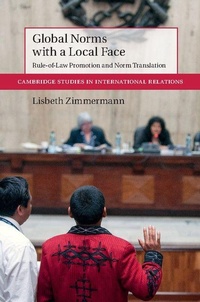
Global Norms with a Local Face
Rule-of-Law Promotion and Norm Translation
Published on 3. August 2017
Book
Hardback
314 pages
978-1-107-17204-3 (ISBN)
Description
To what extent are global rule-of-law norms, which external actors promote in post-conflict states, localized? Who decides whether global standards or local particularities prevail? This book offers a new approach to the debate about how the dilemma between the diffusion of global norms and their localization is dealt with in global politics. Studying the promotion of children's rights, access to public information, and an international commission against impunity in Guatemala, Lisbeth Zimmermann demonstrates that rule-of-law promotion triggers domestic contestation and thereby changes the approach taken by external actors, and ultimately the manner in which global norms are translated. However, the leeway in local translation is determined by the precision of global norms. Based on an innovative theoretical approach and an in-depth study of rule-of-law translation, Zimmermann argues for a shift in norm promotion from context sensitivity to democratic appropriation, speaking to scholars of international relations, peacebuilding, democratization studies, international law, and political theory.
More details
Series
Language
English
Place of publication
Cambridge
United Kingdom
Target group
Professional and scholarly
Dimensions
Height: 235 mm
Width: 157 mm
Thickness: 22 mm
Weight
613 gr
ISBN-13
978-1-107-17204-3 (9781107172043)
Copyright in bibliographic data and cover images is held by Nielsen Book Services Limited or by the publishers or by their respective licensors: all rights reserved.
Schweitzer Classification
Other editions
Additional editions
E-Book
08/2017
Cambridge University Press
€77.49
Available for download
E-Book
07/2017
Cambridge University Press
€93.49
Available for download
Person
Lisbeth Zimmermann is a senior researcher at the Peace Research Institute in Frankfurt. She is an external lecturer at Goethe University Frankfurt and is affiliated with the university's Cluster of Excellence 'Formation of Normative Orders'.
Content
Contents; Tables; Figures; List of abbreviations; Acknowledgements; 1. Introduction: between global norms and local translation: 1.1 Shortcomings of the state of the art; 1.2 The argument: interactive norm-translation; 1.3 Design; 1.4 Making translation more democratic?; 1.5 Data collection and analysis; 1.6 Outline of the book; 2. To socialize or to localize?: 2.1 Norm socialization; asymmetric interaction; 2.2 Norm localization: local agency only; 2.3 Beyond existing norm-diffusion research; 2.4 Acknowledging the interactive element; 3. Guatemala and the international community: 3.1 External actors in war-torn Guatemala; 3.2 Guatemala today: engulfed by violence?; 3.3 A difficult relationship: domestic contestation of rule-of-law promotion; 4. Translating children's rights: 4.1 The Convention on the Rights of the Child: the shift to a rights-based approach; 4.2 Interactive translation of the CRC in Guatemala: in search of a family-based approach; 4.3 Reshaping children's rights; 5. Translating a right to access information: 5.1 The development of a global right to information; 5.2 Interactive ATI translation in Guatemala: securing justice or fighting corruption?; 5.3 Reshaping access to information; 6. Translating scripts for rule-of-law commissions: 6.1 Emerging scripts for rule-of-law commissions; 6.2 Translating the UN scripts: human rights or the fight against crime?; 6.3 Reshaping the rule of law in Guatemala; 7. Towards an interactive perspective on norm-translation: 7.1 Moving norm-translation research forward; 7.2 A research agenda for norm translation; 7.3 Shifting coordinates; 8. Balancing global norms and local faces: 8.1 Global norms with a local face: is translation 'a good thing'?; 8.2 Making appropriation (more) democratic; References; Annex 1: list of interview partners; Annex 2: presidential administrations since democratization in Guatemala; Annex 3: data selection media discourses; Discourse on children's rights; Discourse on right to access information; Discourse on scripts for rule-of-law commission.