

Story Operators
Description
Story Operators develops a rigorous mathematical framework for narrative analysis and transformation built on Reproducing Kernel Hilbert Space (RKHS) theory--the same mathematics powering modern AI. Texts become points in a high-dimensional semantic space where similarity has a precise definition, geometry replaces guesswork, and transformations follow proven mathematical laws.
The framework rests on three pillars: fifteen positive semi-definite narrative kernels (cosine, RBF, Global Alignment, scene co-occurrence, theme activation, and composites); thirty-four bounded linear Story Operators across Doctrine, Fiction, and Poetry domains; and a 768- to 1024-dimensional embedding space populated by sentence-transformer feature maps. Every kernel is proven valid; every operator is non-expansive on the unit sphere; every claim is implementation-ready.
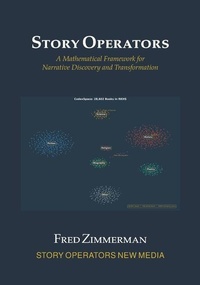
Empirical validation comes from CodexSpace, a working 28,602-book RKHS universe derived from the PG-19 corpus, with extensions to Books3 (52,796 modern works) and the Internet Archive IB1 corpus (452,796 volumes). Twenty-five learned clusters recover ten major literary genres covering 88.3 percent of the corpus; ten Doctrine Morphing operators applied to 105 strategic doctrines yield sixteen validated novel concepts; RKHS-First publishing produces +60 to +89 percent improvements over conventional pipelines.
For publishers acquisition efficiency, competitive intelligence at scale, and navigation of large catalogs by mathematical proximity rather than category guesswork.
For creators the hidden geometry of stories--how narratives cluster, how transformations work, where unexplored territory lies.
For mathematicians and computer scientists formal theorems with proofs, conjectures including the Universal Story Conjecture and Tversky-Challenge, optimal-transport adaptation distances, and worked examples from Romeo and Juliet to West Side Story and Hamlet to The Lion King.
For practitioners complete reference implementations, the open RKHS file format with federation protocols, the deployed Semantic Novelty Toolkit at bigfivekiller.online, and a thirty-three-chapter path from Hilbert-space fundamentals to running production code.
Five appendices catalog formal definitions, every operator with its formula, an extensive bibliography, a glossary for non-mathematicians, and the RKHS Codextype Taxonomy. The 329-page Second Edition (Version 2.0.1) integrates findings from six research papers and production experience from the twenty-nine-book RKHS Integrated Series.
Story Operators is the foundational volume for a new mathematical discipline at the intersection of computational narratology, kernel methods, and modern publishing--in which stories are no longer mysterious but measurab