

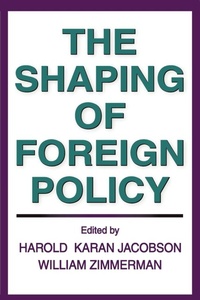
The Shaping of Foreign Policy
1st Edition
Published on 15. March 2008
Book
Paperback/Softback
224 pages
978-0-202-30995-8 (ISBN)
Description
How are foreign policy decisions made? This volume shows the various approaches to answer this question. In their introduction, Jacobson and Zimmerman make clear the goals and techniques of the comparative analysis of foreign policy behavior and, following this, they provide seven basic essays exemplifying, with variations, the principal approaches used to explain foreign policy behavior: the systemic, the environmental, the societal, the governmental, and the idiosyncratic (or psychological).
Jan F. Triska and David D. Finley illustrate the systemic approach as applied to Soviet-American relations. Harold and Margaret Sprout then deal with the significance of the physical environment in the study of international politics. Two essays follow--by, respectively, Karl W. Deutsch and Gabriel A. Almond--representing the merger of international and comparative studies in this field. The contribution by Henry A. Kissinger examines the relationship of certain governmental systems to foreign policy behavior.
The editors' introduction and selections reflect excitingly and accurately the "state of the art" of comparative foreign policy analysis and place before the reader, in clear and compact form, the continuing dialogue among scholars about one of the most controversial areas in the study of political processes.
Jan F. Triska and David D. Finley illustrate the systemic approach as applied to Soviet-American relations. Harold and Margaret Sprout then deal with the significance of the physical environment in the study of international politics. Two essays follow--by, respectively, Karl W. Deutsch and Gabriel A. Almond--representing the merger of international and comparative studies in this field. The contribution by Henry A. Kissinger examines the relationship of certain governmental systems to foreign policy behavior.
The editors' introduction and selections reflect excitingly and accurately the "state of the art" of comparative foreign policy analysis and place before the reader, in clear and compact form, the continuing dialogue among scholars about one of the most controversial areas in the study of political processes.
More details
Language
English
Place of publication
Somerset
United States
Publishing group
Taylor & Francis Inc
Target group
College/higher education
Dimensions
Height: 229 mm
Width: 152 mm
Thickness: 13 mm
Weight
371 gr
ISBN-13
978-0-202-30995-8 (9780202309958)
Copyright in bibliographic data and cover images is held by Nielsen Book Services Limited or by the publishers or by their respective licensors: all rights reserved.
Schweitzer Classification
Other editions
Additional editions
William Zimmerman
The Shaping of Foreign Policy
Book
07/2017
1st Edition
Routledge
€206.30
Shipment within 10-20 days
Person
Harold Karan Jacobson (1929-2001) was professor of political science and Director of the International Organization Program at the University of Michigan. Throughout his career he has held research grants from the Social Science Research Council and the Rockefeller Foundation, and has been a World Affairs Center Fellow. In addition to writing and editing several books on American foreign policy, international organizations, and foreign policy behavior, Jacobson contributed numerous articles to scholarly and professional journals and was a member of the editorial boards of the Journal of Conflict Resolution and International Organization. William Zimmerman is professor of political science, research professor at the Center for Political Studies, and research scientist at the Center for Russian and East European Studies all at the University of Michigan. His research interests include comparative government and politics and world politics/international relations. His most recent book is The Russian People and Foreign Policy: Mass and Elite Perspectives, 1993-2000.
Content
Preface, Approaches to the Analysis of Foreign Policy Behavior, 1: Soviet-American Relations: A Multiple Symmetry Model, 2: Environmental Factors in the Study of International Politics, 3: Toward an Inventory of Basic Trends and Patterns in Comparative and International Politics, 4: A Developmental Approach to Political Systems, 5: Domestic Structure and Foreign Policy, 6: National Images and International Systems, 7: Assumptions of Rationality and Nonrationality in Models of the International System, For Further Reading: A Bibliographical Note, Index