

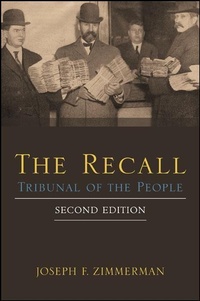
The Recall
Tribunal of the People
2nd Edition
Published on 1. January 2014
Book
Hardback
223 pages
978-1-4384-4925-8 (ISBN)
Description
In-depth study of the recall, the most important popular device allowing voters to remove unresponsive elected officials from office.
The recall, or "election in reverse," is meant to allow voters to remove an elected official from office prior to the completion of his/her term in office. In this revised second edition of The Recall, Joseph F. Zimmerman examines the rise of the recall in the United States and its use by American voters. Proponents of the recall believe the threat of removal from office would ensure that elected officials would act in accord with the public's will, while opponents fear their use would disrupt and inhibit public officers in the performance of their duties. Zimmerman provides a detailed analysis of how the recall has functioned in practice and discovers that the recall has seldom been employed against elected state officials. Although used more often against local government officials, the rate is still not exceptionally high when one considers the extremely large number of elected officials. After a century of use in the United States, the recall has not produced a new era of public official responsibility as hoped for by proponents, but neither has it caused extensive disruption of state and local governments, the original concern of early opponents.
The recall, or "election in reverse," is meant to allow voters to remove an elected official from office prior to the completion of his/her term in office. In this revised second edition of The Recall, Joseph F. Zimmerman examines the rise of the recall in the United States and its use by American voters. Proponents of the recall believe the threat of removal from office would ensure that elected officials would act in accord with the public's will, while opponents fear their use would disrupt and inhibit public officers in the performance of their duties. Zimmerman provides a detailed analysis of how the recall has functioned in practice and discovers that the recall has seldom been employed against elected state officials. Although used more often against local government officials, the rate is still not exceptionally high when one considers the extremely large number of elected officials. After a century of use in the United States, the recall has not produced a new era of public official responsibility as hoped for by proponents, but neither has it caused extensive disruption of state and local governments, the original concern of early opponents.
More details
Edition
Second Edition
Language
English
Place of publication
Albany, NY
United States
Target group
US School Grade: College Graduate Student and over
Product notice
Unsewn / adhesive bound
Paper over boards
Illustrations
6 Tables, black and white; 5 Figures
Dimensions
Height: 238 mm
Width: 163 mm
Thickness: 22 mm
Weight
498 gr
ISBN-13
978-1-4384-4925-8 (9781438449258)
Copyright in bibliographic data and cover images is held by Nielsen Book Services Limited or by the publishers or by their respective licensors: all rights reserved.
Schweitzer Classification
Other editions
Additional editions
E-Book
12/2013
1st Edition
De Gruyter
from
€84.99
Available for download
Person
Joseph F. Zimmerman is Professor of Political Science at the University at Albany, State University of New York. His many books include State-Local Governmental Interactions; Interstate Cooperation, Second Edition: Compacts and Administrative Agreements; and Interstate Water Compacts: Intergovernmental Efforts to Manage America's Water Resources, all published by SUNY Press.
Content
List of Illustrations
Preface
1. The Sovereign Citizen
2. The Legal Foundation
3. Recall of State Government Officers
4. Recall of Local Government Officers
5. The Recall: An Evaluation
6. A Model for Voter Sovereignty
Notes
Bibliography
Index
Preface
1. The Sovereign Citizen
2. The Legal Foundation
3. Recall of State Government Officers
4. Recall of Local Government Officers
5. The Recall: An Evaluation
6. A Model for Voter Sovereignty
Notes
Bibliography
Index