

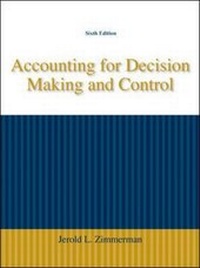
Accounting for Decision Making and Control
6th Edition
Published on 16. May 2008
Book
Hardback
752 pages
978-0-07-337948-7 (ISBN)
Description
Accounting for Decision Making and Control provides students and managers with an understanding and appreciation of the strengths and limitations of an organization's accounting system which allows them to be more intelligent users of these systems. The 6th edition provides a framework for thinking about accounting systems and a basis for analyzing proposed changes to these systems. The text demonstrates that managerial accounting is an integral part of the firm's organizational architecture, not just an isolated set of computational topics. This new edition has improved its readability and accessibility to students.
More details
Edition
6th edition
Language
English
Place of publication
United States
Publishing group
McGraw-Hill Education - Europe
Target group
College/higher education
Dimensions
Height: 262 mm
Width: 216 mm
Thickness: 36 mm
Weight
1501 gr
ISBN-13
978-0-07-337948-7 (9780073379487)
Copyright in bibliographic data and cover images is held by Nielsen Book Services Limited or by the publishers or by their respective licensors: all rights reserved.
Schweitzer Classification
Other editions
Previous edition
Jerold Zimmerman
Accounting for Decision Making and Control
Book
05/2005
5th Edition
McGraw Hill Higher Education
€142.36
Article exhausted; check for reprint
Person
Research and teaching interests involve financial and managerial accounting. He and Professor Ross L. Watts received American Institute of Certified Public Accountants Awards in 1979 and 1980 for their joint papers. He received the American Accounting Association award for Seminal Contribution to Accounting Literature in 2004. He was the 1978 winner of the Competitive Manuscript Award, sponsored by the American Accounting Association, for his paper, "The Costs and Benefits of Cost Allocation." His research, which has come to be called "positive theories of accounting," seeks to understand the costs and benefits of various accounting procedures. He and Watts co-authored a book, Positive Accounting Theory, published by Prentice-Hall in 1986.
Content
Chapter 1: IntroductionChapter 2: The nature of costsChapter 3: Opportunity cost of capital and capital budgetingChapter 4: Organizational architectureChapter 5: Responsibility accounting and transfer pricingChapter 6: Budgets and budgetingChapter 7: Cost allocation: TheoryChapter 8: Cost allocation: PracticesChapter 9: Absorption cost systemChapter 10: Criticisms of absorption cost systems: Incentives to overproduceChapter 11: Criticisms of absorption cost systems: Inaccurate product costsChapter 12: Standard costs: Direct labor and materialsChapter 13: Overhead and marketing variancesChapter 14: Management accounting in a changing environment