

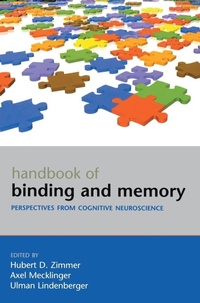
Handbook of Binding and Memory
Perspectives from Cognitive Neuroscience
Published on 22. June 2006
Book
Hardback
752 pages
978-0-19-852967-5 (ISBN)
Description
The creation and consolidation of a memory can rest on the integration of any number of possibly disparate features and contexts - colour, sound, emotion, arousal, context. How is it that these bind together to form a coherent memory? What is the role of binding in memory formation? What are the neural processes that underlie binding? Do these binding processes change with age?
This book offers an unrivalled overview of one of the most debated hotspots of modern memory research: binding. It contains 28 chapters on binding in different domains of memory, presenting classic research from the field of cognitive neuroscience. It is written by renowned scientists and leaders in the field who have made fundamental contributions to the rapidly expanding field of neurocognitive memory research. As well as presenting a state-of-the-art account of recent views on binding and its importance for remembering, it also includes a review of recent publications in the area, of benefit to both students and active researchers. More than just a survey, it supplies the reader with an integrative view on binding in memory, fostering deep insights not only into the processes and their determinants, but also into the neural mechanisms enabling these processes.
The content also encompasses a wide range of binding-related topics, including feature binding, the binding of items and contexts during encoding and retrieval, the specific roles of familiarity and recollection, as well as task- and especially age-related changes in these processes. A major section is dedicated to in-depth analyses of underlying neural mechanisms, focusing on both medial temporal and prefrontal structures. Computational approaches are covered as well.
For all students and researchers in memory, the book will not only enhance their understanding of binding, but will instigate innovative and pioneering ideas for future research.
This book offers an unrivalled overview of one of the most debated hotspots of modern memory research: binding. It contains 28 chapters on binding in different domains of memory, presenting classic research from the field of cognitive neuroscience. It is written by renowned scientists and leaders in the field who have made fundamental contributions to the rapidly expanding field of neurocognitive memory research. As well as presenting a state-of-the-art account of recent views on binding and its importance for remembering, it also includes a review of recent publications in the area, of benefit to both students and active researchers. More than just a survey, it supplies the reader with an integrative view on binding in memory, fostering deep insights not only into the processes and their determinants, but also into the neural mechanisms enabling these processes.
The content also encompasses a wide range of binding-related topics, including feature binding, the binding of items and contexts during encoding and retrieval, the specific roles of familiarity and recollection, as well as task- and especially age-related changes in these processes. A major section is dedicated to in-depth analyses of underlying neural mechanisms, focusing on both medial temporal and prefrontal structures. Computational approaches are covered as well.
For all students and researchers in memory, the book will not only enhance their understanding of binding, but will instigate innovative and pioneering ideas for future research.
Reviews / Votes
The publication of this volume marks the coming of age of cognitive neuroscience. The quest for the Holy Grail in psychology, the neural patterns encoding our daily experiences, has never seemed more close to fulfilment. It is hoped that the unique blend of experimental psychology and imaging neuroscience in this handbook will enthuse more graduate students and researchers to allocate their grey matter to the remaining grey areas. * The Psychologist *More details
Language
English
Place of publication
Oxford
United Kingdom
Target group
College/higher education
Professional and scholarly
Illustrations
8 pp colour plates; numerous line illustrations
Dimensions
Height: 250 mm
Width: 175 mm
Thickness: 44 mm
Weight
1453 gr
ISBN-13
978-0-19-852967-5 (9780198529675)
Copyright in bibliographic data and cover images is held by Nielsen Book Services Limited or by the publishers or by their respective licensors: all rights reserved.
Schweitzer Classification
Persons
Editor
, Department of Psychology, Brain and Cognition Unit, Saarland University, Saarbruecken, Germany
, Department of Psychology, Experimental Neuropsychology Unit, Saarland University, Saarbruecken, Germany
, Director, Centre for Lifespan Psychology, Max Planck Institute for Human Development, Berlin, Germany
Content
SECTION I - NEURAL MECHANISMS OF BINDING ; SECTION II - A COMPUTATIONAL APPROACH TO MECHANISMS OF BINDING ; SECTION III - BINDING IN PERCEPTION AND KNOWLEDGE REPRESENTATION ; SECTION IV - BINDING PROCESSES DURING RETRIEVAL ; SECTION V - BINDING IN THE AGING BRAIN