

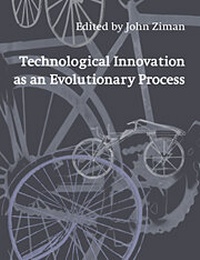
Technological Innovation as an Evolutionary Process
Published on 28. March 2000
Book
Hardback
398 pages
978-0-521-62361-2 (ISBN)
Description
Technological artefacts and biological organisms 'evolve' by very similar processes of blind variation and selective retention. This analogy is explored systematically, for the first time, by a team of international experts from evolutionary biology, history and sociology of science and technology, cognitive and computer science, economics, psychology, education, cultural anthropology and research management. Do technological 'memes' play the role of genes? In what sense are novel inventions 'blind'? Does the element of design make them 'Lamarckian' rather than 'Darwinian'? Is the recombination of ideas the essence of technological creativity? Can invention be simulated computationally? What are the entities that actually evolve - artefacts, ideas or organisations? These are only some of the many questions stimulated and partially answered by this powerful metaphor. With its practical demonstration of the explanatory potential of 'evolutionary reasoning' in a well-defined context, this book is a ground-breaking contribution to every discipline concerned with cultural change.
Reviews / Votes
'... an important and novel contribution to the development of evolutionary theory ...'. Research PolicyMore details
Language
English
Place of publication
Cambridge
United Kingdom
Target group
Professional and scholarly
Illustrations
4 Tables, unspecified; 17 Halftones, unspecified; 24 Line drawings, unspecified
Dimensions
Height: 255 mm
Width: 181 mm
Thickness: 30 mm
Weight
950 gr
ISBN-13
978-0-521-62361-2 (9780521623612)
Copyright in bibliographic data and cover images is held by Nielsen Book Services Limited or by the publishers or by their respective licensors: all rights reserved.
Schweitzer Classification
Other editions
New editions
Book
09/2003
Cambridge University Press
€115.10
Shipment within 15-20 days
Additional editions
Book
09/2003
Cambridge University Press
€115.10
Shipment within 15-20 days
Person
Content
Preface; Part I. Evolutionary Thinking: 1. Evolutionary models for technological change John Ziman; 2. Biological evolution: processes and phenomena Eva Jablonka and John Ziman; 3. Lamarckian inheritance systems in biology: a source of metaphors and models in technological evolution Eva Jablonka; 4. Selectionism and complexity John Ziman; 5. Evolutionary phenomena in technological change Joel Mokyr; 6. Selection criteria and selection processes in cultural evolution theories Richard Nelson; Part II. Innovation as a Cultural Practice: 7. Technological evolution and involution; a preliminary comparison of Europe and Japan Alan Macfarlane and Sarah Harrison; 8. Stasis in complex artefacts Gerry Martin; 9. Gothic tales of spandrels, hooks, and monsters: complexity, multiplicity and association in the explanation of technological change David Turnbull; 10. Path dependence and varieties of learning in the evolution of technological practice Paul A. David; Part III. Invention as a Process: 11. Invention and evolution: the case of Edison's sketches of the telephone W. Bernard Carlson; 12. The evolution of adaptive form David Perkins; 13. Real-world variation-selection in the volution of technological form: historical examples Walter G. Vincenti; 14. Learning to be inventive: design, evaluation and selection in primary school technology Joan Solomon; 15. Technological evolution as self-fulfilling prophecy Geoffrey Miller; Part IV. Institutionalized Innovation: 16. Recursive practice and the evolution of technological knowledge Edward W. Constant II; 17. The concept of 'design space' Rikard Stankiewicz; 18. Artefact<->activity: the co-evolution of artefacts, knowledge and organization in technological innovation James Fleck; 19. The organization of innovative enterprises Gerard Fairclough; Part V. Technological Change in a Wider Perspective: 20. The evolution of war and technology Edward W. Constant II; 21. Learning about technology in society: developing liberating literacy Janet Davies Burns; 22. An end-word; contributors; Bibliography; Index.