

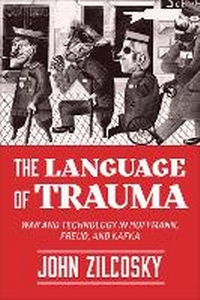
The Language of Trauma
War and Technology in Hoffmann, Freud, and Kafka
Published on 14. June 2021
Book
Hardback
277 pages
978-1-4875-0939-2 (ISBN)
Description
From the Napoleonic Wars to the invention of the railway to the shell shock of World War I, writers tried to give voice to the suffering that war and industrial technology had wrought all around them. Yet they, like the doctors who treated these victims, repeatedly ran up against the incapacity of language to describe such anguish; those who suffered trauma, those who tried to heal it, and those who represented it were all unable to find the appropriate words. In The Language of Trauma, John Zilcosky uncovers the reactions of three major central European writers - E.T.A. Hoffmann, Sigmund Freud, and Franz Kafka - to the birth of modern trauma in the nineteenth and early twentieth centuries.
Zilcosky makes the case that Hoffmann, Freud, and Kafka managed to find the language of trauma precisely by not attempting to name the trauma conclusively and instead allowing their writing to mimic the experience itself. Just as the victims' symptoms seemed not to correspond to a physical cause, the writers' words did not connect directly to the objects of the world. While doctors attempted to overcome this indeterminacy, these writers embraced and investigated it; they sought a language that described language's tragic limits and that, in so doing, exemplified the wider literary and philosophical crisis of their time. Zilcosky boldly argues that this linguistic scepticism emerged together with the medical inability to name the experience of trauma. He thereby places trauma where it belongs: at the heart of both medicine's diagnostic predicament and modern literature's most daring experiments.
Zilcosky makes the case that Hoffmann, Freud, and Kafka managed to find the language of trauma precisely by not attempting to name the trauma conclusively and instead allowing their writing to mimic the experience itself. Just as the victims' symptoms seemed not to correspond to a physical cause, the writers' words did not connect directly to the objects of the world. While doctors attempted to overcome this indeterminacy, these writers embraced and investigated it; they sought a language that described language's tragic limits and that, in so doing, exemplified the wider literary and philosophical crisis of their time. Zilcosky boldly argues that this linguistic scepticism emerged together with the medical inability to name the experience of trauma. He thereby places trauma where it belongs: at the heart of both medicine's diagnostic predicament and modern literature's most daring experiments.
Reviews / Votes
"Zilcosky's book is field-transforming and makes clear for the first time how Hoffman, Freud, and Kafka were hinting at traumatic symptoms in their stories, how they foregrounded the indeterminacy of language, and how they struggled to reveal the unintelligible symptoms of the traumas experienced in their time period." - Susan E. Gustafson, University of Rochester-NY (Monatshefte)More details
Language
English
Place of publication
Toronto
Canada
Target group
College/higher education
Professional and scholarly
Illustrations
10 b&w illustrations
Dimensions
Height: 235 mm
Width: 159 mm
Thickness: 17 mm
Weight
420 gr
ISBN-13
978-1-4875-0939-2 (9781487509392)
Copyright in bibliographic data and cover images is held by Nielsen Book Services Limited or by the publishers or by their respective licensors: all rights reserved.
Schweitzer Classification
Person
John Zilcosky is a professor of German and Comparative Literature at the University of Toronto.
Content
Acknowledgments
List of Illustrations
Introduction: Literature, Trauma, and the Sign of Illness
1. Hoffmann at the Battle of Dresden: "The Sandman" and the Napoleonic Wars
2. Freud and World War I: The Uncanny Trauma of Contagion
3. Inexplicable Tears: Trains, Wars, and Kafka's Aesthetic of Indeterminacy
Conclusion: The Poetics of Trauma: Simulation, Causality, and the Crisis of Insurance
Notes
Index
List of Illustrations
Introduction: Literature, Trauma, and the Sign of Illness
1. Hoffmann at the Battle of Dresden: "The Sandman" and the Napoleonic Wars
2. Freud and World War I: The Uncanny Trauma of Contagion
3. Inexplicable Tears: Trains, Wars, and Kafka's Aesthetic of Indeterminacy
Conclusion: The Poetics of Trauma: Simulation, Causality, and the Crisis of Insurance
Notes
Index