

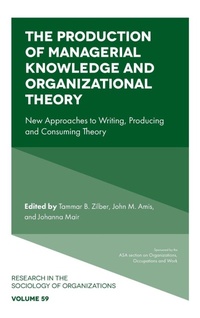
The Production of Managerial Knowledge and Organizational Theory
New Approaches to Writing, Producing and Consuming Theory
Published on 11. April 2019
Book
Hardback
296 pages
978-1-78769-184-1 (ISBN)
Description
As organizational scholars, we are accustomed to using theoretical lenses to understand organizational practices and outcomes. That is, we conceptualize what people do, feel and think in their everyday organizational interactions through the use of theoretical language and models to uncover individual and/or social antecedents and outcomes. We tend to ignore, however, how our own day-to-day work as scholars - doing research - is subjected to the same pressures, affected by similar factors, and should be accounted for through similar modes of analyses. We treat our studies and theories as solid anchor points and as objective truths rather than as constructions embedded within individual, organizational, field and societal contexts.
This volume is a must read for all researchers interested in understanding our own craft. Building on established traditions in the sociology of knowledge, we direct a reflective and critical gaze towards the structures, practices and meaning systems that ground and shape how we produce and consume managerial knowledge and organization theory. The volume includes both empirically-based papers and reflective essays that explore theoretical concepts and analytical reasoning to explain, critique and advance the ways in which we write about, produce, and consume theory.
This volume is a must read for all researchers interested in understanding our own craft. Building on established traditions in the sociology of knowledge, we direct a reflective and critical gaze towards the structures, practices and meaning systems that ground and shape how we produce and consume managerial knowledge and organization theory. The volume includes both empirically-based papers and reflective essays that explore theoretical concepts and analytical reasoning to explain, critique and advance the ways in which we write about, produce, and consume theory.
More details
Series
Language
English
Place of publication
Bingley
United Kingdom
Target group
Professional and scholarly
Dimensions
Height: 235 mm
Width: 157 mm
Thickness: 21 mm
Weight
582 gr
ISBN-13
978-1-78769-184-1 (9781787691841)
Copyright in bibliographic data and cover images is held by Nielsen Book Services Limited or by the publishers or by their respective licensors: all rights reserved.
Schweitzer Classification
Other editions
Additional editions
Tammar B. Zilber | John M. Amis | Johanna Mair
The Production of Managerial Knowledge and Organizational Theory
New Approaches to Writing, Producing and Consuming Theory
E-Book
04/2019
1st Edition
Emerald Publishing Limited
€89.99
Available for download
Persons
Tammar B. Zilber is Associate Professor of Organization Theory at the Jerusalem Business School, Hebrew University, Israel.
John Amis is Professor of Strategic Management and Organisation and Co-Director of the Centre for Strategic Leadership at the University of Edinburgh Business School, UK.
Johanna Mair is a Professor of Organization, Strategy and Leadership at the Hertie School of Governance in Berlin, Germany.
John Amis is Professor of Strategic Management and Organisation and Co-Director of the Centre for Strategic Leadership at the University of Edinburgh Business School, UK.
Johanna Mair is a Professor of Organization, Strategy and Leadership at the Hertie School of Governance in Berlin, Germany.
Content
Introduction: Dismantling the Master's House Using the Master's Tools: On the Sociology of Organizational Knowledge; Tammar B. Zilber, John M. Amis and Johanna Mair 1. Pragmatism in Organizations: Ambivalence and Limits; Wolfgang Seibel
2. The Problem of De-contextualization in Organization and Management Research; Gregory Jackson, Markus Helfen, Rami Kaplan, Anja Kirsch and Nora Lohmeyer
3. Reframing Rigor as Reasoning: Challenging Technocratic Conceptions of Rigor in Management Research; Bill Harley and Joep Cornelissen
4. Knowledge Production and Consumption in the Digital Era: The Emergence of Altmetrics and Open Access Publishing in Management Studies; Trin Thananusak and Shaz Ansari
5. Peer Review and the Production of Scholarly Knowledge: Automated Textual Analysis of Manuscripts Revised for Publication in Administrative Science Quarterly; David Strang and Fedor Dokshin
6. The (Re?)Emergence of New Ideas in the Field of Organizational Studies; Ulla Eriksson-Zetterquist
7. A Discourse Perspective on Creating Organizational Knowledge: The Case of Strategizing; Maurizio Floris, David Grant and Cliff Oswick
8. When Fieldwork Hurts: On the Lived Experience of Conducting Research in Unsettling Contexts; Laura Claus, Mark de Rond, Jennifer Howard-Grenville and Jan Lodge
9. Visual Artefacts as Tools for Analysis and Theorizing; Ann Langley and Davide Ravasi
10. Presenting Findings from Qualitative Research: "One Size Does Not Fit All!"; Trish Reay, Asma Zafar, Pedro Monteiro and Vern Glasser
11. For Social Reflexivity in Organization and Management Theory; Chris Carter and Crawford Spence
12. 'Through the Looking Glass': on Phantasmal Tales, Distortions and Reflexivity in Organizational Scholarship; Barbara Gray
13. When Research and Personal Lifeworlds Collide; April L. Wright and Carla Wright
2. The Problem of De-contextualization in Organization and Management Research; Gregory Jackson, Markus Helfen, Rami Kaplan, Anja Kirsch and Nora Lohmeyer
3. Reframing Rigor as Reasoning: Challenging Technocratic Conceptions of Rigor in Management Research; Bill Harley and Joep Cornelissen
4. Knowledge Production and Consumption in the Digital Era: The Emergence of Altmetrics and Open Access Publishing in Management Studies; Trin Thananusak and Shaz Ansari
5. Peer Review and the Production of Scholarly Knowledge: Automated Textual Analysis of Manuscripts Revised for Publication in Administrative Science Quarterly; David Strang and Fedor Dokshin
6. The (Re?)Emergence of New Ideas in the Field of Organizational Studies; Ulla Eriksson-Zetterquist
7. A Discourse Perspective on Creating Organizational Knowledge: The Case of Strategizing; Maurizio Floris, David Grant and Cliff Oswick
8. When Fieldwork Hurts: On the Lived Experience of Conducting Research in Unsettling Contexts; Laura Claus, Mark de Rond, Jennifer Howard-Grenville and Jan Lodge
9. Visual Artefacts as Tools for Analysis and Theorizing; Ann Langley and Davide Ravasi
10. Presenting Findings from Qualitative Research: "One Size Does Not Fit All!"; Trish Reay, Asma Zafar, Pedro Monteiro and Vern Glasser
11. For Social Reflexivity in Organization and Management Theory; Chris Carter and Crawford Spence
12. 'Through the Looking Glass': on Phantasmal Tales, Distortions and Reflexivity in Organizational Scholarship; Barbara Gray
13. When Research and Personal Lifeworlds Collide; April L. Wright and Carla Wright