

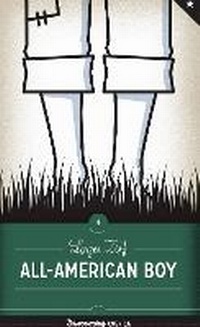
All-American Boy
Published on 1. October 2012
Book
Hardback
154 pages
978-0-292-73892-8 (ISBN)
Description
From his celebrated appearance, hatchet in hand, in Parson Mason Locke Weems's Life of Washington to Booth Tarkington's Penrod, the all-American boy was an iconic figure in American literature for well over a century. Sometimes he was a "good boy," whose dutiful behavior was intended as a model for real boys to emulate. Other times, he was a "bad boy," whose mischievous escapades could be excused either as youthful exuberance that foreshadowed adult industriousness or as deserved attacks on undemocratic pomp and pretension. But whether good or bad, the all-American boy was a product of the historical moment in which he made his appearance in print, and to trace his evolution over time is to take a fresh view of America's cultural history, which is precisely what Larzer Ziff accomplishes in All-American Boy.
Ziff looks at eight classic examples of the all-American boy-young Washington, Rollo, Tom Bailey, Tom Sawyer, Ragged Dick, Peck's "bad boy," Little Lord Fauntleroy, and Penrod-as well as two notable antitheses-Huckleberry Finn and Holden Caulfield. Setting each boy in a rich cultural context, Ziff reveals how the all-American boy represented a response to his times, ranging from the newly independent nation's need for models of democratic citizenship, to the tales of rags-to-riches beloved during a century of accelerating economic competition, to the recognition of adolescence as a distinct phase of life, which created a stage on which the white, middle-class "solid citizen" boy and the alienated youth both played their parts.
Ziff looks at eight classic examples of the all-American boy-young Washington, Rollo, Tom Bailey, Tom Sawyer, Ragged Dick, Peck's "bad boy," Little Lord Fauntleroy, and Penrod-as well as two notable antitheses-Huckleberry Finn and Holden Caulfield. Setting each boy in a rich cultural context, Ziff reveals how the all-American boy represented a response to his times, ranging from the newly independent nation's need for models of democratic citizenship, to the tales of rags-to-riches beloved during a century of accelerating economic competition, to the recognition of adolescence as a distinct phase of life, which created a stage on which the white, middle-class "solid citizen" boy and the alienated youth both played their parts.
Reviews / Votes
"Larzer Ziff has a critical method, the one recommended by T. S. Eliot, that of being very intelligent... A sentence by Ziff is worth more than a paragraph by most other scholar-critics." Denis Donoghue, University Professor and Henry James Chair of English and American Letters at New York University "As a whole, Ziff's book offers important cultural contexts for these famous American boys...This study will be of particular interest to those interested in childhood studies, but it also offers a distinct view on US cultural history for all Americanists through its study of the American boy as he morphs from sage truth-teller to angry young man." - ChoiceMore details
Series
Language
English
Place of publication
Austin, TX
United States
Target group
Professional and scholarly
Product notice
With dust jacket
Dimensions
Height: 229 mm
Width: 140 mm
Thickness: 33 mm
Weight
399 gr
ISBN-13
978-0-292-73892-8 (9780292738928)
Copyright in bibliographic data and cover images is held by Nielsen Book Services Limited or by the publishers or by their respective licensors: all rights reserved.
Schweitzer Classification
Person
Larzer Ziff is the author of a number of books on American literary culture, including Mark Twain; Return Passages: Great American Travel Writing, 1780-1910; and The American 1890s: Life and Times of a Lost Generation, which won the Christian Gauss Award. He has also edited modern editions of major American authors, including Franklin, Hawthorne, Melville, Thoreau, Emerson, Crane, and Dreiser. He was the first person to have been appointed to the English faculty of Oxford University for the purpose of teaching American literature. Ziff is Caroline Donovan Professor Emeritus at Johns Hopkins University.
Content
Introduction
One. The New Nation: Young Washington, Rollo
Two. All-Americans: Tom Bailey, Tom Sawyer
Three. City Life: Ragged Dick, Peck's Bad Boy, Little Lord Fauntleroy
Four. America as Middle Class: Penrod
Five. Antitheses: Huckleberry Finn, Holden Caulfield
Acknowledgments
Notes
Index
One. The New Nation: Young Washington, Rollo
Two. All-Americans: Tom Bailey, Tom Sawyer
Three. City Life: Ragged Dick, Peck's Bad Boy, Little Lord Fauntleroy
Four. America as Middle Class: Penrod
Five. Antitheses: Huckleberry Finn, Holden Caulfield
Acknowledgments
Notes
Index