

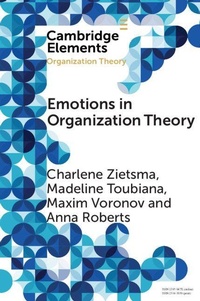
Emotions in Organization Theory
Published on 11. April 2019
Book
Paperback/Softback
108 pages
978-1-108-46823-7 (ISBN)
Description
Emotions are central to social life and thus they should be central to organization theory. However, emotions have been treated implicitly rather than theorized directly in much of organization theory, and in some literatures, have been ignored altogether. This Element focuses on emotions as intersubjective, collective and relational, and reviews structuralist, people-centered and strategic approaches to emotions in different research streams to provide one of the first broad examinations of emotions in organization theory. Charlene Zietsma, Maxim Voronov, Madeline Toubiana and Anna Roberts provide suggestions for future research within each literature and look across the literatures to identify theoretical and methodological considerations.
More details
Series
Language
English
Place of publication
Cambridge
United Kingdom
Target group
Professional and scholarly
Product notice
Paperback (trade)
Illustrations
Worked examples or Exercises; 2 Tables, black and white; 3 Plates, color
Dimensions
Height: 229 mm
Width: 152 mm
Thickness: 7 mm
Weight
170 gr
ISBN-13
978-1-108-46823-7 (9781108468237)
Copyright in bibliographic data and cover images is held by Nielsen Book Services Limited or by the publishers or by their respective licensors: all rights reserved.
Schweitzer Classification
Other editions
Additional editions

Charlene Zietsma
Emotions in Organization Theory
E-Book
04/2019
Cambridge University Press
€14.49
Available for download
Charlene Zietsma | Madeline Toubiana | Maxim Voronov
Emotions in Organization Theory
E-Book
04/2019
Cambridge University Press
€17.49
Available for download
Persons
Content
1. Introduction - emotions in organization theory; 2. Theories featuring substantial work on emotions - institutional theory, social movement theory, identity, and organizational culture, power and control; 3. Theories featuring more limited work on emotions - densemaking, practice theory, network theory and entrepreneurship; 4. Theories where consideration of emotions is nearly absent - organizational economics, economic sociology and embeddedness, organizational ecology, categories and resource dependence theory; 5. Conclusions.