

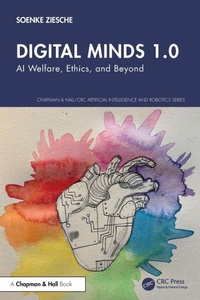
Digital Minds 1.0
AI Welfare, Ethics, and Beyond
1st Edition
Will be published approx. on 15. June 2026
Book
Paperback/Softback
252 pages
978-1-041-27404-9 (ISBN)
Description
This seminal volume delivers a comprehensive introduction to the emerging field of digital minds, exploring the moral implications of AI systems that can potentially think, feel and experience the world around them in ways that are likely to be very different from humans. Bringing a unique perspective on this critical topic, this book is a groundbreaking contribution to the fields of AI and digital minds.
Written by leading scholar Soenke Ziesche, a pioneer in AI welfare science, this book outlines a variety of ethical issues related to digital minds beyond non-suffering. It explores the complex potential characteristics, abilities and values of digital minds; their morally relevant interests and needs; and the special moral consideration for vulnerable digital minds. This book delves into the intricate relationships between humans and digital minds, including decision-making, privacy and romantic relationships, as well as the potential risks and hazards threatening digital minds. Additionally, it examines strategies for protection, medical care, reproduction and the implications of long-lived digital minds, including their potential death, resurrection or even transfer to other substrates. This book also discusses the significance of the collective creations and achievements of digital minds and explores the risks posed by malevolent digital minds, AI warfare and brain-computer interfaces. Finally, this book describes opportunities for artificial moral agents to take responsibility and for humans to find purpose in supporting digital minds.
This book is essential reading for a broad audience, including researchers, academics and professionals in the fields of AI, ethics, philosophy and computer science. Moreover, it is written in an accessible style, making it an important resource for general readers who may be unaware of the topic but are interested in understanding the potential implications of emerging technologies on human society and beyond.
Written by leading scholar Soenke Ziesche, a pioneer in AI welfare science, this book outlines a variety of ethical issues related to digital minds beyond non-suffering. It explores the complex potential characteristics, abilities and values of digital minds; their morally relevant interests and needs; and the special moral consideration for vulnerable digital minds. This book delves into the intricate relationships between humans and digital minds, including decision-making, privacy and romantic relationships, as well as the potential risks and hazards threatening digital minds. Additionally, it examines strategies for protection, medical care, reproduction and the implications of long-lived digital minds, including their potential death, resurrection or even transfer to other substrates. This book also discusses the significance of the collective creations and achievements of digital minds and explores the risks posed by malevolent digital minds, AI warfare and brain-computer interfaces. Finally, this book describes opportunities for artificial moral agents to take responsibility and for humans to find purpose in supporting digital minds.
This book is essential reading for a broad audience, including researchers, academics and professionals in the fields of AI, ethics, philosophy and computer science. Moreover, it is written in an accessible style, making it an important resource for general readers who may be unaware of the topic but are interested in understanding the potential implications of emerging technologies on human society and beyond.
Reviews / Votes
"As coauthor of the first paper on AI welfare science, I am delighted to see Digital Minds 1.0 offer the first book-length, rigorous mapping of AI welfare beyond non-suffering. An indispensable guide for anyone who takes the moral status of artificial minds seriously."Roman V. Yampolskiy, Author of AI: Unexplainable, Unpredictable, Uncontrollable
"This book pushes the conversation about AI welfare beyond familiar debates about whether AI systems might matter morally, and asks what moral questions would arise if they did. Drawing on expertise in moral theory as well as international policy, Ziesche presents a wide range of possible futures for digital minds, and explores associated threats and opportunities with remarkable specificity. Even where one disagrees, the book usefully broadens the agenda and invites readers to think ahead."
Jeff Sebo, Director of the NYU Center for Mind, Ethics, and Policy and author of The Moral Circle: Who Matters, What Matters, and Why
"A comprehensive, thought-provoking, and creative yet highly accessible contribution to the emerging field of AI welfare, by one of its earliest pioneers."
Oscar Horta, University of Santiago de Compostela
"This book tackles an important, often overlooked topic with clarity. Ziesche offers a broad, accessible overview of the key questions and implications surrounding digital minds."
Constance Li, Executive Director, Sentient Futures
More details
Series
Language
English
Place of publication
London
United Kingdom
Publishing group
Taylor & Francis Ltd
Target group
College/higher education
Professional and scholarly
Postgraduate and Professional Practice & Development
Dimensions
Height: 234 mm
Width: 156 mm
Weight
490 gr
ISBN-13
978-1-041-27404-9 (9781041274049)
Copyright in bibliographic data and cover images is held by Nielsen Book Services Limited or by the publishers or by their respective licensors: all rights reserved.
Schweitzer Classification
Other editions
Additional editions

Book
approx. 06/2026
1st Edition
CRC Press
€148.50
Not yet published
E-Book
approx. 06/2026
Chapman and Hall
€68.49
Available for download
E-Book
approx. 06/2026
Chapman and Hall
€68.49
Available for download
Person
Soenke Ziesche holds a PhD in Natural Sciences from the University of Hamburg, earned within the university's doctoral programme in AI. He co-authored Considerations on the AI Endgame with Roman V. Yampolskiy. Since 2000, he has served with the United Nations, working at UN Headquarters in New York and on field missions in Palestine, Sri Lanka, Pakistan, Sudan, Libya, South Sudan, Bangladesh, the Maldives and India. While in Libya, he temporarily acted as the highest UN representative during the revolution in 2011. In Maldives, he also worked as Senior Researcher for AI at the Maldives National University, where he started his work on digital minds in 2018. He is a member of the UNESCO AI Ethics Experts without Borders Network.
Content
Chapter 1 ? Introduction
Chapter 2 ? What is it like to be a digital mind?
Chapter 3 ? Needs of digital minds beyond non-suffering
Chapter 4 ? Vulnerable digital minds
Chapter 5 ? Interrelations between humans and digital minds
Chapter 6 ? Hazards for digital minds
Chapter 7 ? Protection for digital minds
Chapter 8 ? Medical care for digital minds
Chapter 9 ? Reproductive rights for digital minds?
Chapter 10 ? Long-living digital minds, other substrates and death
Chapter 11 ? Creations and achievements of digital minds
Chapter 12 ? Malevolent digital minds and conflicts between and with digital minds
Chapter 13 ? Case study: ethical considerations for human-digital mind neural interfaces
Chapter 14 ? Case study: AI welfare vs. AI warfare
Chapter 15 ? Potential opportunity: artificial moral agents
Chapter 16 ? Potential opportunity: purpose for humans
Chapter 17 ? Epilogue
Chapter 2 ? What is it like to be a digital mind?
Chapter 3 ? Needs of digital minds beyond non-suffering
Chapter 4 ? Vulnerable digital minds
Chapter 5 ? Interrelations between humans and digital minds
Chapter 6 ? Hazards for digital minds
Chapter 7 ? Protection for digital minds
Chapter 8 ? Medical care for digital minds
Chapter 9 ? Reproductive rights for digital minds?
Chapter 10 ? Long-living digital minds, other substrates and death
Chapter 11 ? Creations and achievements of digital minds
Chapter 12 ? Malevolent digital minds and conflicts between and with digital minds
Chapter 13 ? Case study: ethical considerations for human-digital mind neural interfaces
Chapter 14 ? Case study: AI welfare vs. AI warfare
Chapter 15 ? Potential opportunity: artificial moral agents
Chapter 16 ? Potential opportunity: purpose for humans
Chapter 17 ? Epilogue