

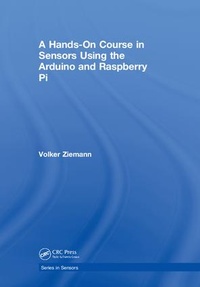
A Hands-On Course in Sensors Using the Arduino and Raspberry Pi
1st Edition
Published on 21. February 2018
Book
Hardback
240 pages
978-0-8153-9359-7 (ISBN)
Description
A Hands-On Course in Sensors using the Arduino and Raspberry Pi is the first book to give a practical and wide-ranging account of how to interface sensors and actuators with micro-controllers, Raspberry Pi and other control systems. The author describes the progression of raw signals through conditioning stages, digitization, data storage and presentation.
The collection, processing, and understanding of sensor data plays a central role in industrial and scientific activities. This book builds simplified models of large industrial or scientific installations that contain hardware and other building blocks, including services for databases, web servers, control systems, and messaging brokers. A range of case studies are included within the book, including a weather station, geophones, a water-colour monitor, capacitance measurement, the profile of laser beam, and a remote-controlled and fire-seeking robot
This book is suitable for advanced undergraduate and graduate students taking hands-on laboratory courses in physics and engineering. Hobbyists in robotics clubs and other enthusiasts will also find this book of interest.
Features:
Includes practical, hands-on exercises that can be conducted in student labs, or even at home
Covers the latest software and hardware, and all code featured in examples is discussed in detail
All steps are illustrated with practical examples and case studies to enhance learning
The collection, processing, and understanding of sensor data plays a central role in industrial and scientific activities. This book builds simplified models of large industrial or scientific installations that contain hardware and other building blocks, including services for databases, web servers, control systems, and messaging brokers. A range of case studies are included within the book, including a weather station, geophones, a water-colour monitor, capacitance measurement, the profile of laser beam, and a remote-controlled and fire-seeking robot
This book is suitable for advanced undergraduate and graduate students taking hands-on laboratory courses in physics and engineering. Hobbyists in robotics clubs and other enthusiasts will also find this book of interest.
Features:
Includes practical, hands-on exercises that can be conducted in student labs, or even at home
Covers the latest software and hardware, and all code featured in examples is discussed in detail
All steps are illustrated with practical examples and case studies to enhance learning
Reviews / Votes
"This unique work provides an accessible and comprehensive hands-on guide for students and professionals entering the field of modern microprocessor-based sensing and control. The examples are instructive and cover many real-world applications. A must-have book for practitioners in the field."- Jeff Corbett, Senior Scientist, Stanford Linear Accelerator Center, Stanford University
More details
Series
Language
English
Place of publication
Bosa Roca
United States
Publishing group
Taylor & Francis Inc
Target group
College/higher education
General, Postgraduate, Professional, and Undergraduate
Illustrations
115 s/w Abbildungen
115 Illustrations, black and white
Dimensions
Height: 254 mm
Width: 178 mm
Weight
612 gr
ISBN-13
978-0-8153-9359-7 (9780815393597)
Copyright in bibliographic data and cover images is held by Nielsen Book Services Limited or by the publishers or by their respective licensors: all rights reserved.
Schweitzer Classification
Other editions
New editions
Book
08/2023
2nd Edition
CRC Press
€301.30
Shipment within 10-20 days
Additional editions
Book
02/2018
1st Edition
CRC Press
€126.26
Article exhausted; check for reprint
Person
Volker Ziemann obtained his PhD in accelerator physics from Dortmund University in 1990. After post-doctoral positions in Stanford at SLAC and in Geneva at CERN, where he worked on the design of the LHC, in 1995 he moved to Uppsala where he worked at the electron-cooler storage ring CELSIUS. In 2005 he moved to the physics department where he has since taught physics. He was responsible for several accelerator physics projects at CERN, DESY and XFEL. In 2014 he received the Thureus prize from the Royal Society of Sciences in Uppsala.
Content
Chapter 1: Introduction. Chapter 2: Sensors. Chapter 3: Actuators. Chapter 4: Microcontroller: Arduino. Chapter 5: Host computer: Raspberry Pi. Chapter 6: Control System: EPICS. Chapter 7: Messaging system: MQTT. Chapter 8: Example: Weather station with distributed sensors. Chapter 9: Example: Geophones. Chapter 10: Example: Monitor for the Color of Water. Chapter 11: Example: Capacitance Measurement. Chapter 12: Example: Profile of a Laser Beam. Chapter 13: Example: Fireseeking Robot. Chapter 14: Presenting and Writing. Appendix A: Basic Circuit Theory. Appendix B: Least-squares fit and error propagation.