

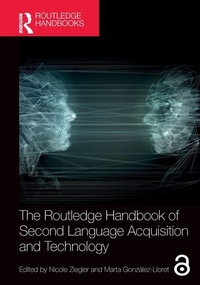
The Routledge Handbook of Second Language Acquisition and Technology
1st Edition
Published on 4. October 2024
Book
Paperback/Softback
410 pages
978-1-032-15031-4 (ISBN)
Description
Technology- mediated language learning has matured over the past few decades, with various tools and contexts now widely used in language education for all ages and levels. Many of today's language learners have experienced technology as an ever- present feature both within and beyond the classroom, highlighting how the role of technology has expanded into many daily activities, and underscoring how research in Second Language Acquisition (SLA) can inform and support the use of established and emerging technologies. The role of technology in language learning has continued to grow, with the recent COVID- 19 global pandemic further demonstrating the potential contributions of technology for supporting and facilitating second language development. Answering this increasing interest, this Handbook provides students, teachers, and scholars with a comprehensive collection of chapters on foundational topics and key issues related to technology, SLA, and where relevant, pedagogical applications.
Chapter 25 of this book is freely available as a downloadable Open Access PDF under a Creative Commons Attribution-Non Commercial-No Derivatives 4.0 license available at http://www.taylorfrancis.com
Chapter 25 of this book is freely available as a downloadable Open Access PDF under a Creative Commons Attribution-Non Commercial-No Derivatives 4.0 license available at http://www.taylorfrancis.com
More details
Series
Language
English
Place of publication
London
United Kingdom
Publishing group
Taylor & Francis Ltd
Target group
College/higher education
Professional and scholarly
Academic and Postgraduate
Illustrations
9 s/w Abbildungen, 3 s/w Photographien bzw. Rasterbilder, 6 s/w Zeichnungen, 10 s/w Tabellen
10 Tables, black and white; 6 Line drawings, black and white; 3 Halftones, black and white; 9 Illustrations, black and white
Dimensions
Height: 254 mm
Width: 178 mm
Thickness: 24 mm
Weight
804 gr
ISBN-13
978-1-032-15031-4 (9781032150314)
Copyright in bibliographic data and cover images is held by Nielsen Book Services Limited or by the publishers or by their respective licensors: all rights reserved.
Schweitzer Classification
Other editions
Additional editions
Nicole Ziegler | Marta Gonzalez-Lloret
The Routledge Handbook of Second Language Acquisition and Technology
Book
02/2022
1st Edition
Routledge
€285.10
Shipment within 15-20 days
Nicole Ziegler | Marta Gonzalez-Lloret
The Routledge Handbook of Second Language Acquisition and Technology
E-Book
01/2022
1st Edition
Routledge
€63.49
Available for download
Nicole Ziegler | Marta Gonzalez-Lloret
The Routledge Handbook of Second Language Acquisition and Technology
E-Book
01/2022
1st Edition
Routledge
€63.49
Available for download
Persons
Nicole Ziegler is Associate Professor of Second Language Studies at the University of Hawai'i at Manoa.
Marta Gonzalez-Lloret is Professor of Spanish Applied Linguistics at the University of Hawai?i at Manoa.
Marta Gonzalez-Lloret is Professor of Spanish Applied Linguistics at the University of Hawai?i at Manoa.
Content
Handbook of SLA & Technology
Routledge
Nicole Ziegler & Marta Gonzalez-Lloret (Eds.)
Part I. Theoretical and Methodological Perspectives
Chapter 1. Historical foundations of technology in SLA. Glenn Stockwell
Chapter 2. Bridging the gap between theory and practice: Technology and teacher education. Phil Hubbard
Chapter 3. Tasks in technology-mediated contexts. Marta Gonzalez-Lloret & Kristin Rock
Chapter 4. Interactionist perspectives and the role of computer-mediated communication in SLA. Nicole Ziegler, OEzguer Parlak & Huy Phung
Chapter 5. Research methods at the intersection of technology and SLA: Advances and challenges. Daniel Isbell, Daniel Dixon & Luke Plonsky
Chapter 6. Technology-enhanced approaches to researching SLA processes: A Vygotskian perspective. Remi Adam Van Compernolle
Chapter 7. Big data in SLA: Advances in methodology and analysis. Theodora Alexopoulou, Detmar Meurers & Akira Murakami
Chapter 8. Technology and assessment. Nguyen Phuong & Volker Hegelheimer
Part II. Developing Competences
Chapter 9. Dialogue systems for language learning: Chatbots and beyond. Serge Bibauw, Thomas Francois & Piet Desmet
Chapter 10. Technology and listening in SLA. Ruslan Suvorov
Chapter 11. Harnessing CMC to foster L2 oral communication. Kimberly Morris & Robert Blake
Chapter 12. Technology and pronunciation. Camino Bueno-Alastuey & Esther Gomez-Lacabex
Chapter 13. Technology and L2 reading: Current research and application. Alan Taylor
Chapter 14. Technology and writing. Rebecca Adams
Chapter 15. Technology and vocabulary. Nina Vyatkina
Chapter 16. Technology and the acquisition of second language pragmatics. Thor Sawin
Part III. Spaces for Learning
Chapter 17. Language learning in online environments. Katie Nielson
Chapter 18. Telecollaboration. Randall Sadler & Melinda Dooly
Chapter 19. Digital storytelling's place in SLA. Ana Oskoz & Idoia Elola
Chapter 20. Digital games and technology-mediated gameful environments for L2 learning and instruction. Frederik Cornillie
Chapter 21. Second language acquisition and multiplayer gaming. Jonathon Reinhardt & Samantha Kirby
Chapter 22. Digital place-based learning. Julie Sykes
Chapter 23. Virtual worlds and second language acquisition. Kristi Jauregi, Silvia Canto & Sabela Melchor-Couto
Chapter 24. Experimental MALL research in SLA: Past, present, and future. Jack Burston & Kelly Arispe
Part IV. Focus on the learner
Chapter 25. Learning across the lifespan: Age, language learning, and technology. Pia Sundqvist
Chapter 26. Heritage language learners and technology-mediated learning. Julio Torres
Chapter 27. Learner autonomy and technology. Chun Lai
Chapter 28. Technology-mediated SLA: Evolving trends and emerging technologies. Robert Goodwin-Jones
Routledge
Nicole Ziegler & Marta Gonzalez-Lloret (Eds.)
Part I. Theoretical and Methodological Perspectives
Chapter 1. Historical foundations of technology in SLA. Glenn Stockwell
Chapter 2. Bridging the gap between theory and practice: Technology and teacher education. Phil Hubbard
Chapter 3. Tasks in technology-mediated contexts. Marta Gonzalez-Lloret & Kristin Rock
Chapter 4. Interactionist perspectives and the role of computer-mediated communication in SLA. Nicole Ziegler, OEzguer Parlak & Huy Phung
Chapter 5. Research methods at the intersection of technology and SLA: Advances and challenges. Daniel Isbell, Daniel Dixon & Luke Plonsky
Chapter 6. Technology-enhanced approaches to researching SLA processes: A Vygotskian perspective. Remi Adam Van Compernolle
Chapter 7. Big data in SLA: Advances in methodology and analysis. Theodora Alexopoulou, Detmar Meurers & Akira Murakami
Chapter 8. Technology and assessment. Nguyen Phuong & Volker Hegelheimer
Part II. Developing Competences
Chapter 9. Dialogue systems for language learning: Chatbots and beyond. Serge Bibauw, Thomas Francois & Piet Desmet
Chapter 10. Technology and listening in SLA. Ruslan Suvorov
Chapter 11. Harnessing CMC to foster L2 oral communication. Kimberly Morris & Robert Blake
Chapter 12. Technology and pronunciation. Camino Bueno-Alastuey & Esther Gomez-Lacabex
Chapter 13. Technology and L2 reading: Current research and application. Alan Taylor
Chapter 14. Technology and writing. Rebecca Adams
Chapter 15. Technology and vocabulary. Nina Vyatkina
Chapter 16. Technology and the acquisition of second language pragmatics. Thor Sawin
Part III. Spaces for Learning
Chapter 17. Language learning in online environments. Katie Nielson
Chapter 18. Telecollaboration. Randall Sadler & Melinda Dooly
Chapter 19. Digital storytelling's place in SLA. Ana Oskoz & Idoia Elola
Chapter 20. Digital games and technology-mediated gameful environments for L2 learning and instruction. Frederik Cornillie
Chapter 21. Second language acquisition and multiplayer gaming. Jonathon Reinhardt & Samantha Kirby
Chapter 22. Digital place-based learning. Julie Sykes
Chapter 23. Virtual worlds and second language acquisition. Kristi Jauregi, Silvia Canto & Sabela Melchor-Couto
Chapter 24. Experimental MALL research in SLA: Past, present, and future. Jack Burston & Kelly Arispe
Part IV. Focus on the learner
Chapter 25. Learning across the lifespan: Age, language learning, and technology. Pia Sundqvist
Chapter 26. Heritage language learners and technology-mediated learning. Julio Torres
Chapter 27. Learner autonomy and technology. Chun Lai
Chapter 28. Technology-mediated SLA: Evolving trends and emerging technologies. Robert Goodwin-Jones