

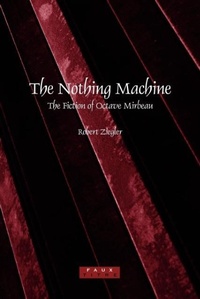
The Nothing Machine
The Fiction of Octave Mirbeau
Published on 1. January 2007
Book
Paperback/Softback
250 pages
978-90-420-2237-9 (ISBN)
Description
In an era when reality was aestheticized as collectibles, Octave Mirbeau unleashed his fiction like a destructive machine, setting fire to stale material and discredited ideologies, burning them as fuel and expelling texts as clean emissions. In this first English-language overview of all the novels published under Mirbeau's name, this study argues that Mirbeau is unique among his fin-de-siecle peers. Unlike the Decadents, whose art was a reliquary in which dead inspiration was preserved, Mirbeau disengaged himself from the corpses of past works. Abhorring tradition and complacency, Mirbeau elaborated a kinetics of fiction that made the novel into an agent of violent transformation.
Contrasting the Decadents' aesthetic of elegant morbidity with Mirbeau's vitalistic view of fiction, this volume shows Mirbeau modeling himself on the figure of the torture artist, cutting up his finished works, building novels to disassemble them, fitting them together in revolutionary ways. Creativity for Mirbeau fertilizes un jardin des supplices, a cemetery smoldering with decomposing texts that are resolved into their constituent parts and then reemerge in different guises. In Mirbeau's writing, lives and art works are only transient aggregates of material, and creativity is immortalized through the perishing of old forms.
Contrasting the Decadents' aesthetic of elegant morbidity with Mirbeau's vitalistic view of fiction, this volume shows Mirbeau modeling himself on the figure of the torture artist, cutting up his finished works, building novels to disassemble them, fitting them together in revolutionary ways. Creativity for Mirbeau fertilizes un jardin des supplices, a cemetery smoldering with decomposing texts that are resolved into their constituent parts and then reemerge in different guises. In Mirbeau's writing, lives and art works are only transient aggregates of material, and creativity is immortalized through the perishing of old forms.
More details
Series
Language
English
Place of publication
Leiden
Netherlands
Publishing group
Brill
Target group
College/higher education
Professional and scholarly
Product notice
Paperback (trade)
Unsewn / adhesive bound
Dimensions
Height: 234 mm
Width: 155 mm
Thickness: 14 mm
Weight
354 gr
ISBN-13
978-90-420-2237-9 (9789042022379)
Copyright in bibliographic data and cover images is held by Nielsen Book Services Limited or by the publishers or by their respective licensors: all rights reserved.
Schweitzer Classification
Content
Introduction
Part I: The Statue
1. Art as Repair: Le Calvaire
2. Iconoclasm: L'Abbe Jules
3. The Perfect Death: Sebastien Roch
Part II: The Matrix
4. Reaching Up: Dans le ciel
5. A Way Out: Un gentilhomme
6. The Undifferentiated Bed: Le Jardin des supplices
7. Fetish and Meaning: Le Journal d'une femme de chambre
Part III: The Nothing Machine
8. From Matter to Motion: Les 21 jours d'un neurasthenique
9. The Novel as Machine: La 628-E8
10. Non-human Narrative: Dingo
Conclusion
References
Index
Part I: The Statue
1. Art as Repair: Le Calvaire
2. Iconoclasm: L'Abbe Jules
3. The Perfect Death: Sebastien Roch
Part II: The Matrix
4. Reaching Up: Dans le ciel
5. A Way Out: Un gentilhomme
6. The Undifferentiated Bed: Le Jardin des supplices
7. Fetish and Meaning: Le Journal d'une femme de chambre
Part III: The Nothing Machine
8. From Matter to Motion: Les 21 jours d'un neurasthenique
9. The Novel as Machine: La 628-E8
10. Non-human Narrative: Dingo
Conclusion
References
Index