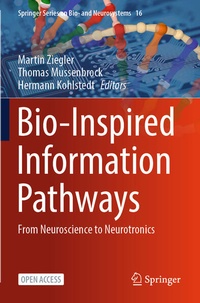
This open access book offers a timely and comprehensive review of the field of neurotronics. Gathering cutting-edge contributions from neuroscientists, biologists, psychologists, as well as physicists, microelectronics engineers and information scientists, it gives extensive information on fundamental information pathways in selected nervous systems. It also highlights their relevance as building blocks for novel computing architectures, such as bio-inspired electronic devices, neuromorphic architectures, memristive devices, adaptive sensors and emergent, pulsed-coupled oscillatory networks.
All in all, this book offers a unique bridge between fundamental research in neuroscience, neural information processing, nonlinear dynamics, and self-organization, and advanced practical applications concerning the fabrication of hardware-oriented computing.
Series
Edition
Language
Place of publication
Publishing group
Springer International Publishing
Target group
Professional and scholarly
Illustrations
39 s/w Abbildungen, 187 farbige Abbildungen
XIII, 433 p. 226 illus., 187 illus. in color.
Dimensions
Height: 235 mm
Width: 155 mm
Thickness: 23 mm
Weight
ISBN-13
978-3-031-36707-6 (9783031367076)
DOI
10.1007/978-3-031-36705-2
Schweitzer Classification
Martin Ziegler
is a full professor and the Chair of Micro- and Nanoelectronic Systems at the Faculty of Electrical Engineering and Information Technology of the Technische Universität Ilmenau, Germany. He works in the field of neuromorphic engineering. His main research interests concern the transfer of biological learning and memory into electronic systems. For this purpose, he studies and applies memristive materials and devices, micro-electromechanical systems, and neuromorphic circuits.
Thomas Mussenbrock
is a full professor and the Chair of Applied Electrodynamics and Plasma Technology in the Faculty of Electrical Engineering and Information Technology at Ruhr University Bochum, Germany. His primary research interests cover modeling and simulation of low-temperature plasmas and plasma processes. Further topics include transport phenomena at the nanoscale and nanoionic devices.
Hermann Kohlstedt
isa full professor of Nanoelectronics at Kiel University, Germany. His research concerns the development of novel electronics device and computing primitives based on biological fundamentals. His topics span from thin film analytics, device fabrication and their electrical characterization.
Matter & Mind Matter.- Neuromorphic circuits with redox-based memristive devices.- Redox-based bi-layer oxide metal memristive devices.- MemFlash - Floating Gate Transistors as Memristors.- Critical discussion of ex situ and in situ TEM measurements of memristive devices.- Modeling and Simulation of of Silver-based Filamentary Memristive Devices.- Bio-inspired, neuromorphic acoustic sensing.