

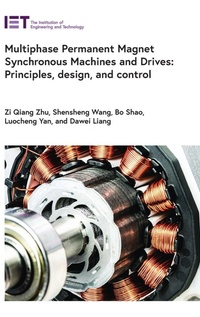
Multiphase Permanent Magnet Synchronous Machines and Drives
Principles, design, and control
Published on 1. April 2025
Book
Hardback
412 pages
978-1-83953-772-1 (ISBN)
Description
The electrification of the economy entails the development and optimization of efficient electrical machines. Permanent magnet machines use permanent magnets, rather than windings, for field excitation. They are more efficient than other electrical machine technologies for high-efficiency applications. Multiphase machines, as compared to 3-phase machines, have advantages including lower torque pulsation, higher power density, and better fault tolerance.
This book offers concise and systematic coverage of multiphase permanent magnet machines and control techniques. It gives an overview of multiphase machines and control techniques in the context of various electrical machine technologies and presents the advantages of multiphase electrical machines. Applications are covered, including wind turbine generators, electric vehicles, electric ships, and aircraft and train propulsion. Machine topologies, modelling, design, control, pulse-width modulation, fault-tolerance, and reduction of current harmonics and torque ripples are considered.
Multiphase Permanent Magnet Synchronous Machines and Drives: Principles, design, and control is written for industrial engineers and researchers, including PhD and post-doctoral research students working on electrical machines and drives, as well as for researchers working on electric vehicles, wind power generators, aerospace, electric ships and trains. Following a general introduction, chapters cover winding configurations, multiphase and dual-three-phase permanent magnet synchronous machines (PMSMs), modelling, design, modulation strategies, field-oriented control, direct torque control, model reference control, sensorless control, and also fault tolerant control for multiphase PMSMs. The logical progression from fundamental concepts to state-of-the-art research outcomes helps readers understand and use multiphase electrical machines.
This book offers concise and systematic coverage of multiphase permanent magnet machines and control techniques. It gives an overview of multiphase machines and control techniques in the context of various electrical machine technologies and presents the advantages of multiphase electrical machines. Applications are covered, including wind turbine generators, electric vehicles, electric ships, and aircraft and train propulsion. Machine topologies, modelling, design, control, pulse-width modulation, fault-tolerance, and reduction of current harmonics and torque ripples are considered.
Multiphase Permanent Magnet Synchronous Machines and Drives: Principles, design, and control is written for industrial engineers and researchers, including PhD and post-doctoral research students working on electrical machines and drives, as well as for researchers working on electric vehicles, wind power generators, aerospace, electric ships and trains. Following a general introduction, chapters cover winding configurations, multiphase and dual-three-phase permanent magnet synchronous machines (PMSMs), modelling, design, modulation strategies, field-oriented control, direct torque control, model reference control, sensorless control, and also fault tolerant control for multiphase PMSMs. The logical progression from fundamental concepts to state-of-the-art research outcomes helps readers understand and use multiphase electrical machines.
More details
Series
Language
English
Place of publication
Stevenage
United Kingdom
Target group
College/higher education
Professional and scholarly
Product notice
sewn/stitched
Cloth over boards
Dimensions
Height: 238 mm
Width: 162 mm
Thickness: 28 mm
Weight
740 gr
ISBN-13
978-1-83953-772-1 (9781839537721)
Copyright in bibliographic data and cover images is held by Nielsen Book Services Limited or by the publishers or by their respective licensors: all rights reserved.
Schweitzer Classification
Persons
Zi Qiang Zhu is a professor at the School of Electrical and Electronic Engineering of the University of Sheffield, UK. He is the founding academic director of the Sheffield Siemens Wind Power Research Centre, a fellow of the UK Royal Academy of Engineering, of the IEEE and of the IET. His research interests include the design and control of permanent magnet machines and drives for applications spanning electrified transportation (including electric vehicles, fast trains and aircraft), domestic appliances, and wind power generation. His awards include the 2019 IEEE Industry Application Society Outstanding Achievement Award, the 2021 IEEE Nikola Tesla Award, the 2024 Global Energy Prize, and 39 Best Paper Awards, and he is the author or co-author of >200 patents and >1,500 papers.
Shensheng Wang is a PhD student at the School of Electrical and Electronic Engineering of the University of Sheffield, UK. His research interests include the design and analysis of permanent magnet synchronous machines.
Bo Shao is a postdoctoral research associate at the School of Electrical and Electronic Engineering of the University of Sheffield, UK. His research interests include the control of permanent magnet machine drives.
Luocheng Yan is a PhD student at the School of Electrical and Electronic Engineering of the University of Sheffield, UK. His research interests include the control of permanent magnet synchronous machine drives.
Dawei Liang is a postdoctoral research associate at the School of Electrical and Electronic Engineering of the University of Sheffield, UK. His research interests include thermal modelling and the management of permanent magnet synchronous machines.
Shensheng Wang is a PhD student at the School of Electrical and Electronic Engineering of the University of Sheffield, UK. His research interests include the design and analysis of permanent magnet synchronous machines.
Bo Shao is a postdoctoral research associate at the School of Electrical and Electronic Engineering of the University of Sheffield, UK. His research interests include the control of permanent magnet machine drives.
Luocheng Yan is a PhD student at the School of Electrical and Electronic Engineering of the University of Sheffield, UK. His research interests include the control of permanent magnet synchronous machine drives.
Dawei Liang is a postdoctoral research associate at the School of Electrical and Electronic Engineering of the University of Sheffield, UK. His research interests include thermal modelling and the management of permanent magnet synchronous machines.
Author
ProfessorUniversity of Sheffield, School of Electrical and Electronic Engineering, UK
PhD StudentUniversity of Sheffield, School of Electrical and Electronic Engineering, UK
Postdoctoral Research AssociateUniversity of Sheffield, School of Electrical and Electronic Engineering, UK
PhD StudentUniversity of Sheffield, School of Electrical and Electronic Engineering, UK
Postdoctoral Research AssociateUniversity of Sheffield, School of Electrical and Electronic Engineering, UK
Content
Chapter 1: General introduction
Chapter 2: General winding configurations of multiphase PMSMs
Chapter 3: Dual-three-phase PMSMs with integer slot overlapping windings
Chapter 4: Dual three-phase PMSMs with fractional slot non-overlapping windings
Chapter 5: Modeling of multiphase PMSMs
Chapter 6: Design optimization and comparison of multiphase PMSMs
Chapter 7: Modulation strategies for multiphase PMSMs
Chapter 8: Control strategies for multiphase PMSMs
Chapter 9: Sensorless control of multiphase PMSMs
Chapter 10: Fault-tolerant control for multiphase PMSMs
Appendix A: Specifications of prototype machines and experimental platforms
Chapter 2: General winding configurations of multiphase PMSMs
Chapter 3: Dual-three-phase PMSMs with integer slot overlapping windings
Chapter 4: Dual three-phase PMSMs with fractional slot non-overlapping windings
Chapter 5: Modeling of multiphase PMSMs
Chapter 6: Design optimization and comparison of multiphase PMSMs
Chapter 7: Modulation strategies for multiphase PMSMs
Chapter 8: Control strategies for multiphase PMSMs
Chapter 9: Sensorless control of multiphase PMSMs
Chapter 10: Fault-tolerant control for multiphase PMSMs
Appendix A: Specifications of prototype machines and experimental platforms