

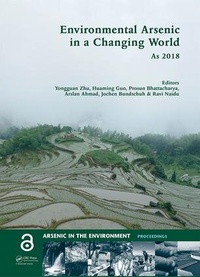
Environmental Arsenic in a Changing World
Proceedings of the 7th International Congress and Exhibition on Arsenic in the Environment (AS 2018), July 1-6, 2018, Beijing, P.R. China
1st Edition
Published on 3. September 2019
Book
Hardback
714 pages
978-1-138-48609-6 (ISBN)
Description
The Congress "Arsenic in the Environment" offers an international, multi- and interdisciplinary discussion platform for research and innovation aimed towards a holistic solution to the problem posed by the environmental toxin arsenic, with significant societal impact. The Congress has focused on cutting edge and breakthrough research in physical, chemical, toxicological, medical, agricultural and other specific issues on arsenic across a broader environmental realm. The Biennial Congress "Arsenic in the Environment" was first organized in Mexico City (As2006) followed by As2008 in Valencia (Spain), As2010 in Tainan (Chinese Taiwan), As2012 in Cairns (Australia), As2014 in Buenos Aires (Argentina) and As2016 in Stockholm (Sweden).
The 7th International Congress As2018 was held July 1-6, 2018, in Beijing, P. R. China and was entitled Environmental Arsenic in a Changing World.
The Congress addressed the broader context of arsenic research aligned on the following themes:
Theme 1: Arsenic Behaviour in Changing Environmental Media
Theme 2: Arsenic in a Changing Agricultural Ecosystem
Theme 3: Health Impacts of Environmental Arsenic
Theme 4: Technologies for Arsenic Immobilization and Clean Water Blueprints
Theme 5: Sustainable Mitigation and Management
Arsenic in drinking water (mainly groundwater) has emerged as an issue of global health concern. During last decade, the presence of arsenic in rice, possibly also other food of plant origins, has attained increasing attention. This is particularly true in the Asian countries, where the use of high arsenic groundwater as source of irrigation water and drinking water has been flagged as severe health concern. This has been accentuated by elevating arsenic concentrations in deep groundwater recharged from shallow high arsenic groundwater, which may have further detrimental effects on public health. Notably, China has been in the forefront of research on arsenic biogeochemical cycling, health effects of arsenic, technologies for arsenic removal, and sustainable mitigation measures. The Congress has attracted professionals involved in different segments of interdisciplinary research on arsenic in an open forum, and strengthened relations between academia, research institutions, government and non-governmental agencies, industries, and civil society organizations to share an optimal ambience for exchange of knowledge.
The 7th International Congress As2018 was held July 1-6, 2018, in Beijing, P. R. China and was entitled Environmental Arsenic in a Changing World.
The Congress addressed the broader context of arsenic research aligned on the following themes:
Theme 1: Arsenic Behaviour in Changing Environmental Media
Theme 2: Arsenic in a Changing Agricultural Ecosystem
Theme 3: Health Impacts of Environmental Arsenic
Theme 4: Technologies for Arsenic Immobilization and Clean Water Blueprints
Theme 5: Sustainable Mitigation and Management
Arsenic in drinking water (mainly groundwater) has emerged as an issue of global health concern. During last decade, the presence of arsenic in rice, possibly also other food of plant origins, has attained increasing attention. This is particularly true in the Asian countries, where the use of high arsenic groundwater as source of irrigation water and drinking water has been flagged as severe health concern. This has been accentuated by elevating arsenic concentrations in deep groundwater recharged from shallow high arsenic groundwater, which may have further detrimental effects on public health. Notably, China has been in the forefront of research on arsenic biogeochemical cycling, health effects of arsenic, technologies for arsenic removal, and sustainable mitigation measures. The Congress has attracted professionals involved in different segments of interdisciplinary research on arsenic in an open forum, and strengthened relations between academia, research institutions, government and non-governmental agencies, industries, and civil society organizations to share an optimal ambience for exchange of knowledge.
More details
Series
Language
English
Place of publication
London
United Kingdom
Publishing group
Taylor & Francis Ltd
Target group
College/higher education
Professional and scholarly
Postgraduate and Professional
Dimensions
Height: 246 mm
Width: 174 mm
Weight
1620 gr
ISBN-13
978-1-138-48609-6 (9781138486096)
Copyright in bibliographic data and cover images is held by Nielsen Book Services Limited or by the publishers or by their respective licensors: all rights reserved.
Schweitzer Classification
Other editions
Additional editions
Yongguan Zhu | Huaming Guo | Prosun Bhattacharya
Environmental Arsenic in a Changing World
Proceedings of the 7th International Congress and Exhibition on Arsenic in the Environment (AS 2018), July 1-6, 2018, Beijing, P.R. China
Book
03/2021
1st Edition
CRC Press
€76.70
Shipment within 15-20 days
Yongguan Zhu | Huaming Guo | Prosun Bhattacharya
Environmental Arsenic in a Changing World
Proceedings of the 7th International Congress and Exhibition on Arsenic in the Environment (AS 2018), July 1-6, 2018, Beijing, P.R. China
E-Book
08/2019
1st Edition
CRC Press
€0.00
Available for download
Yongguan Zhu | Huaming Guo | Prosun Bhattacharya
Environmental Arsenic in a Changing World
Proceedings of the 7th International Congress and Exhibition on Arsenic in the Environment (AS 2018), July 1-6, 2018, Beijing, P.R. China
E-Book
08/2019
CRC Press
€0.00
Available for download
Persons
Yongguan Zhu, Huaming Guo, Prosun Bhattacharya, Arslan Ahmad, Jochen Bundschuh, Ravi Naidu
Content
Plenary presentations, Section 1: Arsenic behaviour in changing environmental media, Section 2: Arsenic in a changing agricultural ecosystem and food chain effects, Section 3: Health impacts of environmental arsenic, Section 4: Technologies for arsenic immobilization and clean water blueprints, Section 5: Sustainable mitigation and management.