

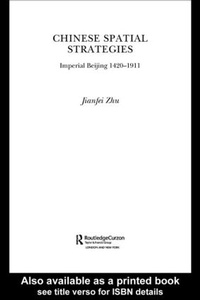
Chinese Spatial Strategies
Imperial Beijing, 1420-1911
1st Edition
Published on 27. November 2003
Book
Hardback
296 pages
978-0-415-31883-9 (ISBN)
Description
Chinese Spatial Strategies presents a study of social spaces of the capital of Ming Qing China (1420-1911). Focusing on early Ming and early and middle Qing, it explores architectural, urban and geographical space of Beijing, in relation to issues of history, geopolitics, urban social structure, imperial rule and authority, symbolism, and aesthetic and existential experience. At once historical and theoretical, the work argues that there is a Chinese approach to spatial disposition which is strategic and holistic.
More details
Language
English
Place of publication
London
United Kingdom
Publishing group
Taylor & Francis Ltd
Target group
Professional and scholarly
College/higher education
Dimensions
Height: 234 mm
Width: 156 mm
Weight
710 gr
ISBN-13
978-0-415-31883-9 (9780415318839)
Copyright in bibliographic data and cover images is held by Nielsen Book Services Limited or by the publishers or by their respective licensors: all rights reserved.
Schweitzer Classification
Other editions
Additional editions
E-Book
08/2004
Routledge
€60.49
Available for download
E-Book
08/2004
Routledge
€60.99
Available for download
Person
Jianfei Zhu teaches Architecture in the Faculty of Architecture, Building and Planning at the University of Melbourne, Australia. He has published on imperial Beijing and modern Chinese architecture. His work explores conditions of space in late imperial and modern China, and searches a possible dialogue between Western social theory and Asian architectural experience.
Content
List of figuresAcknowledgementsIntroduction: Beijing as a Critical ProblemIn Search of a Chinese SpaceOutline of the Research and the ArgumentA Note on Method1. A Geo-Political Project2. City Plan as IdeologyA Classical TraditionNeo-Confucianism3. Social Space of the CityA City of CitiesSpace of the StateSpace of SocietyConcluding Notes 1: Architecture of the City and the Land4. A Sea of Walls: The Purple Forbidden Palace5. The Palace: Framing a Political LandscapeThe Inner Court as a Corporeal SpaceThe Outer Court as an Institutional SpaceA Composition of Forces6. The Palace: a BattlefieldFlows of Reports and DirectivesDefenceRecurring Crises7. Constructs of AuthorityLegalism and The Art of War Vis-a-vis the Panopticon: Two Ages of ReasonConcluding Notes 2: Architecture as a Machine of the State8. A Religious DiscourseComposing and Building the DiscoursePerforming an Ideology9. Formal Compositions: Visual and ExistentialBeijing as a ScrollVis-a-vis 'Cartesian Perspectivalism': Two Ways of SeeingConcluding Notes 3: Architecture of HorizonAppendix: dynasties, reigns and emperorsNotesBibliographyIndex