

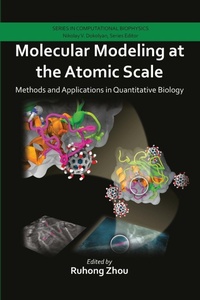
Molecular Modeling at the Atomic Scale
Methods and Applications in Quantitative Biology
1st Edition
Published on 30. June 2020
Book
Paperback/Softback
388 pages
978-0-367-57607-3 (ISBN)
Description
Although molecular modeling has been around for a while, the groundbreaking advancement of massively parallel supercomputers and novel algorithms for parallelization is shaping this field into an exciting new area. Developments in molecular modeling from experimental and computational techniques have enabled a wide range of biological applications. Responding to this renaissance, Molecular Modeling at the Atomic Scale: Methods and Applications in Quantitative Biology includes discussions of advanced techniques of molecular modeling and the latest research advancements in biomolecular applications from leading experts.
The book begins with a brief introduction of major methods and applications, then covers the development of cutting-edge methods/algorithms, new polarizable force fields, and massively parallel computing techniques, followed by descriptions of how these novel techniques can be applied in various research areas in molecular biology. It also examines the self-assembly of biomacromolecules, including protein folding, RNA folding, amyloid peptide aggregation, and membrane lipid bilayer formation. Additional topics highlight biomolecular interactions, including protein interactions with DNA/RNA, membrane, ligands, and nanoparticles. Discussion of emerging topics in biomolecular modeling such as DNA sequencing with solid-state nanopores and biological water under nanoconfinement round out the coverage.
This timely summary contains the perspectives of leading experts on this transformation in molecular biology and includes state-of-the-art examples of how molecular modeling approaches are being applied to critical questions in modern quantitative biology. It pulls together the latest research and applications of molecular modeling and real-world expertise that can boost your research and development of applications in this rapidly changing field.
The book begins with a brief introduction of major methods and applications, then covers the development of cutting-edge methods/algorithms, new polarizable force fields, and massively parallel computing techniques, followed by descriptions of how these novel techniques can be applied in various research areas in molecular biology. It also examines the self-assembly of biomacromolecules, including protein folding, RNA folding, amyloid peptide aggregation, and membrane lipid bilayer formation. Additional topics highlight biomolecular interactions, including protein interactions with DNA/RNA, membrane, ligands, and nanoparticles. Discussion of emerging topics in biomolecular modeling such as DNA sequencing with solid-state nanopores and biological water under nanoconfinement round out the coverage.
This timely summary contains the perspectives of leading experts on this transformation in molecular biology and includes state-of-the-art examples of how molecular modeling approaches are being applied to critical questions in modern quantitative biology. It pulls together the latest research and applications of molecular modeling and real-world expertise that can boost your research and development of applications in this rapidly changing field.
More details
Series
Language
English
Place of publication
London
United Kingdom
Publishing group
Taylor & Francis Ltd
Target group
College/higher education
Dimensions
Height: 234 mm
Width: 156 mm
Thickness: 21 mm
Weight
591 gr
ISBN-13
978-0-367-57607-3 (9780367576073)
Copyright in bibliographic data and cover images is held by Nielsen Book Services Limited or by the publishers or by their respective licensors: all rights reserved.
Schweitzer Classification
Other editions
Additional editions
Book
08/2014
1st Edition
CRC Press
€182.50
Shipment within 15-20 days
E-Book
08/2014
1st Edition
CRC Press
€67.49
Available for download
E-Book
08/2014
CRC Press
€67.49
Available for download
Person
Ruhong Zhou
Content
Introduction. I. Advanced Simulation Techniques. Novel sampling algorithms for molecular dynamics. Advanced free energy perturbation techniques. Massively parallel supercomputers and software for molecular dynamics. Development of modern polarizable force fields. MM-QM methods for enzymatic reactions. II. Self-Assembly of Biomolecules. Protein folding dynamics and pathways. Folding kinetics with Markov State Models. RNA folding. Misfolding and aggregation. III. Biomolecular Interactions. Protein-protein interactions. Protein-nanoparticle interactions. Ligand-receptor binding. RNA(DNA)-protein interactions. IV. Other Applications in Molecular Biology. Modeling of DNA sequencing with nanopore. Biological (confined) water dynamics. Enzymatic reaction pathways.