

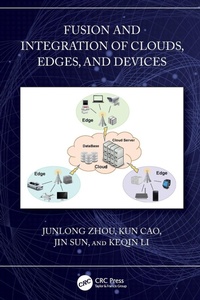
Fusion and Integration of Clouds, Edges, and Devices
1st Edition
Published on 6. December 2024
Book
Hardback
218 pages
978-1-032-88457-8 (ISBN)
Description
This book provides an in-depth examination of recent research advances in cloud-edge-end computing, covering theory, technologies, architectures, methods, applications, and future research directions. It aims to present state-of-the-art models and optimization methods for fusing and integrating clouds, edges, and devices.
Cloud-edge-end computing provides users with low-latency, high-reliability, and cost-effective services through the fusion and integration of clouds, edges, and devices. As a result, it is now widely used in various application scenarios. The book introduces the background and fundamental concepts of clouds, edges, and devices, and details the evolution, concepts, enabling technologies, architectures, and implementations of cloud-edge-end computing. It also examines different types of cloud-edge-end orchestrated systems and applications and discusses advanced performance modeling approaches, as well as the latest research on offloading and scheduling policies. It also covers resource management methods for optimizing application performance on cloud-edge-end orchestrated systems.
The intended readers of this book are researchers, undergraduate and graduate students, and engineers interested in cloud computing, edge computing, and the Internet of Things. The knowledge of this book will enrich our readers to be at the forefront of cloud-edge-end computing.
Cloud-edge-end computing provides users with low-latency, high-reliability, and cost-effective services through the fusion and integration of clouds, edges, and devices. As a result, it is now widely used in various application scenarios. The book introduces the background and fundamental concepts of clouds, edges, and devices, and details the evolution, concepts, enabling technologies, architectures, and implementations of cloud-edge-end computing. It also examines different types of cloud-edge-end orchestrated systems and applications and discusses advanced performance modeling approaches, as well as the latest research on offloading and scheduling policies. It also covers resource management methods for optimizing application performance on cloud-edge-end orchestrated systems.
The intended readers of this book are researchers, undergraduate and graduate students, and engineers interested in cloud computing, edge computing, and the Internet of Things. The knowledge of this book will enrich our readers to be at the forefront of cloud-edge-end computing.
More details
Language
English
Place of publication
London
United Kingdom
Publishing group
Taylor & Francis Ltd
Target group
College/higher education
Professional and scholarly
Academic, Postgraduate, Professional Reference, Undergraduate Advanced, and Undergraduate Core
Illustrations
34 s/w Abbildungen, 34 s/w Zeichnungen, 31 farbige Zeichnungen, 30 s/w Tabellen
30 Tables, black and white; 31 Line drawings, color; 34 Line drawings, black and white; 34 Illustrations, black and white
Dimensions
Height: 260 mm
Width: 183 mm
Thickness: 17 mm
Weight
632 gr
ISBN-13
978-1-032-88457-8 (9781032884578)
Copyright in bibliographic data and cover images is held by Nielsen Book Services Limited or by the publishers or by their respective licensors: all rights reserved.
Schweitzer Classification
Other editions
Additional editions
Junlong Zhou | Kun Cao | Jin Sun
Fusion and Integration of Clouds, Edges, and Devices
Book
approx. 07/2026
1st Edition
CRC Press
€56.00
Not yet published
Junlong Zhou | Kun Cao | Jin Sun
Fusion and Integration of Clouds, Edges, and Devices
E-Book
12/2024
1st Edition
CRC Press
€82.99
Available for download
Junlong Zhou | Kun Cao | Jin Sun
Fusion and Integration of Clouds, Edges, and Devices
E-Book
12/2024
1st Edition
CRC Press
€82.99
Available for download
Persons
Junlong Zhou is Associate Professor at the School of Computer Science and Engineering, Nanjing University of Science and Technology, Nanjing, China. His research interests include edge computing, cloud computing, and embedded systems.
Kun Cao is Associate Professor at the Jinan University, Guangzhou, China. His research interests include the Internet of Things, edge/fog/cloud computing, and cyber-physical systems.
Jin Sun is Professor at the School of Computer Science and Engineering, Nanjing University of Science and Technology, Nanjing, China. His research interests include computer architecture and high-performance computing.
Keqin Li is a SUNY Distinguished Professor at the State University of New York, a National Distinguished Professor at Hunan University, China, and a Member of Academia Europaea (Academician of the Academy of Europe). He is among the world's top five most influential scientists in parallel and distributed computing in terms of single-year and career-long impacts based on a composite indicator of the Scopus citation database. He is an AAAS Fellow, an IEEE Fellow, an AAIA Fellow, an ACIS Fellow, and an AIIA Fellow.
Kun Cao is Associate Professor at the Jinan University, Guangzhou, China. His research interests include the Internet of Things, edge/fog/cloud computing, and cyber-physical systems.
Jin Sun is Professor at the School of Computer Science and Engineering, Nanjing University of Science and Technology, Nanjing, China. His research interests include computer architecture and high-performance computing.
Keqin Li is a SUNY Distinguished Professor at the State University of New York, a National Distinguished Professor at Hunan University, China, and a Member of Academia Europaea (Academician of the Academy of Europe). He is among the world's top five most influential scientists in parallel and distributed computing in terms of single-year and career-long impacts based on a composite indicator of the Scopus citation database. He is an AAAS Fellow, an IEEE Fellow, an AAIA Fellow, an ACIS Fellow, and an AIIA Fellow.
Content
1. Introduction to Clouds, Edges, and Devices 2. Introduction to Cloud-Edge-End Computing 3. Cloud-Edge-End Orchestrated Systems 4. Cloud-Edge-End Orchestrated Applications 5. Summary and Future Research